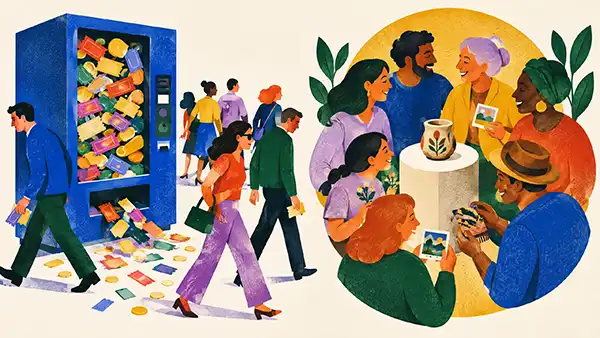
The Loyalty Illusion: Why Emotional Connection Outperforms Every Discount You Can Offer
The loyalty industry has a dirty secret. It has spent two decades building the most sophisticated transactional infrastructure in the history of commerce — points engines, tiered rewards, gamified apps, real-time personalization algorithms — and American consumers have never been less loyal.
According to 5W Public Relations’ 2026 synthesis of loyalty research from Bain, McKinsey, Deloitte, and Forrester, the share of U.S. consumers reporting “true loyalty” to the brands they buy fell to 29 percent in 2025, a five-point decline from the prior year. The average American belongs to 17.4 loyalty programs and actively uses fewer than nine of them. Enrollment has never been higher. Engagement has never been lower. And the machinery designed to create loyalty is producing something closer to loyalty theater.
CivicScience, analyzing responses from more than one million U.S. adults between January 2020 and January 2026, found something that should reframe the entire conversation. Across 23 demographic groups, emotional connection to brands accounted for as much as 90 percent of the variation in self-reported loyalty. Service accounted for roughly half. Price and deals accounted for 10 percent. Quality accounted for 2 percent.
Read those numbers again. The factor that most loyalty programs are built around — price and deals — explains a tenth of the variation in loyalty. The factor that most programs treat as an afterthought — emotional connection — explains almost all of it.
What emotional connection actually means at the point of sale
Emotional connection is not a marketing abstraction. It is a measurable force with quantifiable business consequences.
ITA Group’s 2025 study, which analyzed loyalty programs from companies including Wells Fargo, T-Mobile, Starbucks, Chick-fil-A, and Sephora, found that emotionally connected customers are four times more likely to visit and four times more likely to spend. When emotional connection is combined with clear value and ease of use, the impact multiplies to eight times more visits and sales.
The mechanism is not complicated. The source material for this reflection identifies the elements that create loyalty at the human level: trust, relationship management, deep product knowledge, accompanying the customer rather than selling to them, and presentation quality. The first of these — trust — is the foundation. The rest are skills that can be developed. But without trust, none of them matter.
The trust-loyalty relationship has been quantified with unusual precision. A 2025 study published in PLOS ONE by Vanessa Gabriela Yarza Navarro-Schär and colleagues at the Lucerne University of Applied Sciences and Arts surveyed 1,370 Swiss consumers and assessed trust across ten dimensions alongside their Net Promoter Scores. The findings were stark: high customer trust was associated with an NPS of +36.5, while low trust produced an NPS of −68.6. That is a swing of more than a hundred points on a scale that most companies treat as the single most important metric of customer sentiment.
The study also found something that challenges conventional loyalty strategy. Different trust components become salient at different levels of customer advocacy. Ability, experience, and reputation showed consistent positive effects across all quantiles. But joint interests and continuity emerged as relevant only at higher NPS levels, while reciprocity was significant only at the 25th percentile. The implication is that loyalty is not a single state that can be engineered with a single strategy. It is a developmental process, and the interventions that work at one stage do not work at another.
The friction that kills loyalty before it forms
The Antavo Global Customer Loyalty Report 2026, based on a survey of more than 1,000 U.S. consumers, identified a phenomenon that every loyalty program manager should be required to memorize. Nearly half of respondents — 49.1 percent — said it takes too long to earn rewards. 41.1 percent were frustrated by expiring points. 38.9 percent found the rewards unattractive.
The consequence is not simply dissatisfaction. It is abandonment. More than a quarter of U.S. loyalty program points go unspent, and more than one in ten are left to expire, resulting in an estimated $10 billion in lost savings annually.
Attila Kecsmar, CEO of Antavo, put the problem in terms that should be printed on the wall of every marketing department: “Friction is the enemy of loyalty”. When rewards feel out of reach, engagement fades, and points go unused. The brands that give customers a loyalty experience that feels immediate, rewarding, and tailored to their wants are seeing impressive returns. Those that do not are watching unspent points pile up while customers become less satisfied and, eventually, leave.
The data on what consumers actually want is unambiguous. 70.8 percent cite money-saving benefits such as coupons, vouchers, or cashback. 46.3 percent value free products or services. But 41.6 percent want personalized offers and rewards tailored to their preferences and values. The transactional benefits get people in the door. The personalized experience keeps them there.
What the personalization paradox reveals about modern loyalty
The tension between personalization and trust is the defining challenge of loyalty strategy in 2025 and beyond. Twilio’s sixth annual State of Customer Engagement Report, based on surveys of businesses and consumers, found a gap that is widening rather than closing.
On one side: 96 percent of companies say AI is improving customer-facing operations, and 75 percent see increased customer spend from personalization efforts. 56 percent of brands now use AI to tailor experiences, from personalized content and recommendations to real-time support and dynamic offers.
On the other side: only 45 percent of consumers feel understood by the brands they interact with, down from 46 percent in 2024. 61 percent of consumers do not believe brands use their data in their best interest. 55 percent say they are tired of hearing about AI. And 71 percent will walk away from a purchase if the experience does not feel relevant.
The paradox is not that personalization does not work. It is that personalization without transparency produces the opposite of its intended effect. The consumer who receives a perfectly targeted offer but suspects the brand is using their data against them is not more loyal. They are more wary. The personalization arms race has created a trust deficit that no algorithm can close.
Twilio’s report identifies the variables that actually matter: real-time engagement and transparency. 88 percent of consumers are more likely to buy when engagement is personalized in real time, but only 44 percent of brands say they are executing at that level. 84 percent of consumers want control over their personalization settings. 54 percent want to know when they are talking to AI rather than a human.
The companies that are getting loyalty right are not the ones with the most sophisticated algorithms. They are the ones that have recognized that personalization without consent is surveillance, and that the permission to personalize must be earned through transparency.
The generational shift that no one saw coming
The assumption that loyalty is something consumers age into has been one of the foundational beliefs of brand strategy for decades. Younger consumers were supposed to be fickle, experimental, and disloyal. They would settle down eventually.
CivicScience’s data suggests the opposite. In 2020, brand loyalty peaked among 45- to 54-year-olds. By December 2025, it peaked among 18- to 24-year-olds, at 46 percent. The share of U.S. adults who describe themselves as “very loyal” to their favorite brands rose from 31 percent in 2020 to 36 percent in 2026. Among adults under 35, the increase was roughly three times that of the general population.
The finding has profound implications. Young consumers are not less loyal. They are more loyal, and they are more category-exclusive, tending to commit to one brand or a few within a given category. The brand that wins them early may lock competitors out.
The CivicScience study also found that mindset predicts loyalty better than demographics. Of 160 attributes tested, the strongest predictors were attitudinal. Consumers who follow markets and the economy closely are 19 percentage points more likely than average to describe themselves as “very loyal”.
The old assumption that loyalty is a function of age has been replaced by a more complex reality. Loyalty is a function of identity. It is about who the consumer believes they are and which brands they believe share that identity.
The behavioral gap between satisfaction and advocacy
The loyalty literature has long treated satisfaction and advocacy as points on a single continuum. Satisfied customers will repurchase; delighted customers will recommend. But a 2025 study published in Administrative Sciences found a critical asymmetry between the two.
Loyalty — measured as customer loyalty intention — is primarily calculative and habitual. It is directly contingent on cumulative satisfaction. Advocacy, measured by Net Promoter Score, involves social risk. It requires satisfaction to exceed a higher threshold before customers willingly endorse the brand publicly.
The practical implication is that satisfaction-focused strategies will reliably boost retention. But converting satisfied customers into active promoters requires additional interventions: referral incentives, social proof mechanisms, or identity-affirming brand positioning that amplify satisfaction’s effect on word-of-mouth.
The study also found that the influence of operational efficiency on loyalty outcomes is fully mediated. Efforts to improve loyalty by directly targeting loyalty metrics may be less effective than addressing root causes — effort reduction and experience enhancement — whose benefits propagate forward through the satisfaction mechanism.
What the numbers do not capture
The loyalty premium — the measurable value that loyal customers deliver over non-loyal ones — is among the highest-leverage metrics in business. The Bain/Reichheld finding that a five-percentage-point improvement in customer retention can increase profits by 25 to 95 percent depending on sector has been validated repeatedly over twenty-five years. Acquiring a new customer continues to cost five to twenty-five times more than retaining an existing one.
But the numbers do not capture the texture of what loyalty actually is at the human level. The source material identifies the nirvana of loyalty as the “propagandist customer” — the person who does not merely repurchase but actively advocates. The research supports the framing. The emotionally connected customer is not just more likely to buy. They are more likely to tell others. They are more likely to forgive mistakes. They are more likely to see the brand as an extension of their own identity.
The loyalty programs that are failing are the ones that have confused the measurable with the meaningful. They have optimized for points redeemed and transactions completed while missing the emotional connection that actually drives behavior. The programs that are succeeding have recognized that the transaction is the beginning of the relationship, not the end.
The limits of strategy
There is a limit to what loyalty strategy can accomplish. If the product or service is fundamentally inadequate, no amount of emotional connection or personalized engagement will compensate. The research on trust and loyalty consistently finds that ability, experience, and reputation are the trust components with the most consistent positive effects on advocacy. If the brand cannot deliver on its most basic promises, the rest is decoration.
There is also a limit to what any organization can do alone. The loyalty deficit in American commerce is not simply a failure of individual brands. It is a systemic condition shaped by economic precarity, consumer skepticism, and a decade of data practices that have eroded the trust on which loyalty depends. The brands that are navigating this environment successfully are not doing so with better algorithms. They are doing so with a different set of priorities.
The loyalty you cannot buy
The loyalty industry has spent billions trying to purchase something that cannot be purchased. The data is now clear enough to draw a conclusion that has been available for years but is only now becoming impossible to ignore: the most powerful loyalty driver is not points, not discounts, not even the quality of the product. It is the experience of being seen, understood, and valued by another human being.
The seller who remembers your name. The service representative who solves the problem without making you explain it twice. The brand that treats you as a person rather than a data point. These are the experiences that produce loyalty. They cannot be automated. They cannot be scaled with AI. They can only be delivered by people who have been trained, supported, and given the autonomy to do their jobs well.
The question every organization should be asking is not how to build a better loyalty program. It is how to create the conditions under which loyalty becomes the natural consequence of every interaction. The answer, as it always has been, is people.