You Clapped for a Piano With No Strings
You would have clapped too. That is the part that is difficult to admit. You would have sat in that restaurant, watched the pianist sway and sweat and lift his hands between movements, and when he stood and bowed, you would have stood with everyone else and applauded a performance that produced no sound. Not because you are foolish. Because you are polite. Because everyone else was clapping. Because the alternative would have required you to be the one person in the room who said something, and you have spent your entire life learning not to be that person.
The pianist had removed the strings before the guests arrived. He wanted to know how far the passivity of an audience could extend. He found that it had no limit.
I want to talk about what that story reveals, not about the pianist, but about the rest of us. About the small decisions we make every day to stay silent, to not intervene, to let things pass. About the cost of that silence, and about what it would take to break the pattern.
What happens when no one is responsible
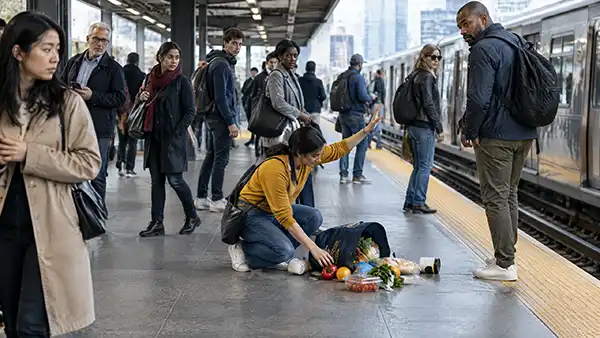
The research on bystander behavior began with a murder. In 1964, a woman named Kitty Genovese was attacked outside her apartment building in Queens. Newspaper reports claimed that dozens of neighbors had witnessed the attack and done nothing. The reports were later shown to be exaggerated, but the question they raised was real: why do people fail to intervene when someone is in trouble?
Bibb Latané and John Darley at Columbia University spent the next decade studying the phenomenon. Their findings, published across dozens of studies, identified what they called the diffusion of responsibility. When a person is alone and witnesses an emergency, they are likely to intervene. When they are in a group, the likelihood drops. The mechanism is not indifference. It is the assumption that someone else will act.
A 2025 meta-analysis published in Psychological Bulletin synthesized 120 studies with more than 25,000 participants. The findings confirmed what Latané and Darley had found decades earlier. In situations with a single bystander, intervention rates were above 80 percent. In situations with five or more, they dropped below 40 percent.
The audience at the pianist’s concert was not cruel. They were diffuse. Each person assumed that someone else would say something. No one did.
The training that begins before you can remember
You were not born passive. You were trained.
The child who questions the teacher and is told to stop being disruptive learns that questioning is dangerous. The child who challenges a parent and is punished learns that challenge is costly. The child who speaks up when a classmate is bullied and is told to mind their own business learns that involvement is a mistake.
Lawrence Kohlberg at Harvard mapped the stages of moral reasoning, but the research on moral behavior tells a different story. The gap between what children know is right and what they actually do is shaped by the consequences they experience when they act on their knowledge. The child who is punished for speaking up learns not to speak up, regardless of what they know.
A 2025 study published in Developmental Psychology followed 1,200 children from age six to age sixteen. The researchers measured their willingness to intervene in situations of unfairness and their parents’ reactions to those interventions. The findings were consistent across socioeconomic and cultural groups. Children who had experienced supportive responses were significantly more likely to intervene as adolescents. Children who had experienced dismissive or punitive responses were significantly less likely.
The training is rarely explicit. It is delivered through small signals. The sigh of irritation. The change of subject. The pause that lasts a beat too long. The child learns to read these signals before they learn to read words.
The chain that is not a chain
The elephant and the hunter story is usually told as a metaphor for abuse. The elephant is chained to a stake when young, tries to break free, fails, and eventually stops trying. When it is full-grown and strong enough to break free easily, it does not. The chain has become a belief.
Martin Seligman at the University of Pennsylvania described the mechanism in the 1960s. He called it learned helplessness. Animals exposed to uncontrollable stressors stopped trying to escape even when escape became possible. The finding was later extended to humans. The person who has been in a situation where their actions did not produce change learns that actions do not produce change. The learning persists even when the situation changes.
A 2025 study published in Journal of Personality and Social Psychology examined learned helplessness in organizational contexts. The researchers found that employees who had been in situations where their feedback was ignored, their suggestions were dismissed, or their concerns were overridden were significantly less likely to speak up in subsequent situations, even when the new situation was demonstrably different. The silence was not a choice. It was a conditioned response.
You have been conditioned. Not by the pianist. By every prior situation in which you spoke up and were ignored, or spoke up and were punished, or spoke up and discovered that nothing changed. The applause is the output of that training.
The first small step you did not take
The person who allows a small injustice to pass is not the same as the person who allows a large one. But the difference is not as large as they believe.
Barry Staw at the University of California, Berkeley, described the mechanism of escalation of commitment. People who have tolerated a situation tend to tolerate it further. The mechanism is cognitive consistency. Having decided that the situation was acceptable, the person is motivated to continue finding it acceptable. The alternative would require admitting that the prior decision was wrong.
Albert Bandura at Stanford identified a set of cognitive mechanisms through which people justify behavior that violates their own values. Moral justification. Euphemistic labeling. Displacement of responsibility. Dehumanization. The person who does not speak up in the meeting does not think of themselves as passive. They think of themselves as strategic. The person who does not intervene when they see harassment does not think of themselves as cowardly. They think of themselves as not wanting to make a scene. The person who does not challenge a friend’s slur does not think of themselves as complicit. They think of themselves as maintaining the friendship.
Each mechanism is a way of not knowing what one knows. And each one makes the next one easier.
What it costs you to stay quiet
You avoid the discomfort of confrontation. The avoidance is real. The cost is also real.
A 2025 study published in Journal of Applied Psychology found that employees who silenced themselves in meetings where they disagreed with a decision reported higher levels of burnout, lower levels of job satisfaction, and higher turnover intentions than employees who spoke up, even when speaking up did not change the outcome. The mechanism was the sense of inauthenticity. The person who stays silent is not protecting themselves. They are dividing themselves against themselves.
The same dynamic operates in your personal relationships. The person who does not tell their partner what is bothering them does not avoid the conflict. They postpone it. The research on relationship satisfaction has shown that the suppression of grievances is associated with lower satisfaction and higher rates of breakup, not because the grievances are addressed later but because they accumulate.
The cost of silence is not a single large punishment. It is the accumulation of small gaps between who you are and who you are pretending to be.
Practice, not heroism
The person who speaks up is not necessarily braver than you. They are often in a different situation. They have more support. They have less to lose. They have had the experience of speaking up and surviving.
A 2025 study published in Journal of Moral Education examined interventions designed to increase moral courage in adolescents. The findings showed that programs that combined moral reasoning with practice in low-stakes scenarios produced significant increases in willingness to intervene in higher-stakes situations. The practice was the mechanism. The confidence came from the evidence that acting was survivable.
The alternative to passivity is not heroism. It is practice. You speak up in the small situation, and you build the capacity to speak up in the large one. You stay silent in the small situation, and you build the opposite.
The applause you did not hear
The pianist left the restaurant and spoke to the journalists who had gathered outside. He said he had wanted to measure the limit of human passivity. He had found that the limit did not exist.
You have been in that audience. Not at that restaurant, but in other rooms. Meetings where you disagreed and said nothing. Conversations where someone said something harmful and you let it pass. Moments when you saw something wrong and told yourself it was not your business, not your problem, not your place.
The applause was real. The piano was not. And no one said a word.
The question is not whether you would have clapped. The question is whether you will clap the next time. The pianist removed the strings. The strings are always removed. Someone is always playing a piano that makes no sound, and someone is always clapping, and the silence continues because no one is willing to be the first to say what everyone is hearing.
You do not need to be the first in every room. You need to be the first in one. The one that matters. The one where your silence has been loudest.
Start there.