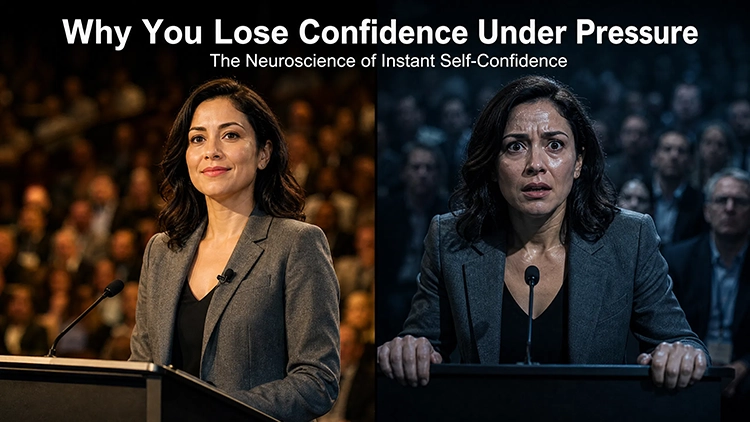
The High-Stakes Illusion: Why Quick Confidence Hacks Are Biological Circuit Breakers
You are standing behind the heavy doors of a boardroom, or sitting in your parked car two minutes before a crucial interview, or waiting at a quiet corner table for a first date. Your heart is hammering against your ribs like a trapped bird. Your palms are cool and damp. You know you possess the necessary skills, experience, and intelligence for this moment, yet your cognitive capacity feels as though it is evaporating in real time. In a desperate attempt to regain control, you straighten your posture, take a deep breath, and silently repeat: “I am strong, I am capable, I am ready.”
Yet, beneath those affirmations, the subtle tremor of anxiety remains. Why does intellectual knowledge fail us precisely when we need it most?
Popular culture frames confidence as a stable personality trait that you either possess or lack. When rapid interventions are suggested—like striking a “power pose” or reciting positive self-talk—they are frequently dismissed as superficial psychological gimmicks. But this dismissal ignores a fundamental biological truth: situational confidence is not an abstract state of mind; it is a physiological baseline.
When high-stakes performance anxiety strikes, you are not suffering from a sudden failure of self-esteem. You are experiencing an autonomic threat response. To master the art of rapid composure, we must stop treating confidence as a philosophical realization and start managing it as a biological regulation system.
The Neurobiology of State Shifts: How Physiology Rewires Mindset
When faced with acute social evaluation—such as public speaking or high-stakes negotiations—the brain’s threat detection center, the amygdala, cannot easily distinguish between a physical predator and social rejection. It initiates a sympathetic nervous system cascade, flooding your system with cortisol and epinephrine. Your heart rate accelerates, your breathing shallows, and blood shifts away from your prefrontal cortex—the region responsible for executive function, fluid communication, and complex decision-making.
[ External Trigger: High-Stakes Evaluation ]
│
▼
[ Amygdala Threat Activation: Sympathetic Surge ]
│
▼
[ Prefrontal Cortical Inhibition ] ──> Executive Function Drops
│
▼
[ Somatic Signal: Posture Slumps, Shallow Breath ]
This explains why attempting to “think positively” in the middle of an anxiety spike rarely works. The cognitive prefrontal cortex has been temporarily deprioritized by your survival circuitry. To restore executive function, you must bypass the top-down cognitive route and execute a bottom-up physiological intervention.
Somatic Feedback Loop:
The bidirectional neurological pathway through which body posture, respiratory rhythm, and muscle tension send real-time signals to the brain regarding environmental safety. By manually altering physical posture and breathing patterns, you force the central nervous system to downgrade its threat assessment.
When you straighten your spine, open your chest, and engage in slow, diaphragmatic breathing, you alter the afferent signals sent via the vagus nerve back to the brainstem. The brain registers the physical markers of safety and downregulates the sympathetic fight-or-flight response. You are not “tricking” your mind into feeling confident; you are restoring the biological prerequisites for high-level cognitive performance.
The Cognitive Dissociation Technique: The Power of Self-Distant Language
While somatic adjustments address the physiological baseline, the psychological chatter inside your head requires a different intervention. When under pressure, most people default to first-person internal monologue (“Why am I so nervous? I can’t mess this up”). This language anchors your identity directly to the anxiety, amplifying the physiological threat response.
Psychological research into cognitive reframing highlights the profound impact of self-distant language—the practice of addressing yourself in the third person or by name during moments of acute stress.
“When you address yourself by name rather than as ‘I’, your brain processes the situation with the same emotional distance and objective clarity it uses when giving advice to a trusted friend.”
First-Person Monologue ("I am terrified")
└──> Threat Identified with Self
└──> Amygdala Hyperactivation
└──> High Emotional Reactivity
Third-Person Distancing ("Alex is experiencing stress, but Alex is prepared")
└──> Observed Experience
└──> Prefrontal Cortex Re-engagement
└──> Emotional Regulation
Imagine a senior analyst about to pitch a high-value strategy to executive leadership. If they think, “I’m going to ruin this,” their stress escalates. If they shift their internal narrative to, “Sarah is feeling a surge of adrenaline right now, which means her body is preparing to focus,” a crucial shift occurs. By using her own name, Sarah transitions from being the helpless subject of anxiety to an objective observer of her physiological state.
This subtle linguistic shift activates the brain’s mentalizing network, allowing you to regulate emotions without suppressing them or engaging in forced positivity.
The Sensory Priming Architecture: Environmental Anchors
The human brain relies heavily on contextual priming. Specific sensory inputs—auditory rhythms, visual cues, and olfactory stimuli—act as immediate neural shortcuts to past physiological states.
              ┌──────────────────────────────────────────┐
│      SENSORY PRIMING ARCHITECTURE        │
└────────────────────┬─────────────────────┘
│
High ┌───────────────────────┼───────────────────────┐
│                       │  ACOUSTIC ENTRAINMENT │
│                       │  (High-Bass Rhythms)  │
│                       │                       │
Sensory   │                       ├───────────────────────┤
Impact    │                       │                       │
│  OLFACTORY ANCHORS    │  ENCLOTHED COGNITION  │
│  (Limbic Priming)     │  (Symbolic Identity)  │
Low └───────────────────────┴───────────────────────┘
Low                   Arousal                  High
Consider how sensory inputs systematically recalibrate your internal state:
- Enclothed Cognition: The psychological phenomenon where the symbolic meaning of clothing directly alters the wearer’s cognitive processes and performance. Wearing tailored, structured attire signals competence to your internal self-image before you ever speak a word.
- Olfactory Limbic Pathways: Unlike other sensory modalities, olfactory signals bypass the thalamus and project directly into the amygdala and hippocampus. A familiar, high-status scent instantly triggers memories of control and composure.
- Acoustic Entrainment: Listening to music with heavy basslines and driven tempos induces an elevated sense of power and abstract thinking capacity, preparing the brain for dominant social interactions.
| Sensory Vector | Mechanism | Strategic Application |
| Somatic Posture | Afferent Vagal Feedback | Expansive posture, uncrossed arms, grounded stance |
| Linguistic Frame | Psychological Distancing | Address yourself by name in internal dialogue |
| Acoustic Input | Neural Entrainment | High-bass, structured tempo music prior to entry |
| Olfactory Priming | Direct Limbic Activation | Wear a specific, distinct scent associated with success |
By stacking these sensory anchors immediately before a high-stakes event, you construct an artificial micro-environment that forces your internal biology to align with external readiness.
Practical Application: The 3-Minute Pre-Performance Protocol
When you have less than five minutes before stepping into a high-pressure environment, bypass abstract self-help theory and execute this rapid, systematically structured protocol:
[ Minute 1: Biological Reset ] ──► [ Minute 2: Psychological Distance ] ──► [ Minute 3: Contextual Priming ]
Minute 1: The Physiological Reset
- Physiological Sigh: Take two quick, deep nasal inhalations followed by one long, extended oral exhalation. Repeat this sequence three times to lower your heart rate rapidly.
- Postural Expansion: Stand straight, roll your shoulders back and down, and ground your feet firmly at hip-width. Maintain this posture for 60 seconds to signal biological safety to your brainstem.
Minute 2: Psychological Distancing & Reframing
- Name-Based Framing: Speak to yourself silently using your name. Say: “[Name], your heart is beating fast because your body is mobilizing energy for this moment. You are prepared, and you know this material.”
- Anchoring Memory: Spend 30 seconds recalling a specific past instance where you felt entirely competent and in command. Re-experience the visual and physical details of that moment.
Minute 3: Tactical Execution
- Immediate Action Step: Step toward the doorway or open the meeting window before your mind hesitates. As you walk in, make deliberate, calm eye contact with the first person you meet and speak your opening sentence at a measured, unhurried cadence.
Immediate Action Step:
The next time you feel a spike of anticipatory stress today—even in a low-stakes email exchange or phone call—pause, execute two physiological sighs, address yourself by name, and lower your speaking pitch slightly. Notice how quickly your baseline anxiety drops.
Beyond the Quick Fix: The Infinite Map of Self-Efficacy
Quick-confidence interventions are designed as emergency circuit breakers—tools to restore access to your existing intellect when stress threatens to shut it down. However, true, enduring self-efficacy cannot be built solely through power postures or breathing protocols.
As philosopher Arthur Schopenhauer observed, real confidence is not the illusion that we will never encounter adversity; it is the quiet, empirical knowledge that we possess the resilience to navigate whatever adversity arrives. The quick hacks buy you time and composure in the present moment, but true personal mastery comes from repeatedly stepping into discomfort until the unfamiliar becomes your home.
Key Takeaways
- The Core Misconception: Confidence is not a lack of fear; it is the biological regulation of the threat response.
- The Somatic Lever: Physiology drives psychology. Change your breath and posture to unlock your prefrontal cortex.
- The Language Shift: Move from “I am nervous” to using third-person self-talk to gain immediate cognitive distance.
- The End State: Use short-term state changes to navigate critical moments while building long-term competence through deliberate exposure.