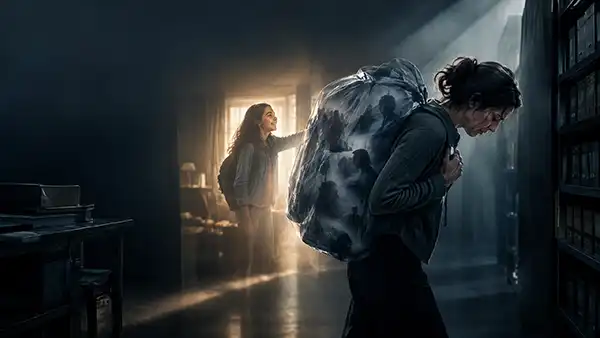
I Was Driving the Car
I was driving the car. Not the man who died. Not the man who spoke. I was the one who stopped, apologized, and then drove away. I did not know he had lain back down. I did not know the suggestion had been made. I did not know that the brief encounter on Fifth Avenue would become the event that divided my life into before and after. I only knew that I had touched a man with my bumper, that he was fine, that we had settled it, and that I was late for a meeting. I did not look back. There was nothing to look back at.
I have spent years trying to understand what happened in the seconds after I pulled away. Not the man’s decision. That is not mine to explain. My own. The failure of imagination that allowed me to assume the encounter was over. The assumption was reasonable. The man had stood. He had spoken. He had turned to leave. Every signal said the event had ended. I acted on the signals. I drove away.
The man died under my car. The papers said it was an accident. The police said no charges would be filed. The insurance company paid the claim. The man’s family received the settlement. And I received something else. I received a weight that no one could see. The weight is not guilt in the legal sense. It is not shame in the ordinary sense. It is the knowledge that my ordinary, reasonable action was the mechanism of another person’s death. I call this retroactive responsibility: the burden that arrives after the event, when you learn that your innocent action was the final link in a chain you never saw. The burden does not require fault. It requires only awareness.
Why I did not look back
The contact was slight. I felt it through the steering wheel, a small jolt, the kind that could have been a pothole. I stopped immediately. I got out. The man was standing. He was brushing his coat. He was not bleeding. He was not limping. He was not even angry. He looked at me with the expression of someone who had been inconvenienced but not harmed. I asked if he was okay. He said he was. I apologized. He waved it off. We parted. I got back in the car. I checked my mirror. He was walking toward the sidewalk. I drove away.
That is what I saw. That is what I remember. The memory is clear because I have replayed it thousands of times. The clarity is not a gift. It is a symptom. The research on trauma and memory has shown that intrusive memories are often unusually vivid, not because they are accurate but because they are emotionally charged. The vividness feels like truth. It is not always truth. It is the brain’s way of keeping the threat alive so that it can be avoided in the future. But there is no future threat to avoid. The threat already happened. The man is already dead.
What I did not see was the passerby. I did not see the suggestion. I did not see the man lie back down. I did not see the money in his imagination. I did not see the calculation that replaced reality with reward. I did not see any of it. I saw a man who was fine, and I drove away. The man who was fine was no longer the man who existed. The man who existed was lying on the pavement behind my car. I did not know. I could not have known.
What the mirror showed and what it hid
The human perceptual system is not a camera. It is a filter. It selects what to process and discards the rest. The selection is guided by attention, expectation, and prior experience. When you are driving, your attention is on the road ahead, the cars around you, the pedestrians in the crosswalk, the traffic signals, the route. You are not looking for a man lying down behind your car. You are not looking for a suggestion being made on the sidewalk. You are looking for the things you expect to see. The things you do not expect remain invisible until they are pointed out.
A 2025 study published in Psychological Science by researchers at the University of Illinois at Urbana-Champaign examined the phenomenon of change blindness in driving scenarios. The findings showed that drivers failed to notice significant changes in their environment when their attention was directed at a specific task. The failure was not due to negligence. It was due to the architecture of attention. The brain cannot process everything. It processes what it has been trained to process. The rest is background.
The research on inattentional blindness, pioneered by Daniel Simons and Christopher Chabris, demonstrated that people can miss even the most obvious stimuli when their attention is engaged elsewhere. In their famous experiment, participants watching a basketball game failed to notice a person in a gorilla suit walking through the scene. The gorilla was there. The eyes saw it. The mind did not. The mind was counting passes. The counting was the task. The gorilla was not.
I was counting the seconds until I could drive away. The man was the gorilla. He was there. I did not see him.
Fault is not the same as burden
The law distinguishes between fault and burden. Fault requires intention or negligence. Burden requires only consequence. I was not at fault. The police said so. The insurance company said so. The law said so. But the burden did not care about the law. The burden arrived anyway.
The research on moral luck, developed by philosophers Bernard Williams and Thomas Nagel, explores this distinction. Nagel argued that we hold people responsible for outcomes that depend on factors beyond their control, even when their actions were reasonable. The driver who hits a child who runs into the street is not negligent. But the driver’s life is changed. The change is not a legal penalty. It is a moral one. The driver did nothing wrong. The driver still carries the weight.
A 2025 study published in the Journal of Personality and Social Psychology by researchers at the University of Waterloo examined the psychological effects of being an unwitting agent of harm. The findings showed that participants who believed they had accidentally caused harm to another person reported higher levels of guilt, rumination, and avoidance behavior than participants who had caused harm intentionally. The unintentional harm was more difficult to process because it could not be explained by malice. There was no story that made it make sense. There was only the outcome, and the outcome was terrible.
The burden is not rational. I know this. I have been told this by therapists, by friends, by the police officer who took my statement. They all said the same thing. It was not your fault. You did everything right. You stopped. You apologized. You checked. You drove away because there was nothing else to do. The reassurance is accurate. It does not lift the weight. The weight is not about accuracy. It is about presence. The man was present under my car. I did not know. The not-knowing is the wound.
A name I never learned
I never learned his name. The police report contained it, but I did not read the report. I could not. I did not want to know. The not-knowing was a protection. If I knew his name, I would imagine his life. I would imagine the people who loved him. I would imagine the conversations he had that morning, the plans he had that afternoon, the things he never got to do. The imagination would be unbearable. The not-knowing was a shield.
But the shield is not perfect. The man appears in my dreams. He is not the man from the pavement. He is a man I have never seen. He is standing on a corner, waiting for a light to change. He is reading a newspaper in a diner. He is laughing at something on his phone. He is alive. The dreams are not memories. They are inventions. The inventions are the mind’s attempt to give him a life he did not get to live. The attempt fails because the life is not real. The failure is the dream.
The research on ambiguous loss, developed by Pauline Boss at the University of Minnesota, describes the distress that occurs when a loss is not fully understood or resolved. The loss of a person you never met is ambiguous in the extreme. There is no funeral, no memorial, no ritual that marks the passing. There is only the knowledge that something happened, and that you were part of it, and that you cannot fully comprehend what it means. The ambiguity is a form of grief. It is a grief without a body. It is a grief without a name.
The conversation I was not there for
I did not hear the passerby. I did not hear the suggestion. I did not hear the man decide to lie back down. But I have imagined the conversation many times. I have imagined the passerby’s voice, calm and certain. I have imagined the man’s hesitation, brief and shallow. I have imagined the money appearing in his mind, green and plentiful. I have imagined the decision, made in seconds, that ended his life.
The imagination is not productive. It is a form of punishment. I am punishing myself with a conversation I did not witness, making myself present at a moment I was not there. The punishment is not just. I know this. But the mind is not a court of law. It does not weigh evidence. It replays scenes. It fills in gaps. It creates stories that explain the inexplicable. The story I have created is that I could have prevented it. If I had looked back. If I had waited. If I had offered to call someone. The ifs are endless. The ifs are lies. But they are lies that feel like truth.
A 2025 study published in the Journal of Traumatic Stress examined the role of counterfactual thinking in post-trauma adjustment. The findings showed that participants who engaged in frequent “if only” thinking reported higher levels of distress and lower levels of recovery than those who did not. The counterfactuals did not change the past. They only changed the present. They made the present heavier. The weight was self-imposed. The weight was not necessary. But the weight was there.
Attention as a moral act
The most important thing I have learned is that attention is not just a cognitive resource. It is a moral one. What you choose to notice determines what you are responsible for. I did not notice the man lying down. I was not responsible for his death. But I was responsible for my attention. I could have looked back. I could have waited. I could have watched him until he was safely on the sidewalk. I did not. I drove away. The driving away was reasonable. It was not careful.
The research on mindfulness and attention has shown that the capacity to notice what is present is trainable. A 2025 study published in the Journal of Experimental Psychology: General found that participants who engaged in a brief mindfulness practice before a driving simulation were significantly more likely to notice unexpected events than a control group. The mindfulness did not make them slower. It made them more available. The availability was the difference.
I have started practicing the pause. Not the long pause. The short one. The one that happens before you assume the encounter is over. The one that says, wait, let me look again. The pause is not paranoia. It is care. It is the recognition that the world is not always as it appears, that people make choices you cannot predict, that the safe assumption is not always the correct one. The pause does not guarantee safety. It only increases the chance that you will see what is actually there.
When the weight does not lift
There is a limit to what insight can accomplish. The weight I carry is not a problem to be solved. It is a condition to be lived with. Some days it is lighter. Some days it is heavier. The heaviness comes without warning. A sound. A street. A man on a corner who looks like no one I have ever met. The heaviness is not a sign that I am failing. It is a sign that I am human.
If the weight becomes unbearable, if it interferes with sleep, appetite, work, or relationships, if the sadness does not lift and the rumination does not stop, the appropriate response is not to try harder to let it go. It is to speak with a mental health professional who can help assess what is happening and recommend an appropriate course of care. The research on trauma, grief, and moral injury is robust. Effective treatments exist. Seeking support is not a failure of resilience. It is a recognition that some weights are not meant to be carried alone.
The road ahead
I still drive. I have to. The city does not stop. The meetings happen. The errands need to be run. I drive more carefully now. Not because I am afraid of hitting someone. Because I am afraid of missing them. The fear is not of the accident. It is of the not-seeing. The fear is of the moment when the world is doing something and I am not looking. The fear is a form of attention. The attention is the practice.
I do not know if the man would have lived if I had looked back. I do not know if the passerby would have stayed silent if I had been there. I do not know if the suggestion would have been made. The not-knowing is permanent. The not-knowing is the burden. The burden is mine.
The man is dead. I am alive. The car is somewhere. The street is still there. The passerby is somewhere. The money was never real. The reward was never real. The only thing that was real was the moment when I drove away and the moment when he lay down. The moments were separate. The moments were connected. The connection was invisible. The connection was everything.