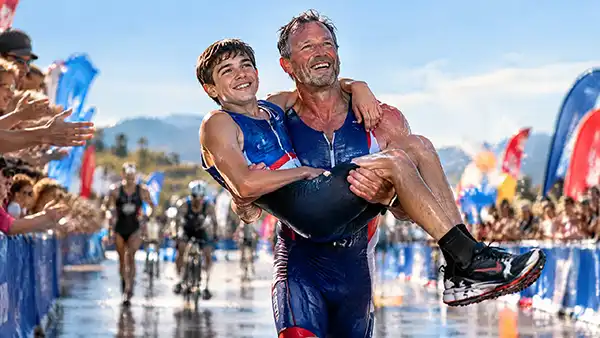
When One Body Does the Work of Two
The Ironman 70.3 in Hradec Králové is not a race for the faint-hearted. It is a half-triathlon: 1.9 kilometers of swimming, 90 kilometers of cycling, 21.1 kilometers of running. The winner finishes in under four hours. The middle of the pack finishes in six. The back of the pack finishes in seven or eight, if they finish at all. In September 2026, a Polish father named Przemysław Jurczak crossed the line in eight hours, five minutes, and twenty-two seconds. He did not cross alone. His son, Jakub, was with him for every meter of the course. Jakub was born with a severe form of cerebral palsy. He cannot walk, talk, or move his limbs with intention. He can, however, desire. And his desire was to finish the race.
The swimming leg came first. Przemysław swam 1.9 kilometers through open water, towing an inflatable boat behind him on a tether. Jakub lay in the boat, his body still, his face turned toward the sky. The cycling leg came next. Przemysław pedaled 90 kilometers with Jakub seated in a custom trailer fixed to the front of the bike. The running leg came last. Przemysław pushed a three-wheeled running chair for 21.1 kilometers, his hands gripping the handles, his legs driving into the pavement, his son’s head bobbing gently with the rhythm of the stride. When they crossed the finish line, they crossed as a single unit. The applause was for both of them. The exhaustion was for one.
Before going further, one thing needs to be said plainly. This story is extraordinary, and extraordinary stories can be dangerous when they are used as templates. The vast majority of parents caring for children with severe disabilities are not running Ironman races. They are managing feeding tubes, therapy appointments, sleepless nights, financial strain, and the quiet erosion of their own health. They are heroes in a different register. If you are a caregiver and the weight of the role is producing persistent sadness, anxiety, or distress that interferes with sleep, appetite, work, or relationships, the appropriate response is not to try harder to be the Ironman parent. It is to speak with a mental health professional. The research on caregiver mental health is robust, and effective support exists. This article is a story about one family. It is not a prescription for yours.
The five-mile run that changed everything
The template for this kind of devotion was established nearly fifty years ago in Massachusetts. Dick Hoyt was a military veteran and a former athlete, but he was not a runner. His son Rick was born in 1962 with cerebral palsy. The doctors told Dick and his wife Judy that Rick would never walk, never talk, and would live a life of limited function. Their recommendation was institutionalization. The Hoyts refused. They raised Rick at home, enrolled him in public school, and fought for his inclusion in every domain of life.
In 1977, Rick told his father he wanted to participate in a five-mile benefit run for a lacrosse player who had been paralyzed in an accident. Dick was not a runner. He was forty years old. He pushed Rick’s wheelchair for five miles. When they finished, Rick communicated something that would change both of their lives. He said that when he was running, it felt like his disability disappeared. The sentence became the engine for everything that followed.
Over the next four decades, Dick and Rick Hoyt competed in more than 1,000 races. They completed 32 Boston Marathons, six Ironman triathlons, and a coast-to-coast trek across the United States. Dick pushed, pulled, towed, and carried his son through every course. Rick became a college graduate, a motivational speaker, and a symbol of what inclusion can look like when someone refuses to accept the limits that others impose. The BBC reported that Rick finished the Boston Marathon 36 times in his wheelchair. The Hoyt Foundation noted that the pair inspired millions of people with disabilities to believe in themselves. Dick died in 2021. Rick died in 2023. Their legacy is not a trophy. It is the proof that a father’s body can become the instrument of his son’s will.
What happens to a father’s heart
The physiology of what these fathers do is not fully understood because the research on extreme endurance has focused almost entirely on single athletes. A 2021 study published in Science Advances examined the metabolic limits of endurance athletes across a range of events, from marathons to ultra-triathlons. The researchers found that the human body can sustain an energy expenditure of roughly 2.5 times its basal metabolic rate over long periods. Beyond that, the body begins to break down its own tissues. The ceiling is not psychological. It is metabolic.
The father who tows a boat, pedals a trailer, and pushes a chair for eight hours is operating at the edge of that ceiling. He is doing the work of two bodies with the metabolic budget of one. The effort is not divided. It is doubled. The heart must pump more blood. The lungs must process more oxygen. The muscles must clear more lactic acid. The father’s body does not adapt to the load by becoming stronger in the way a single athlete’s body adapts to a marathon. It adapts by enduring the damage and recovering afterward. The recovery is slower. The cost is higher. The achievement is not lessened by the cost. It is defined by it.
Technology cannot carry the weight alone
The technology of co-authored endurance has evolved. Jeff Agar and his son Johnny, who also has cerebral palsy, completed the 2016 Ironman World Championships in Kona, Hawaii. Jeff pushed and pulled Johnny through 2.4 miles of swimming, 112 miles of cycling, and 26.2 miles of running. They did not finish before the cutoff. Jeff told Popular Mechanics that his training was not comprehensive enough to handle the load of both men, the equivalent of a 340-pound person. They came back with better equipment and professional coaching. They finished the 70.3 in Florida five minutes ahead of their predicted time.
The equipment matters. The inflatable boat that Przemysław used is lighter and more stable than the craft Dick Hoyt used in the 1980s. The running chair that Jeff Agar pushes has been engineered with aerodynamic shells and carbon fiber components. The technology does not reduce the effort. It redistributes it. It allows the father to direct more energy toward forward motion and less toward balance and stabilization. The innovation is not a shortcut. It is a refinement of the same act: one person moving another person through space, by will and by muscle.
Total devotion has a shadow side
I want to name what is happening here. It is not self-sacrifice in the ordinary sense. It is not martyrdom. It is not the erasure of the father’s needs for the sake of the child’s. It is a structure that I call co-authored endurance: a form of achievement in which the desire and the capacity originate in different people, and the resulting effort belongs fully to both without being divided between them. The son provides the will. The father provides the body. The race is not the father’s race with the son as passenger. It is the son’s race with the father as engine.
The distinction matters because it changes the psychology of the effort. The father who is running for himself is running to satisfy his own ambition. The father who is running for his son is running to satisfy a desire that is not his own. He has chosen to serve it, but he did not create it. The desire is the son’s. The father’s role is to make it real. The exhaustion is his. The meaning is shared.
The research on purpose in life provides a framework for understanding why this structure is sustainable for some fathers and crushing for others. A 2025 study in the Journal of Affective Disorders followed 8,880 older women and found that those with low levels of purpose in life had a 3.6-fold higher risk of death before the age of 85. Purpose regulates stress responses. It reduces the physiological wear of chronic effort. The father who has a purpose that is larger than his own comfort can endure more than the father who is enduring for no reason he can name. The purpose does not eliminate the cost. It makes the cost bearable.
When the load exceeds the love
The darker side of this structure is not often discussed in the stories that celebrate it. The same devotion that produces extraordinary achievement can also produce exhaustion, resentment, and collapse. A 2022 study published in PLOS ONE by researchers at the University of Haifa examined the lifelong experience of older parents caring for adult children with developmental disabilities. The researchers identified four distinct patterns: total devotion, in which the child becomes the parent’s entire world; balancing, in which the parent pursues personal and familial goals alongside caregiving; self-actualization through caregiving, in which the caregiving itself becomes a calling; and emphasizing self-actualization, in which the parent maintains a strong separate identity.
The patterns are not equally sustainable. Total devotion produces the highest risk of burnout because the parent’s identity is fused with the caregiving role. When the role is threatened, the self is threatened. The balancing and self-actualization patterns are more protective because they allow the parent to maintain a sense of self that is not entirely dependent on the child’s needs. The research does not suggest that devotion is wrong. It suggests that devotion without boundaries is fragile.
A 2026 longitudinal study published in Family Relations examined the relationship between family resilience and post-traumatic growth among caregivers of children with disabilities. The findings showed a bidirectional, mutually reinforcing relationship. Family resilience predicted growth, and growth predicted resilience. The cycle was not automatic. It required support, resources, and the presence of people who could share the load. The fathers who complete Ironman races are not doing it alone. They have coaches, medical teams, equipment sponsors, and communities of other parents who understand what they are facing. The isolation is the risk factor. The community is the protection.
The finish line belongs to both
There is a version of this story that becomes a demand. The father who sacrifices everything becomes the standard against which other parents are measured. The mother who cannot run a marathon with her disabled child is not less devoted. The father who works two jobs and cannot be present for every therapy session is not less loving. The research on caregiving shows that the majority of parents of children with disabilities do not have access to the resources that make extreme devotion possible. They are managing the same demands without the equipment, without the coaching, without the community, and without the recognition.
The celebration of the extraordinary father can become a subtle indictment of the ordinary one. It can suggest that love is measured in miles run and hours endured. It can make the parent who is already exhausted feel that their exhaustion is evidence of insufficient commitment. The research does not support this hierarchy. Love is not a performance. It is a condition. The father who sits beside his son’s bed through the night is performing an act of devotion that no marathon can measure.
Przemysław Jurczak did not finish the Ironman for himself. He finished it because his son wanted to finish it. The desire was Jakub’s. The body was his father’s. The applause was for both. The exhaustion was for one. The meaning was shared.
The finish line is not the point. The finish line is the punctuation at the end of a sentence that neither of them wrote alone. The sentence began with a question. The answer was yes. The rest was endurance. The rest was love. The rest was a father’s body doing what his son’s body could not, not because he was asked to, but because he chose to. And the choosing was the whole of it.