The Money I Was Afraid to Count
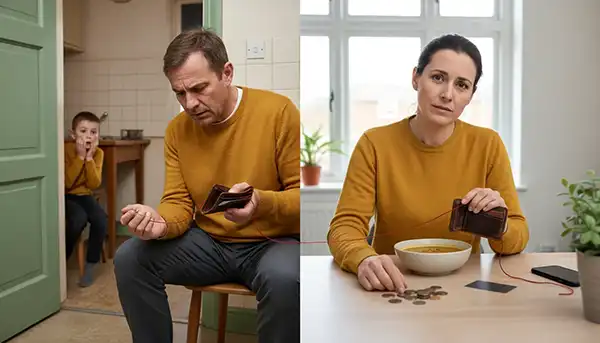
My mother used to hide cash in the freezer. Not because she was worried about burglars, though she was, but because she was worried about banks. Banks had rules. Banks had minimums. Banks could take your money and not give it back if you made a mistake. The freezer was safe. The freezer had no rules. I grew up thinking money was something you kept hidden, something you didn’t talk about, something that disappeared if you looked at it too long. I also grew up thinking we were poor. We were not poor. My father had a stable job. We had a house. We had food. But the fear was real, and the fear was in the walls, and I absorbed it the way children absorb everything, without knowing I was absorbing it.
I carried that fear into my twenties, my thirties, my forties. I made money. I saved money. I invested money. And I never once felt like I had enough. The number went up. The feeling stayed the same. The number was not the problem. The problem was the hidden cash in the freezer of my mind.
The scarcity that does not show on the bank statement
The research on scarcity mindset was pioneered by Sendhil Mullainathan and Eldar Shafir in their 2013 book Scarcity: Why Having Too Little Means So Much. Their central finding was that scarcity, whether of money, time, or social connection, imposes a measurable tax on cognitive bandwidth. The mind becomes consumed by what is lacking. The consumption leaves fewer resources for everything else. A 2025 study in the Journal of Behavioral and Experimental Economics confirmed the mechanism: a scarcity mindset was directly and positively associated with riskier financial behavior. The scarcity did not produce caution. It produced gambling. The person who is worried about rent is not evaluating a business opportunity. They are surviving.
The finding is counterintuitive because the standard assumption is that scarcity makes people careful. The research shows the opposite. Scarcity narrows attention to the immediate problem, which helps with the immediate problem and harms everything else. The survival mode is adaptive in a crisis. It is corrosive in a life.
A 2025 study published in Cognitive Therapy and Research found that subjective scarcity was negatively associated with financial management behavior and analytical thinking. The scarcity did not just make people feel poor. It made them worse at the tasks that would improve their financial situation. The feeling created the outcome. The outcome reinforced the feeling.
What I learned from a therapist who asked about my mother
I started seeing a therapist in my late forties. Not because I was in crisis, but because I had noticed a pattern. Every time I paid a bill, I felt a small knot in my stomach. Every time I checked my bank account, I braced for bad news. Every time I thought about retirement, I felt the same cold fear I had felt as a child watching my mother count coins at the kitchen table. The numbers were fine. The fear was not.
The therapist asked me about my parents. She asked me what I had learned about money before I was old enough to question it. I told her about the freezer. I told her about the arguments I had heard through the bedroom wall. I told her about the way my mother would say “we can’t afford that” without checking whether it was true. The therapist nodded. She said something that stayed with me: “You inherited a relationship with money. You did not choose it. But you can change it.”
The research on financial socialization has shown that parents transmit financial attitudes and behaviors to their children through modeling and communication. A 2025 study in the Journal of Family and Economic Issues found that parental financial socialization was a significant predictor of adult financial behavior, even after controlling for income, education, and financial literacy. The transmission was not about money. It was about meaning. The meaning I inherited was that money was dangerous, scarce, and shameful. The meaning shaped my behavior long after the objective conditions had changed.
The moment I stopped hiding
I decided to do something that felt radical at the time. I wrote down every number. My income. My savings. My debts. My monthly expenses. I put them all in a spreadsheet and I looked at them for an hour. I did not look away. I did not minimize the window. I did not tell myself I would deal with it later. I just looked.
The number was not as bad as I feared. It was not as good as I hoped. It was just a number. And for the first time in my life, I felt something I had never felt about money. I felt neutral. The neutrality was not excitement. It was not relief. It was the absence of the knot. The absence was enough.
The research on financial avoidance has shown that the fear of looking at one’s finances is associated with worse financial outcomes. The avoidance is not protective. It is harmful. The person who avoids the number never learns what the number is. The not knowing is scarier than the knowing. The knowing is the beginning.
What gratitude actually does to the fear
I started a gratitude practice. Not because I believed it would make me rich. Because I needed to change what I was looking for. The research on gratitude and financial behavior has produced findings that are both consistent and counterintuitive. A 2025 study led by Dr. Rona Hart at the University of Sussex found that higher levels of gratitude predicted lower financial stress. The gratitude did not change the objective financial situation. It changed the experience of the situation.
A 2026 study published in the European Journal of Social Psychology examined whether gratitude reduces the desire for money across four preregistered studies with 3,125 participants. The findings showed that gratitude was negatively associated with money desire, and that the effect was mediated by enhanced social connectedness and increased self-transcendence. The grateful person felt more connected to others and less consumed by narrow self-interest. The connection reduced the need for money to serve as a substitute for belonging.
I wrote down five things I was grateful for every morning. The first week was awkward. The second week was easier. By the third week, I noticed something I had not expected. I was less afraid of my bank account. The fear had not disappeared. But it had lost some of its authority. The gratitude had not made me rich. It had made me less afraid of being poor. The fear was the thing that had been running my life. The gratitude was the thing that started to loosen it.
The forgiveness that freed the bandwidth
The source of my scarcity mindset was not just my mother. It was also the resentment I carried toward her. I blamed her for the fear. I blamed her for the freezer. I blamed her for the years I spent feeling poor when I was not. The blame was not unfair. It was just not useful.
I forgave her. Not because she asked. Not because she deserved it. Because I needed the bandwidth. The research on forgiveness has shown that the act of forgiving reduces rumination, lowers cortisol, and improves cardiovascular function. A 2025 study published in the Journal of Behavioral Medicine found that forgiveness interventions were associated with reduced stress reactivity and improved emotional regulation. The forgiveness did not change the offender. It changed the forgiver.
I wrote a letter I never sent. I told her what I had learned. I told her I understood that she had been afraid too. I told her I was letting go of the resentment. The letter was not for her. It was for me. The act of writing it was the act of releasing the weight I had been carrying. The weight was not the money. The weight was the story I had told myself about the money. The story was finally over.
What abundance literacy looks like in practice
The term I use for the capacity to recognize and act on this mechanism is abundance literacy: the ability to distinguish between the subjective experience of not having enough and the objective reality of what is actually available. Scarcity thinking is not the same as poverty. It is a cognitive state that can afflict the wealthy and spare the poor. It is the feeling of lack, the hyperfocus on what is missing, the narrowing of attention that makes the brain efficient at solving the immediate problem and blind to everything else.
The practice of abundance literacy begins with looking. Not at the positive. At the real. The spreadsheet. The numbers. The truth. The truth is usually less scary than the fear. The fear is a story. The truth is a fact. The fact can be worked with. The story cannot.
The second practice is gratitude. Not as a mood. As a mechanism. The gratitude changes what the brain is looking for. The brain that is looking for what is missing will find it. The brain that is looking for what is present will find that instead. The finding is the beginning.
The third practice is forgiveness. Not as a moral act. As a practical one. The resentment is a leak. The leak drains the bandwidth that is needed for the work. The work is the only thing that changes the number. The forgiveness is the thing that makes the work possible.
When the fear does not lift
There is a limit to what self-directed practice can accomplish. If the financial fear is accompanied by persistent sadness, anxiety, or distress that interferes with sleep, appetite, work, or relationships, the appropriate response is not to try harder to think abundant thoughts. It is to speak with a mental health professional who can assess what is happening and recommend an appropriate course of care. The research on financial anxiety, depression, and the psychological effects of chronic scarcity is robust. Effective treatments exist. The support is not a sign that you have failed to manage your mindset. It is a recognition that some fears were installed before you could evaluate them and require more than adult willpower to dismantle.
The number that is not the point
I still check my bank account. I still pay attention to the number. But the number is not the point. The number was never the point. The point was the fear. The point was the story. The point was the freezer. The story was never true. The fear was never necessary. The freezer was just a freezer.
My mother died last year. I found cash in her apartment. Not in the freezer. In a drawer. In an envelope. The envelope had my name on it. The cash was old. The bills were from a different era. She had been saving it for me. She had been saving it for years. The saving was her love. The hiding was her fear. I kept the envelope. I did not spend the cash. I did not put it in a bank. I put it in a drawer. The drawer is not the freezer. The drawer is just a drawer. But some habits are hard to break. Some habits are hard to break because they were never just habits. They were love. They were fear. They were the only things she had to give.
The abundance was always there. The abundance was in the envelope. The abundance was in the drawer. The abundance was in the fact that she thought of me. The abundance was in the fact that I survived her. The abundance was in the fact that I am still here, still counting, still afraid, still learning. The abundance is not the money. It is the learning. It is the practice. It is the choice to look at the drawer and see the love instead of the fear. The choice is available. The choice is mine. The choice is now.