The Long Spoon: Why Giving Is the Only Way to Eat
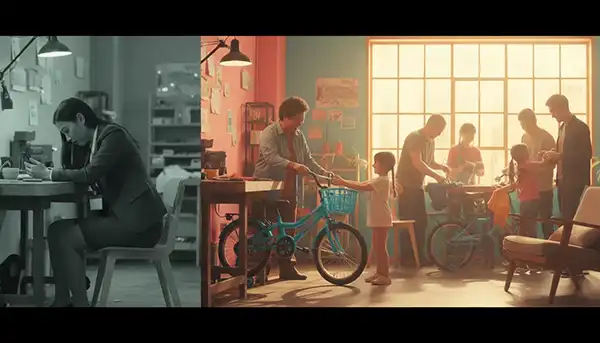
There is an old story about a teacher who wanted to show the difference between talking about love and living it. The teacher set a table with two groups of people. The first group was given long spoons and told they could not bend their elbows. They tried to feed themselves, but the spoons were too long. The soup spilled. They went hungry. The second group was given the same spoons. They used them to feed the person across the table. Everyone ate. The story is usually told as a lesson about altruism. It is more accurately a lesson about interdependence. The difference between talking about love and living it is not sentiment. It is the willingness to use your spoon to feed someone else, and the recognition that this is the only way you will ever be fed.
The story is ancient. The insight is not. The research on prosocial behavior has been circling the same conclusion for decades, and the conclusion is uncomfortable for a culture that treats self-sufficiency as the highest virtue. The people who give are not just kinder. They are healthier, happier, and more resilient. The people who hoard their spoons are not just lonelier. They are depleted. The table is not a metaphor. It is a description of how human beings actually function.
What the research on giving actually shows
The most famous study in this domain was conducted by Elizabeth Dunn at the University of British Columbia and Michael Norton at Harvard Business School. They gave participants a small amount of money and told them to spend it on themselves or on someone else. The participants who spent it on others reported significantly higher levels of happiness at the end of the day. The finding was not about the amount. It was about the direction. The money that flowed outward produced more joy than the money that stayed in.
A 2025 study published in the Journal of Personality and Social Psychology replicated the finding across cultures and income levels. The researchers found that prosocial spending predicted well-being even when controlling for income, age, and personality traits. The effect was small but consistent. The people who gave were not richer. They were not more generous by nature. They were simply acting in a way that aligned with a basic human need: the need to matter to someone else.
Sonja Lyubomirsky at the University of California, Riverside, has studied the relationship between kindness and well-being for decades. Her research has shown that performing small acts of kindness for others produces measurable increases in mood and life satisfaction. The acts do not need to be large. Holding a door, writing a note, listening without interrupting. The kindness does not change the world. It changes the person who offers it. The change is not a mood boost. It is a shift in orientation. The person who is looking for ways to help is not consumed by their own problems. The attention has moved outward. The movement is the relief.
The helper’s high is not a metaphor
Allan Luks, a researcher and social worker, coined the term “helper’s high” in the 1980s to describe the euphoric feeling that accompanies acts of service. The feeling is not imaginary. The brain releases endorphins, the same chemicals associated with exercise and pleasure, when a person engages in helping behavior. The release produces a sense of calm, energy, and connection. The helper does not need to be a saint. The helper does not need to be selfless. The helper only needs to act.
A 2025 study published in the Journal of Health and Social Behavior found that volunteering was associated with lower levels of depression, higher levels of life satisfaction, and even longer life. The effect was strongest for older adults, but it was present across the lifespan. The mechanism was not the activity itself. It was the sense of purpose and connection that the activity provided. The volunteers were not just busy. They were needed. The need was the medicine.
Stephanie Brown at Stony Brook University conducted a longitudinal study of older adults and found that those who volunteered regularly had a significantly lower risk of mortality than those who did not. The effect was independent of physical health, socioeconomic status, and social support. The giving itself was protective. The protection was not a reward for virtue. It was a biological response to being part of something larger than the self.
Why reciprocity is not transactional
The long-spoon story is often interpreted as a lesson about reciprocity: you feed me, I feed you, and we both benefit. The interpretation is correct, but it is incomplete. The reciprocity in the story is not a contract. It is a condition. The people at the table are not keeping score. They are not trading favors. They are eating. The feeding is not a transaction. It is a necessity.
I call this condition sustenance reciprocity. It is the recognition that your well-being and my well-being are not separate. They are intertwined. The person who feeds you is not doing you a favor. They are maintaining the system that keeps them alive. The person who refuses to feed you is not just cruel. They are undermining the system that would feed them. The table is not a marketplace. It is an ecosystem.
The research on social capital supports this framing. Robert Putnam at Harvard University has documented the decline of community in American life and the consequences that followed: increased loneliness, decreased trust, and a deterioration of the informal networks that people rely on in times of crisis. The decline was not caused by a single factor. It was caused by a shift in orientation. People began to see themselves as consumers of community rather than participants in it. The consumption depleted the resource. The depletion left everyone hungrier.
The loneliness of the self-feeder
The first group in the story is not evil. They are not selfish in the ordinary sense. They are simply trying to eat. They are using the tools they have been given in the way they have been taught. The problem is that the tools do not work in isolation. The spoons are too long. The arms are too short. The soup is out of reach. The self-feeder is not a bad person. They are a person who has not yet realized that the only way to eat is to feed someone else.
The research on loneliness has consistently found that the feeling of isolation is not about the number of relationships. It is about the quality of connection. A 2025 study published in The Lancet Public Health found that social isolation was associated with a significantly increased risk of dementia, independent of other risk factors. The isolation was not just sad. It was damaging. The brain that is not connected to other brains does not function as well. The connection is not a luxury. It is a requirement.
The self-feeder is often the person who has been hurt. They have given before and been burned. They have fed someone who did not feed them back. The withdrawal is protective. The protection is understandable. But the protection is also a prison. The person who stops feeding to avoid being hurt stops eating. The body does not understand the difference between caution and starvation.
When giving becomes depletion
There is a version of this story that becomes a demand. The person who gives and gives and gives, who feeds everyone at the table and never eats, who pours out the soup until the bowl is empty. The giving becomes a form of self-erasure. The erasure is not love. It is a slow form of self-harm. The research on caregiver burnout has documented the pattern extensively. The person who gives without boundaries eventually collapses. The collapse does not help anyone.
The long-spoon story does not require self-sacrifice. It requires mutual feeding. The person who feeds you is also eating. The person who gives is also receiving. The reciprocity is not optional. It is the mechanism. The person who gives without receiving is not practicing sustenance reciprocity. They are practicing self-neglect with a noble vocabulary.
If the giving has become compulsive, if it is accompanied by resentment, exhaustion, or a sense of being trapped, the appropriate response is not to try harder to give. It is to examine the pattern. The research on codependency and compassion fatigue is robust. Effective support exists. If the exhaustion is persistent and interferes with sleep, appetite, work, or relationships, the appropriate response is to speak with a mental health professional who can help assess what is happening and recommend an appropriate course of care. The support is not a sign that you have failed to love enough. It is a recognition that love without boundaries is unsustainable.
The table we are all sitting at
The story ends with the second group eating. They are not described as heroes. They are described as nourished. The feeding was not a sacrifice. It was a solution. The solution was not complicated. It was the recognition that the spoon was long enough to reach across the table, and that the person across the table was also holding a spoon.
The research on cooperation has shown that human beings are wired for reciprocity. The norm of reciprocity, described by Alvin Gouldner in 1960, is one of the most universal moral principles across cultures. The norm does not require saintliness. It requires only the expectation that giving and receiving are linked. The linkage is the foundation of trust. The trust is the foundation of community. The community is the foundation of survival.
The table is not a metaphor. It is a description of the human condition. We are all sitting at the same table. The spoons are all the same length. The soup is in the middle. The only question is whether we will try to feed ourselves or whether we will feed each other. The first option does not work. The second option is the only one that ever has.
The person who gives is not a martyr. They are a participant. The person who receives is not a charity case. They are a partner. The feeding is not a transaction. It is a rhythm. The rhythm is the life. The life is the table. The table is waiting.