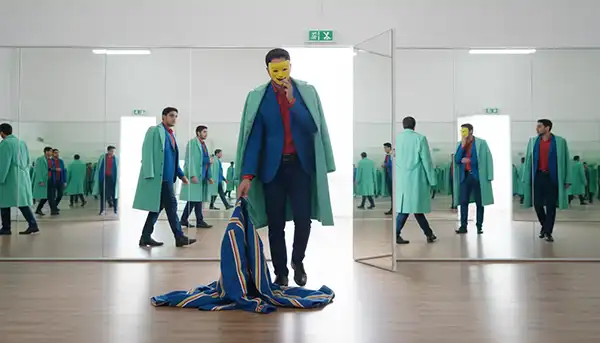
The Mirror I Refused to Look Into
I spent most of my twenties believing I was fine. Not happy, exactly. Not thriving. But fine. I had a job, an apartment, a group of friends I saw on weekends. I had the things that looked like a life from the outside. And on the inside, I was running. Running from something I could not name. Running so fast that I did not have time to notice I was not going anywhere.
The running had a logic to it. If I kept moving, I never had to stop and look at the person doing the moving. If I kept producing, achieving, performing, I never had to ask whether the production was mine or someone else’s script. The activity was the anesthetic. The anesthetic worked. It worked for years.
The term I now use for what I was doing is authenticity avoidance. It is the practice of staying so busy, so distracted, so committed to the external markers of a life that you never have to confront the internal reality of one. The avoidance is not laziness. It is fear. The fear is not of failure. It is of seeing. Seeing what? Seeing that the person you have been presenting to the world is not the person you actually are.
Fear has many disguises
The source of the avoidance is fear, but fear is rarely experienced as fear. It is experienced as ambition. It is experienced as responsibility. It is experienced as the reasonable decision to postpone the difficult conversation, the scary career change, the honest look in the mirror, until the timing is better. The timing is never better. The timing is a story the fear tells to keep you in place.
The research on avoidance behavior has shown that the anticipation of a threat is often more distressing than the threat itself. A 2025 study published in Behaviour Research and Therapy examined the relationship between fear of failure and goal pursuit across 1,200 adults. The findings showed that fear of failure predicted avoidance of challenging tasks even when the participants had the skills and resources to succeed. The fear did not change the difficulty of the task. It changed the perception of the task.
I was avoiding something that had no objective danger. There was no bear in the woods. There was no cliff edge. There was only a question. The question was: if you stopped running, who would you be? The question was terrifying because I did not have an answer. I had been defining myself by the running for so long that I did not know what was underneath.
Ego builds walls, not bridges
The ego is not a thing. It is a process. It is the process by which a person constructs and maintains a sense of self through external feedback. The process is not conscious. It operates below the threshold of awareness, shaping behavior in ways that the person experiences as natural, inevitable, and correct. When I say “I am a hard worker,” I am not describing a fact. I am describing a position I have taken in a social economy where hard work is rewarded. The position is useful. The position is also a wall.
A 2025 study published in the Journal of Personality and Social Psychology found that people who scored high on measures of ego involvement were more likely to interpret neutral feedback as a threat and more likely to respond defensively. The ego did not protect them. It isolated them. The isolation was the cost of the wall.
The wall served a purpose. It protected me from the discomfort of not knowing who I was. It gave me a stable identity in a world that was unstable. But the stability was brittle. It depended on the world continuing to reward the position I had taken. If the reward stopped, the identity stopped with it. I had built a self on a foundation that was not mine.
Self-deception is not a survival strategy
The most common form of self-deception is not lying to yourself about what you are doing. It is lying to yourself about why you are doing it. I told myself I was working hard because I cared about the work. I told myself I was staying late because I was committed. I told myself I was not having the difficult conversation because the timing was wrong. The stories were not lies in the literal sense. They were rationalizations. They were the justifications that made the avoidance feel like a choice rather than a flight.
The research on self-deception has shown that people are remarkably skilled at generating reasons for the conclusions they want to reach. A 2025 study published in the Journal of Experimental Psychology: General found that participants who were motivated to see themselves in a positive light were more likely to notice, remember, and believe information that supported that view. The motivation shaped the perception. The perception shaped the conclusion. The conclusion felt like the truth.
The truth was simpler and harder. I was afraid. I was afraid of what I would find if I stopped. I was afraid of the emptiness. I was afraid that the person underneath the performance would be someone I did not like. The fear was real. The stories were the defense.
What the gap costs you
The authenticity gap does not announce itself. It does not send an invoice. It collects its payment in other ways. It collects in the low-grade anxiety that arrives for no clear reason. It collects in the relationships that feel close but never quite intimate. It collects in the moments when you look at your life and feel like a stranger in it.
A 2025 study published in the Journal of Counseling Psychology found that authenticity was negatively associated with anxiety, depression, and burnout. The authenticity was not about expressing every thought. It was about the alignment between the internal experience and the external expression. The person who is aligned is not performing. They are being. The being is the relief.
I did not know I was misaligned. I did not know I was performing. I knew I was tired. I knew I was not satisfied. I knew that the things I had worked for did not feel like mine. I did not know why. The why was the gap.
Staying the same becomes more painful than changing
The change did not happen because I decided to change. It happened because the cost of staying the same became higher than the cost of changing. The cost was not a single event. It was an accumulation. A relationship ended because I had not been present for it. A project failed because I had not been honest about my capacity. A health issue arrived because I had been ignoring my body for years. The accumulation reached a threshold. The threshold was not a decision. It was a collapse.
The research on behavior change has shown that the most effective interventions are not the ones that motivate people to change. They are the ones that make the change easier than the alternative. A 2025 study published in the Journal of Applied Psychology found that when the cost of inaction was made salient, participants were significantly more likely to take action. The salience was the mechanism. The mechanism was not motivation. It was reality.
I had been avoiding reality for years. Reality arrived anyway. It always does.
The day I stopped performing
I did not stop performing all at once. I stopped performing in small increments. I told a friend the truth about how I was feeling. I said no to a project I did not have the capacity for. I asked for help. I sat with the emptiness instead of filling it. The increments were small. The increments were not dramatic. But the increments were real.
The research on vulnerability has shown that the willingness to be seen as one actually is, including the parts that are imperfect, is a precondition for genuine connection. Brené Brown at the University of Houston has spent two decades studying this. Her finding is consistent: the performance produces approval. It does not produce intimacy. The intimacy requires the risk of being known.
The risk was the change. The change was not a destination. The change was a direction. The direction was toward the self I had been avoiding. The self was not a monster. The self was a person. The person was tired. The person was scared. The person was also curious. The curiosity had been buried under the performance. The curiosity was the beginning.
A note on when you cannot do it alone
There is a limit to what self-directed change can accomplish. If the patterns described here are accompanied by persistent sadness, anxiety, or distress that interferes with sleep, appetite, work, or relationships, the appropriate response is not to try harder to change alone. It is to speak with a mental health professional who can assess what is happening and recommend an appropriate course of care. The research on cognitive behavioral therapy, acceptance and commitment therapy, and other evidence-based treatments for anxiety, depression, and the effects of chronic self-deception is robust. Effective support exists. The support is not a sign that you have failed to change yourself. It is a recognition that some patterns were installed before you had the capacity to evaluate them and require more than adult willpower to dismantle.
The mirror you are avoiding
There is a mirror in front of you. It has been there for a long time. You have been walking past it. You have been telling yourself you will look when the timing is better. The timing is not better. The timing is a story. The mirror is not a threat. The mirror is a beginning.
You do not need to like what you see. You do not need to fix what you see. You need to see it. The seeing is the change. The seeing is the end of the avoidance. The seeing is the beginning of the life you have been postponing.
The mirror is waiting. The reflection is waiting. The person in the reflection is waiting. They have been waiting for a long time. They are not angry. They are not disappointed. They are just there. They have always been there. The question is whether you will stop walking past. The question is whether you will look. The question is now.