Relational Static: Why We Stop Hearing Each Other and How to Clear the Signal
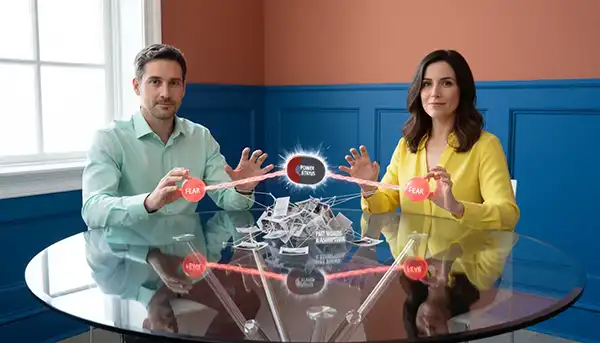
Most communication failures are not caused by disagreement. They are caused by interference. Two people can want the same thing, respect each other, and still walk away from a conversation feeling misunderstood, dismissed, or attacked. The problem is not the message. The problem is the noise that accumulates between the sender and the receiver. I call this relational static: the layer of fear, assumption, defensiveness, and unmet need that distorts what is said and what is heard. The static is not visible. It is not intentional. But it is the most common reason that conversations fail.
I spent a decade working as a mediator in Chicago, sitting between people who had stopped listening to each other. I learned that the loudest arguments were rarely about the topic on the table. They were about the static underneath. A dispute about a delayed project was really about a manager who felt disrespected. A conflict about money was really about a partner who felt unseen. The words were the surface. The static was the current. If you want to improve communication, you do not start with better words. You start by clearing the signal.
A manager in Chicago who could not hear the word no
A general manager I worked with once promoted a talented operations assistant into a troubled marketing department. The manager thought he was offering an opportunity. He raised the assistant’s salary, gave him a title, and told him the department needed his skills. The assistant resigned within two weeks. The manager was baffled. He had done everything right, he thought. He had rewarded the man. He had trusted him. He had given him a challenge.
What the manager did not do was explain. He did not say why he believed the assistant could succeed. He did not say what he valued about him. He did not say that he understood the department had a bad reputation and that the assignment was difficult. He simply assumed the promotion would speak for itself. It did not. The assistant heard a different message: you are being sent to a failing department because no one else wants to go. The manager thought he was offering a gift. The assistant experienced a sentence.
The research on communication breakdown has repeatedly found that the gap between intention and impact is one of the most common sources of conflict. A 2025 study published in the Journal of Applied Psychology found that employees who felt their managers explained the reasoning behind decisions reported significantly higher levels of trust and engagement. The explanation was not a formality. It was the bridge between the manager’s intent and the employee’s perception.
Fear wears the mask of silence
The first source of static is fear. Fear of saying the wrong thing. Fear of being laughed at. Fear of looking stupid. Fear of emotions that might become uncontrollable if they are expressed. These fears do not announce themselves. They hide behind silence, behind small talk, behind the safe topics that keep conversation shallow and safe.
The research on communication apprehension, developed by James McCroskey at West Virginia University, has shown that fear of communication is one of the most common social anxieties. People who score high on communication apprehension avoid situations that require spontaneous speech. They prepare less. They participate less. They are perceived as less competent, even when their ideas are sound. The fear does not just affect the speaker. It affects the listener, who receives less information and forms a less accurate impression.
The exit from this trap is not to become an extrovert. It is to recognize that the fear is a signal, not a command. The person who is afraid of saying the wrong thing can prepare. They can write down the main point. They can practice the first sentence. They can ask a question instead of making a statement. The preparation does not eliminate the fear. It reduces the static enough that the message can get through.
Preconception shuts the door before the knock
The second source of static is preconception. A preconception is a belief about how someone is or how something should be, held without verification. We all carry them. We assume the quiet colleague is arrogant. We assume the loud colleague is shallow. We assume the person who disagrees with us is either foolish or malicious. The assumption shapes the conversation before it begins.
Marshall Rosenberg, the psychologist who developed Nonviolent Communication, argued that most conflict is caused by the language of judgment. When we label someone as lazy, selfish, or unreasonable, we are not describing reality. We are describing our own unmet needs. The label blocks the conversation because it turns a person into a category. Categories do not negotiate. People do.
The alternative is to separate observation from evaluation. “You missed the deadline” is an observation. “You are unreliable” is an evaluation. The first invites a conversation. The second invites a defense. The difference seems small. It is not. It is the difference between a door opening and a door slamming.
Name-calling leaves a residue that words cannot wash away
The third source of static is name-calling. It is not limited to children on a playground. Adults do it in offices, in marriages, and in the quiet comments they make about themselves. The nickname that seems harmless. The joke that is always at someone else’s expense. The label that becomes a shorthand for a person’s entire identity.
The research on labeling theory, developed by Howard Becker at Northwestern University, describes how labels shape behavior. When a person is repeatedly described in a certain way, they begin to internalize the description. The child who is told they are lazy becomes an adult who believes they are incapable of effort. The employee who is called difficult becomes a person who avoids speaking up. The label is not just a description. It is an instruction.
A 2025 study published in the Journal of Social and Personal Relationships found that couples who used contemptuous language toward each other reported significantly lower levels of relationship satisfaction and higher rates of breakup. John Gottman at the University of Washington identified contempt as one of the most reliable predictors of divorce. The contempt is not just an insult. It is a message that the other person is beneath consideration. The message is received. The relationship erodes.
Indecision is a message of its own
The fourth source of static is indecision. The person who cannot make a decision is not just frustrating their conversation partner. They are communicating something. They are communicating that they do not trust themselves. They are communicating that they are afraid of the consequences of choosing. They are communicating that they would rather endure the discomfort of ambiguity than risk the discomfort of commitment.
The research on decisional procrastination has shown that indecision is associated with higher levels of anxiety, rumination, and stress. A 2025 study published in the Journal of Personality and Social Psychology found that participants who scored high on measures of decisional procrastination reported lower levels of life satisfaction and higher levels of interpersonal conflict. The indecision did not resolve the problem. It kept the problem alive.
The linguistic markers of indecision are familiar. The “ums” and “ers.” The “you knows.” The sentences that start and stop and start again. These markers are not just verbal tics. They are signals that the speaker is not clear about what they want to say. The clarity is not a personality trait. It is a preparation. The person who writes down the main point before the conversation is the person who can speak without tripping over their own uncertainty.
When sensitivity becomes a wall
The fifth source of static is hypersensitivity. The person who takes offense at every comment. The person who hears criticism in every suggestion. The person who is so afraid of being hurt that they interpret neutral statements as attacks. The sensitivity is a protective mechanism. It developed in response to experiences of being hurt. But it becomes a wall that prevents connection.
The research on rejection sensitivity, developed by Geraldine Downey at Columbia University, has shown that people who are high in rejection sensitivity are more likely to perceive rejection in ambiguous situations. They are also more likely to respond with hostility or withdrawal. The perception creates the outcome. The person who expects rejection behaves in ways that provoke it. The cycle is self-reinforcing.
The exit from the cycle is not to stop caring. It is to distinguish between information and attack. The person who can ask “what did you mean by that?” is the person who can interrupt the cycle. The question does not guarantee a good answer. But it creates space for clarification. The space is the beginning.
Self-focus turns dialogue into monologue
The sixth source of static is self-focus. The conversation that is always about the speaker. The person who responds to your story by telling a bigger one. The person who asks how you are and then talks for twenty minutes without waiting for an answer. The self-focus is not always narcissism. It is often anxiety. The person who dominates the conversation is often the person who is most afraid of silence.
The research on conversational dominance has shown that people who talk more are perceived as more competent but less likable. The perception is a trade-off. The person who dominates gets attention. They do not get connection. The connection requires turn-taking. The turn-taking requires the willingness to listen.
The alternative is not to become silent. It is to practice the pause. The pause after the other person finishes speaking. The pause before you respond. The pause that allows you to hear what was actually said rather than what you planned to say next. The pause is the beginning of dialogue.
Four ingredients of a message that lands
The research on effective communication has identified several core components of a message that is received as intended. The first is observation. The observation is what you saw or heard, without judgment. “You arrived fifteen minutes after the meeting started” is an observation. “You are always late” is an accusation. The observation invites a conversation. The accusation invites a defense.
Thought without accusation
The second is thought. The thought is the interpretation you made based on the observation. “I thought you might have forgotten the meeting” is a thought. The thought is not a fact. It is a hypothesis. The person who presents a thought as a fact is not communicating. They are dictating.
Feeling without blame
The third is feeling. The feeling is the emotion you experienced. “I felt embarrassed” is a feeling. “I felt disrespected” is a judgment disguised as a feeling. The distinction matters because feelings are internal. Judgments are external. The person who shares a feeling is sharing something about themselves. The person who shares a judgment is making a claim about the other person.
Need without demand
The fourth is need. The need is what you want or require. “I need you to arrive on time” is a need. “You need to respect me” is a demand dressed as a need. The need is a request. The demand is a command. The request can be negotiated. The command can only be obeyed or resisted.
Repair is a skill, not an apology
The most important communication skill is not the ability to avoid conflict. It is the ability to repair after conflict. The research on relationship repair has shown that the quality of the repair is a stronger predictor of long-term satisfaction than the frequency of the conflict. The couples who thrive are not the ones who never fight. They are the ones who know how to come back together.
The repair begins with accountability. Not the generic apology. The specific acknowledgment. “I interrupted you three times in that conversation, and I can see how that made you feel dismissed.” The specificity is the mechanism. The specificity says that you were paying attention. The attention is the repair.
The repair continues with a change. The apology without a change is not a repair. It is a pause. The change does not need to be dramatic. It needs to be consistent. The person who stops interrupting after apologizing for interrupting has repaired the relationship. The person who apologizes and continues to interrupt has not.
When the static will not clear
There is a limit to what communication skills can accomplish. If the conflict is persistent, if it is accompanied by contempt, abuse, or a pattern of control, the problem is not the static. The problem is the relationship. The appropriate response is not to try harder to communicate. It is to speak with a mental health professional who can assess what is happening and recommend an appropriate course of care. The research on emotional abuse, coercive control, and the psychological effects of chronic conflict is robust. Effective support exists. The support is not a sign that you have failed to communicate. It is a recognition that some relationships are not safe to repair.
The signal you can clear
The static is not permanent. It is a habit. The habit can be changed. The change begins with a pause. The pause before you speak. The pause before you assume. The pause before you label. The pause is the beginning of clarity. The clarity is the beginning of connection. The connection is the point.