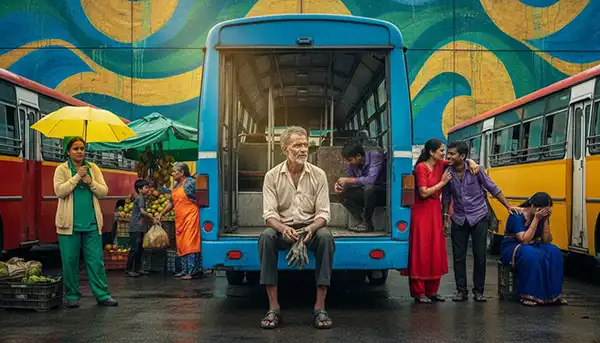
What twenty hard lessons actually teach you
Most life advice fails because it tells you what to do without telling you how to become the kind of person who can do it. You can memorize a list of twenty lessons and still repeat the same mistakes, because the list does not change the underlying pattern. The pattern is passive. It waits for clarity, for permission, for the right moment. The alternative is a skill I call opportunity literacy: the capacity to see where your actions can influence an outcome, to create openings that are not already there, and to act before certainty arrives. Opportunity literacy is not optimism. It is not positive thinking. It is a disciplined way of paying attention to the space between what is and what could be, and then stepping into that space.
The twenty lessons that follow are not a checklist. They are a description of what changes when you stop waiting and start participating. Some of them are psychological. Some are practical. All of them are connected. The connection is the point.
Waiting is a tax on the possible
The most expensive habit in a human life is not failure. It is waiting. Waiting for the right time. Waiting for the right person. Waiting for the right feeling. Waiting for someone else to open the door. The research on locus of control, developed by Julian Rotter in the 1950s, has consistently shown that people who believe their outcomes are determined by their own actions do better than people who believe their outcomes are determined by external forces. The difference is not talent. It is orientation. The person with an internal orientation acts. The person with an external orientation waits. The waiting feels safe. It is actually a slow surrender.
Opportunities rarely knock. They are not distributed by a benevolent universe to those who sit still. They are created, noticed, and pursued by people who are already moving. A 2025 study published in the Journal of Vocational Behavior found that proactive personality—the tendency to take initiative and scan for opportunities—predicted career success even after controlling for cognitive ability and socioeconomic background. The proactive person does not wait for the opportunity to be obvious. They make it obvious by acting first.
Failure pays in a currency you cannot see
Failure is not the opposite of success. It is the raw material. The research on post-traumatic growth, developed by Richard Tedeschi and Lawrence Calhoun at the University of North Carolina at Charlotte, has shown that people who experience significant adversity sometimes report profound positive changes: deeper relationships, greater appreciation for life, increased personal strength. The growth is not guaranteed. It is not a reward for suffering. But it is common enough to be considered a normal human response, not an exception.
The key is not the failure itself. It is what you do with it. Carol Dweck at Stanford University spent decades studying implicit theories of intelligence. Her research showed that people who believe their abilities are fixed avoid challenges because failure would be a verdict. People who believe their abilities are developable seek challenges because failure is information. The failure is the same. The meaning is different. The meaning determines the trajectory.
The negativity bias is not a life sentence
The human brain is wired to notice threats more quickly than opportunities. This is not a character flaw. It is an evolutionary inheritance. Roy Baumeister and his colleagues at Florida State University reviewed decades of research and concluded that bad events carry greater psychological weight than good ones. A single criticism can drown out a dozen compliments. A looming deadline can erase the satisfaction of completed work.
But the bias is not destiny. The research on learned optimism, developed by Martin Seligman at the University of Pennsylvania, has shown that people can be taught to recognize and challenge their pessimistic interpretations. The Penn Resiliency Program, evaluated across multiple studies, has shown that teaching people to think more realistically about setbacks reduces symptoms of depression and anxiety. The change is not a matter of repeating affirmations. It is a matter of learning to notice the automatic interpretation and to evaluate it against evidence.
If the negativity becomes persistent, if it interferes with sleep, appetite, work, or relationships, the appropriate response is not to try harder to think positively. It is to speak with a mental health professional who can assess what is happening and recommend an appropriate course of care.
Perspective is not a lens; it is the room
You do not see the world as it is. You see it as you are. The research on cognitive reappraisal, developed by James Gross at Stanford University, has shown that people who habitually reinterpret stressful situations in less threatening terms experience lower levels of negative emotion and better psychological outcomes. The reinterpretation is not denial. It is the recognition that every event has multiple valid interpretations, and that some are more useful than others.
A job rejection can mean “I am not good enough” or “this was not the right fit.” A failed project can mean “I am incompetent” or “I learned something that will help the next attempt.” The event is neutral. The meaning is chosen. The choice is not always conscious, but it can become conscious with practice. The practice is the skill.
Gratitude is one of the most reliable ways to shift the room. Robert Emmons at the University of California, Davis, has spent decades studying gratitude. His research has consistently found that people who regularly record things they are thankful for report better sleep, lower stress, and greater life satisfaction. The practice does not deny difficulty. It simply refuses to let difficulty occupy the entire field of vision.
Joy is not a reward for finishing; it is fuel for continuing
Most people treat enjoyment as something that happens after the work is done. The research suggests the opposite. Barbara Fredrickson at the University of North Carolina at Chapel Hill developed the broaden-and-build theory, which shows that positive emotions expand the range of thoughts and actions available to a person. Joy makes you playful. Curiosity makes you exploratory. Gratitude makes you reach toward others. These states are not distractions from the work. They are the conditions that make the work sustainable.
The practical implication is that you do not need to postpone pleasure until the project is complete. You need to build pleasure into the process. A 2025 study published in the Journal of Happiness Studies found that participants who intentionally scheduled small enjoyable activities throughout the week reported higher motivation and lower burnout than participants who saved their enjoyment for the weekend. The enjoyment was not a reward. It was a resource.
Help someone today, and watch what returns
The most reliable way to feel better is not to focus on yourself. It is to focus on someone else. The research on prosocial behavior has consistently found that helping others improves mood, reduces stress, and increases life satisfaction. A 2025 study published in the Journal of Happiness Studies examined the relationship between volunteering and well-being across 3,000 adults. The findings showed that participants who volunteered regularly reported higher life satisfaction, lower depression, and greater sense of purpose than those who did not. The effect was independent of income and social support.
The mechanism is not mysterious. Helping others interrupts rumination. It creates connection. It provides evidence that you are capable and useful. And it often returns in ways that are not visible at the moment. The person you help today may not help you tomorrow. But the habit of helping builds a reputation, a network, and a self-concept that makes help more likely to arrive when you need it.
Passion is not a feeling. It is a practice.
The advice to “follow your passion” is common and often misleading. It suggests that passion is something you find, like a lost object. The research suggests something different. Passion is something you develop, through engagement, mastery, and meaning. Angela Duckworth at the University of Pennsylvania studied grit—perseverance and passion for long-term goals—and found that it predicted success beyond talent. But the passion in her model is not a fleeting enthusiasm. It is a sustained commitment that grows through practice.
The practical implication is that you do not need to wait for passion to arrive before you begin. You begin, and the passion follows. You get good at something, and the goodness creates the love. The love is not the prerequisite. It is the reward.
You have more talents than your résumé admits
Most people identify one or two things they are good at and organize their lives around those things. The research on multiple intelligences, proposed by Howard Gardner at Harvard University, suggests that human ability is broader than the narrow band that standardized tests measure. Linguistic, logical-mathematical, spatial, musical, bodily-kinesthetic, interpersonal, intrapersonal, and naturalistic abilities are not the same thing. They are different systems. The person who is mediocre at math may be extraordinary at reading people. The person who cannot draw may be able to build.
The problem is not lack of talent. The problem is lack of exploration. The person who finds one thing they are good at often stops looking. The person who keeps looking finds more. The research on adult development has shown that people continue to develop new capacities well into middle age and beyond. The brain remains plastic. The potential remains available.
Money is a tool, not a scoreboard
Money is a threshold variable. Below a certain level, it dominates everything. Above that level, it recedes. The research on income and well-being, conducted by Daniel Kahneman and Angus Deaton, found that emotional well-being rises with income up to a point, but beyond that point the relationship flattens. Money can buy comfort. It cannot buy meaning. It can buy time. It cannot buy connection. It can buy a house. It cannot buy a home.
The mistake is not wanting money. The mistake is treating money as the measure of a life. The person who pursues money as an end will find that the end is empty. The person who pursues meaningful work, and allows money to be a byproduct, often finds both.
No one builds a life alone
The myth of the self-made individual is one of the most destructive stories in modern culture. It suggests that success is a solo achievement. The research on social networks and career outcomes has consistently shown the opposite. A 2025 study published in Nature Human Behaviour examined the relationship between network diversity and career success across 20,000 professionals. The findings showed that people with more diverse networks—connections across different industries, backgrounds, and perspectives—had higher incomes, more promotions, and greater job satisfaction.
The network is not a luxury. It is infrastructure. The person who invests in relationships is building the support system that will carry them through difficulty and open doors that qualifications alone cannot open. The person who neglects relationships is building a life that will be fragile when the storms come.
Open-mindedness is a survival skill
The world is too complex for any single perspective to capture. The person who believes they already know everything has stopped learning. The person who remains curious continues to adapt. The research on intellectual humility, conducted by researchers including Tenelle Porter at the University of California, Davis, has shown that people who can acknowledge the limits of their own knowledge are more likely to seek out new information, revise their beliefs, and learn from disagreement.
Open-mindedness is not the same as having no convictions. It is the willingness to hold convictions lightly enough to examine them. The person who can say “I might be wrong” is the person who can actually learn.
Words are not neutral; they are instructions
The language you use shapes the reality you experience. A 2025 study published in the Journal of Experimental Psychology: General found that participants who were instructed to describe a stressful event using neutral rather than emotional language showed lower physiological reactivity and better subsequent performance. The words were not just descriptions. They were commands to the nervous system.
The practical form of this is unglamorous. Notice the words you use when you talk about yourself. “I am terrible at this” is a verdict. “I have not learned this yet” is a direction. The first closes the door. The second keeps it open. The difference is not positive thinking. It is accuracy.
Reward the effort, not just the outcome
The research on motivation has consistently found that people who reward themselves for effort, rather than only for outcomes, are more persistent and more resilient. The outcome is not always under your control. The effort is. The person who only celebrates the win will stop trying when the wins become rare. The person who celebrates the attempt will keep attempting.
The reward does not need to be large. A break. A treat. A moment of recognition. The reward is a signal. It says: the effort mattered. The effort always matters.
Small acts change the world by changing you
The final lesson is the one that seems the most grandiose and is actually the most practical. You can change the world. Not by becoming famous. Not by leading a movement. By changing your own life. The research on social contagion has shown that behaviors and emotions spread through networks. A 2025 study published in Science Advances examined the spread of prosocial behavior across 5,000 participants. The findings showed that acts of kindness spread through the network, increasing the likelihood that recipients would perform their own acts of kindness. The effect reached three degrees of separation.
The person who changes their own life changes the lives of the people around them. The person who becomes kinder makes kindness more likely. The person who becomes braver makes bravery more possible. The world is not changed by a single grand gesture. It is changed by the accumulation of ordinary choices made by ordinary people who decided to stop waiting.
The twenty lessons are not a formula. They are a description of a direction. The direction is toward agency. The direction is toward participation. The direction is toward the life that is yours. The beginning is available right now. The beginning is the next choice. The choice is yours.