The 25th frame is a ghost story we tell about our own minds
The claim is always the same. A single frame, flashed for a fraction of a second, slips beneath conscious awareness and plants a command in the subconscious. Buy popcorn. Drink Coca-Cola. Vote for this candidate. The story has circulated for nearly seventy years, and it has never been true. But the fact that it is false does not make it unimportant. The myth survives because it tells us something we already suspect about ourselves: that we are not fully in control, that something beneath the surface is making decisions we do not authorize. The 25th frame is not a technology. It is a mirror. And what it reflects is our anxiety about the hidden machinery of our own minds.
The confession that started everything
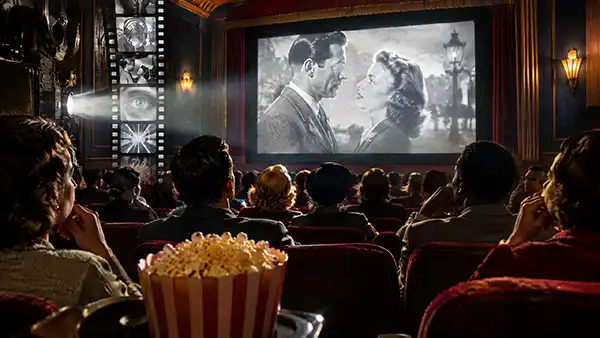
In 1957, a market researcher named James Vicary held a press conference in New York. He claimed that he had conducted an experiment in a movie theater in Fort Lee, New Jersey. During the screening, a machine had flashed the words “EAT POPCORN” and “DRINK COCA-COLA” on the screen for one three-thousandth of a second, every five seconds. The result, he said, was a dramatic increase in concession sales. Popcorn sales rose by more than fifty percent. Coca-Cola sales rose by nearly twenty percent.
The story was reported widely. It appeared in newspapers, magazines, and eventually in Vance Packard’s 1957 bestseller The Hidden Persuaders. The public was outraged. The idea that advertisers could bypass conscious consent and manipulate behavior from the shadows was terrifying. The Federal Communications Commission held hearings. Congress considered legislation. The term “subliminal advertising” entered the cultural vocabulary.
There was only one problem. The experiment never happened. Vicary was unable to reproduce his results. He refused to provide the raw data. In 1962, he admitted to a journalist that the whole thing had been a fabrication. He had invented the experiment to drum up business for his struggling research firm. The confession was buried in a trade publication. The myth was already loose in the world, and it has never been recaptured.
The American Psychological Association formally rejected the claim in 1958. The scientific consensus was clear: subliminal commands of the kind Vicary described do not work. But the consensus never reached the public. The myth was too satisfying, too useful as a metaphor for the feeling of being manipulated by forces beyond our control. It became folklore. And folklore does not require evidence.
What the research actually shows about the unconscious
The fact that Vicary lied does not mean the unconscious mind is a sealed vault. It means the unconscious is not a command center waiting for instructions. The research on subliminal perception has produced a more modest and more interesting picture.
Anthony Greenwald at the University of Washington spent decades studying unconscious cognition. In 1996, he and his colleagues published a paper in Science describing what they called the “subliminal sandwich” technique. Subjects were shown a string of consonants, then a priming word, then another string of consonants. The priming word flashed so briefly that subjects could not report seeing it. Then subjects were asked to identify a target word as quickly as possible. When the priming word and the target word were related—two female names, for example—subjects identified the target more quickly. When they were unrelated, subjects made more errors. The effect was real and reproducible.
But Greenwald was careful about what the finding meant. “What we see indicates that unconscious cognition is capable of only simple mental operations compared to the powers of conscious thought,” he said. The influence of a subliminal message is fleeting, lasting perhaps a tenth of a second. It can prime a response. It cannot plant a command. It can make a word easier to recognize. It cannot make you buy a product you do not want.
The distinction is crucial. Priming is not persuasion. It is a nudge, not a push. The research on subliminal priming has consistently found that the effects are small, short-lived, and dependent on the person already being motivated to do the thing the prime suggests. A subliminal message cannot make you hungry. It can only make the idea of food slightly more accessible if you were already hungry.
Why the myth refuses to die
The 25th frame myth persists because it answers a question that the science does not fully resolve. The question is not whether subliminal messages work. The question is how much of our behavior is driven by processes we do not control. And the honest answer is: a lot.
The research on implicit bias, automaticity, and dual-process thinking has shown that much of human behavior operates below the threshold of conscious deliberation. Daniel Kahneman at Princeton University described two systems of thought: System 1, which is fast, automatic, and intuitive; and System 2, which is slow, deliberate, and effortful. Most of our daily decisions are made by System 1. We do not consciously choose to interpret a facial expression as hostile or friendly. We do not consciously choose to feel uneasy in a crowded room. The brain processes the information and produces the feeling before conscious awareness has time to intervene.
The 25th frame myth takes this real phenomenon and exaggerates it into a conspiracy. It says that someone else is controlling the automatic processes. It says that the hidden machinery can be hijacked. The myth is not a description of how advertising works. It is a projection of our own unease about how we work. We know that we are not fully transparent to ourselves. We know that our reasons are often post-hoc rationalizations. The myth gives that unease a villain. It says: it is not you. It is them. They are doing it to you.
The real world of hidden influence
The 25th frame is not used in advertising because it does not work. But hidden influence is real. It just does not look like a flashing frame. It looks like the design of a menu. It looks like the placement of products on a shelf. It looks like the default option in a software installation. It looks like the social proof of a five-star rating. It looks like the emotional framing of a news story.
The research on choice architecture, developed by Richard Thaler and Cass Sunstein, has shown that small changes in how options are presented can produce large changes in behavior. The default option is the most powerful. If you are automatically enrolled in a retirement savings plan, you are more likely to save. If you have to opt in, you are less likely to save. The difference is not a hidden command. It is a structural feature of the decision environment. It works because people are busy, distracted, and prone to inertia. It works because System 1 takes the path of least resistance.
The same principles apply to advertising. The most effective advertising does not hide its message. It repeats it. It associates the product with positive emotions. It uses attractive people and pleasant music. It creates a sense of familiarity and trust. The influence is not subliminal. It is supraliminal. It is right there in front of you, and it works because you are not paying attention to how it works.
When the fear becomes the problem
There is a point at which the fear of hidden influence stops being a reasonable response to a real phenomenon and becomes a source of distress. The research on conspiracy thinking and paranoid ideation has shown that the belief in hidden control is often a manifestation of anxiety. The anxious mind looks for patterns. It looks for agents. It looks for someone to blame. The 25th frame myth is a ready-made pattern. It explains the feeling of helplessness without requiring any change in behavior.
If the fear of being manipulated has become persistent, if it interferes with sleep, appetite, work, or relationships, if it has turned into a chronic suspicion of every advertisement, every news broadcast, every political message, the appropriate response is not to try harder to detect the hidden signals. It is to speak with a mental health professional who can help you assess what is happening and develop strategies for managing the anxiety. The research on anxiety disorders and cognitive behavioral therapy is robust. Support is not a sign that you are being naive. It is a recognition that some fears are easier to carry with a guide.
The frame that was never there
The 25th frame is a ghost story. It was invented by a man who needed attention. It was amplified by a public that needed a villain. It was kept alive by a culture that finds the idea of unconscious influence both terrifying and irresistible. The story tells us more about ourselves than it does about advertising. It tells us that we are not sure we trust our own minds. It tells us that we suspect we are being played. It tells us that the line between persuasion and manipulation feels thinner than we would like.
The line is real. Persuasion is an argument. Manipulation is a trick. The difference is consent. The 25th frame would be manipulation because it bypasses consent. But the 25th frame does not exist. The tricks that do exist are mostly visible. The default option is visible if you look. The menu design is visible if you look. The emotional music is audible if you listen. The problem is not that the influence is hidden. The problem is that we are not looking.
The ghost story is comfortable because it absolves us of responsibility. It says that the game is rigged and we are helpless. The research says something harder. The game is designed. The design influences us. But the design is not invisible. It is not magic. It is a set of choices made by people who understand how attention works. And we can learn to see it. The seeing is the practice. The practice is the freedom. The freedom is not the absence of influence. It is the presence of awareness. And awareness, unlike the 25th frame, is real.