The Harbor Is a Habit, and the Map Is a Lie
Field note: Gloucester, Massachusetts, 6:14 a.m.
The fishing boats are leaving the harbor. I count seven. They move in a line, one after another, following the channel that has been dredged and marked and maintained for two hundred years. The channel is safe. The channel is known. The captains do not need to look at their charts. They know the depth of the water, the location of the rocks, the direction of the current. The channel is not a choice. It is a habit. The boats will go out, fish, and return. They will follow the same route tomorrow. They will follow it until the fish run out or the boat sinks or the captain dies. The channel is the shoreline’s promise. Stay close, and you will survive. Stay close, and you will never see anything new.
Field note: The map on the wall
The harbormaster’s office has a map on the wall. It is a modern chart, printed by the National Oceanic and Atmospheric Administration. The coastline is drawn in detail. Every rock, every shoal, every channel is marked. The open ocean is a blank expanse of blue. There is no detail in the blue. The blue is not empty. The blue is unmapped. The blue is where the boats do not go unless they have a reason. The map tells the captains where the dangers are. It does not tell them where the possibilities are. I have been thinking about this map because I have been thinking about the maps we all carry inside our heads. I call these inherited cartographies: the internal maps of what is safe, what is possible, and what is expected that we absorb from our families, our communities, and our cultures before we have the capacity to question them. Inherited cartographies are not lies. They are accurate descriptions of the coastline. They are blank descriptions of everything else.
Field note: The captain who went vertical
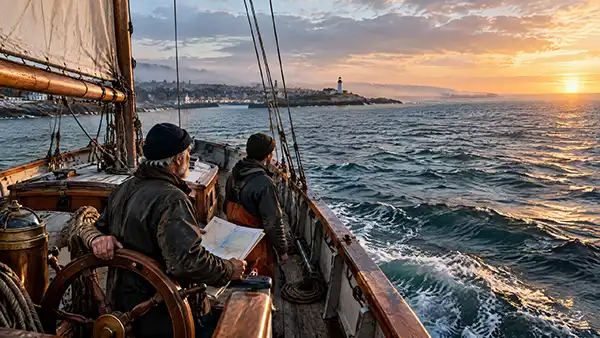
There is a story in this town about a captain who left the channel. His name was Elias. He was a fisherman, like his father and his grandfather before him. He knew the coastline the way you know your own hands. He knew the habits of the fish, the rhythms of the tide, the signs of a coming storm. He was successful. He was respected. He was safe. And then one day, he pointed his boat toward the open water and did not turn back. He did not have a map. He did not have a destination. He had a question. He wanted to know what was out there. He was gone for three weeks. When he returned, he had a story. The story was not about fish. It was about a current he had discovered, a current that carried warmer water from the south. The current was full of species that no one in Gloucester had ever seen. The current changed the town. The town grew rich on the new fish. The map was redrawn. The channel was widened. And Elias became a legend.
I do not know if the story is true. It does not matter. The story is a parable. The parable is about the difference between the coastline and the open sea. The coastline is where the maps are. The open sea is where the maps are not. The person who stays on the coastline will survive. The person who goes vertical will not always survive. But the person who goes vertical is the only one who can discover a new world.
Field note: The research on exploration
The research on exploratory behavior has shown that the willingness to leave the familiar is associated with higher creativity, greater resilience, and more meaning in life. A 2024 study published in the Journal of Research in Personality examined the relationship between openness to experience and psychological well-being across 2,200 adults. The findings showed that openness predicted greater life satisfaction, more positive emotions, and a stronger sense of purpose. The mechanism was not novelty for its own sake. It was the accumulation of diverse experiences that provided a broader perspective and a richer sense of self. The person who explores is not just collecting experiences. They are building a self.
The research on cognitive flexibility, developed by researchers including Adele Diamond at the University of British Columbia, has shown that the capacity to shift between mental sets is a core component of executive function. The person who can hold multiple perspectives is more creative, more resilient, and better at solving complex problems. The person who is locked into a single perspective is rigid, defensive, and prone to error. The coastline is a single perspective. The open sea is multiple perspectives. The person who goes vertical is training the brain to be flexible.
A 2025 study published in Trends in Cognitive Sciences examined the relationship between exploration and cognitive flexibility. The findings showed that participants who engaged in novel activities showed increased connectivity between the prefrontal cortex and the hippocampus, regions associated with flexible thinking and memory integration. The novelty was the mechanism. The mechanism was the change.
Field note: The fear that keeps you in the channel
The fear is not irrational. The open sea is dangerous. The storms are real. The rocks are real. The possibility of failure is real. The research on loss aversion, developed by Daniel Kahneman and Amos Tversky, has shown that people weigh losses more heavily than gains. The pain of losing something is psychologically twice as powerful as the pleasure of gaining something of equal value. The asymmetry is not a character flaw. It is a survival mechanism. The person who stays on the coastline is not a coward. They are a rational agent responding to a real risk.
But the rationality is incomplete. The loss aversion is calculated against the wrong baseline. The person who stays on the coastline is not avoiding loss. They are avoiding the possibility of loss while accepting the certainty of stagnation. They are trading the risk of failure for the guarantee of sameness. The trade feels safe because the loss is invisible. The loss is the life that was not lived. The loss is the self that was not built. The loss is the new world that was not found.
A 2025 study published in Journal of Behavioral Decision Making examined the relationship between loss aversion and life satisfaction across 2,400 adults. The findings showed that participants who scored high on loss aversion reported lower life satisfaction and lower levels of personal growth, even when their objective circumstances were stable and secure. The security was real. The cost was also real.
Field note: The vertical move is not a single leap
The vertical move is not a leap off a cliff. It is a calculated departure from the known. The calculation is not about eliminating risk. It is about accepting the right risk. The research on deliberate practice, developed by Anders Ericsson at Florida State University, has shown that mastery is built through focused, effortful work on tasks just beyond current ability. The person who stays in the channel is practicing the same task. They are refining the same skill. They are not stretching. The person who goes vertical is stretching. They are working at the edge of their capacity. The edge is uncomfortable. The edge is where growth happens.
A 2025 study published in Psychological Science examined the relationship between comfort zone expansion and skill development. The findings showed that participants who consistently engaged in activities slightly beyond their current ability showed greater long-term improvement than participants who stayed within their comfort zone. The discomfort was the mechanism. The mechanism was the growth.
Field note: The inherited cartography that keeps you small
The inherited cartography is not always about geography. It is about the boundaries of the self. The person who was told they were not good at math will avoid math. The person who was told they were not creative will avoid creative work. The person who was told they were not lovable will avoid intimacy. The map is internal. The map is accurate to the coastline of the past. It is blank for the open sea of the future.
The research on self-fulfilling prophecies, developed by Robert Merton at Columbia University, has shown that beliefs shape behavior, and behavior shapes outcomes. The person who believes they are not good at math will not study math. They will not ask questions. They will not seek help. They will fail, and the failure will confirm the belief. The cycle is self-reinforcing. The cartography is the cause.
The way out of the cycle is not positive thinking. It is evidence. The person who believes they are bad at math must have a success. The success must be real. The success must be specific. The success must be personally experienced. The evidence is the new map. The new map is the beginning.
Field note: When the shoreline is not a choice
There is a limit to what self-directed exploration can accomplish. Some people are not on the shoreline because they are afraid. They are on the shoreline because they are trapped. The research on structural inequality, poverty, and trauma has documented the ways in which external conditions constrain agency. The person who is working three jobs does not have the luxury of exploring the unknown. The person who is caring for a sick parent does not have the freedom to sail away. The inherited cartography framework can become another form of victim-blaming if it ignores the real barriers.
If you are experiencing persistent anxiety, depression, hopelessness, or distress that interferes with sleep, appetite, work, or relationships, the problem is not a lack of courage. It is a clinical condition that requires professional care. The research on cognitive behavioral therapy, trauma-informed care, and anxiety treatment is robust. Effective support exists. The appropriate response is not to try harder to leave the shore alone. It is to speak with a mental health professional who can assess what is happening and recommend an appropriate course of care. The support is not a sign that you have failed to be brave. It is a recognition that some shores are guarded by forces larger than any one person can overcome alone.
Field note: The harbor at dusk
The fishing boats are returning. I count seven. They move in a line, one after another, following the channel back to the dock. The channel is safe. The channel is known. The boats are full of fish. The captains are tired. They will sleep, and they will wake, and they will do it again. The channel is not a choice. It is a habit.
But I notice something. One of the boats is not in the line. It is coming from the north, from the open water. It is smaller than the others. It is older. It is moving slowly. The captain is standing at the bow, looking at the harbor as if he has never seen it before. He has been gone for a while. He has a story. The story is not about fish. The story is about the current. The current is the new world. The new world is always there. The question is whether you are willing to go vertical to find it.
The map on the wall is still the same. The blue is still blank. But the captain knows something the map does not. The blue is not empty. The blue is where the story begins.