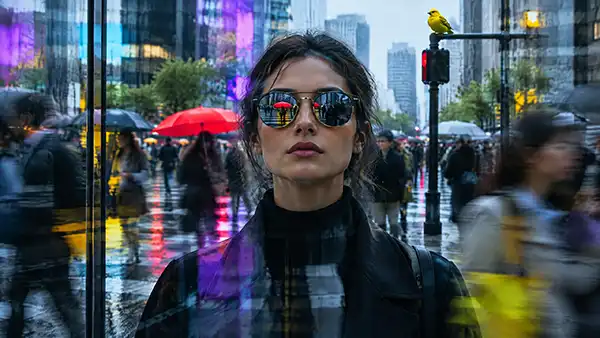
The Boy Who Saw More Without Eyes
The boy in the back seat of the car was blind. The man who asked him for directions was not. The boy told him where the bakery was. The man was confused. The boy explained: the linden trees, the magnolias, the bread. The man turned and saw the cane. The boy said he missed seeing. The man said he was no longer sure he saw better. This is a story about perception. It is not about eyes. It is about attention. I call the skill the boy possessed sensory literacy: the practiced capacity to read the world through all available channels, and to recognize that sight is only one of them. Most sighted people have never developed it. They look, but they do not perceive. They see, but they do not understand.
What the blind boy heard that the stranger missed
The stranger was lost in a small town he had never visited. He pulled over beside a parked car. A boy sat alone in the back seat. The stranger asked for directions to the bakery. The boy said he was also a stranger. But he said the bakery was probably to the right. The man asked how he knew. The boy said he could smell the linden blossoms. He could hear the birds. He said the scent was too strong to come from a single tree. He said magnolias were mixed in. He said if the man breathed deeply, he would smell fresh bread.
The man breathed deeply. He smelled it. He turned to thank the boy and saw the cane. The boy was blind. The boy had been blind for three years. He had lost his sight in an accident. He said he missed seeing more than anything. He asked if the man’s eyes were healthy. The man said he was no longer sure. He said the only thing he was sure of was that the boy saw better than he did.
This is not a story about a miraculous sense. It is a story about a neglected one. The boy did not have superhuman powers. He had attention. He had learned, through necessity, to read the world through the channels that remained open to him. The man had eyes. He had not learned to use them. He had been looking at the road. He had not been smelling the trees. He had not been listening to the birds. He had been navigating. Navigation is not perception. It is the reduction of the world to a destination.
Research on sensory compensation
The research on blindness and sensory compensation has documented what the boy demonstrated. A 2025 review in the journal Neuroscience & Biobehavioral Reviews synthesized decades of studies on cross-modal plasticity. The findings showed that people who lose one sense often develop heightened abilities in the remaining senses. The enhancement is not magical. It is neurological. The brain reallocates resources. Areas that were dedicated to processing visual information are repurposed for auditory, tactile, and olfactory processing. The blind brain does not have a hole where vision used to be. It has a reorganization.
Brigitte Röder at the University of Hamburg has spent decades studying this phenomenon. Her research has shown that blind individuals often outperform sighted individuals on tasks that require auditory localization, tactile discrimination, and olfactory identification. The differences are not small. They are measurable. They are consistent. They are the result of practice. The blind person is not born with a better nose. They have simply used the nose they have more than the sighted person has used theirs.
A 2025 study published in Nature Human Behaviour examined the neural mechanisms of this compensation. The researchers found that blind participants showed greater connectivity between the auditory cortex and the prefrontal cortex, a pathway associated with attention and working memory. The connectivity was not innate. It developed over time. The brain had learned to listen more carefully because it could not rely on seeing.
The boy in the car had not been trained in a laboratory. He had been trained by his own life. He had learned that the world was still available to him, but only if he paid attention. The man had not learned that lesson. He had eyes. He had never needed to learn. The boy had no eyes. He had learned everything.
Why sight can blind us
The man in the story was not stupid. He was not careless. He was a sighted person in a sighted world. He had been trained to prioritize vision above all other senses. He had been taught that seeing is believing. He had been taught that the eyes are the window to the soul. He had been taught that blindness is a tragedy. He had not been taught that sight can be a filter.
The research on inattentional blindness, pioneered by Daniel Simons and Christopher Chabris, demonstrates this with uncomfortable precision. In their famous experiment, participants watched a video of people passing basketballs and were asked to count the passes. A person in a gorilla suit walked through the scene, stopped, faced the camera, and walked off. Half the participants never saw the gorilla. They were looking, but they were not seeing. Their attention was elsewhere. The gorilla was invisible because it was not the task.
The man in the story was counting passes. He was looking for a bakery. He was not looking for linden trees. He was not listening for birds. He was not smelling for magnolias. He was navigating. The boy was not navigating. The boy was perceiving. The difference is not the eyes. It is the orientation.
A 2025 study published in Psychological Science examined the relationship between visual attention and environmental awareness. The findings showed that participants who were instructed to focus on a specific goal—finding a location, completing a task, reaching a destination—were significantly less likely to notice unexpected sensory information in their environment. The goal narrowed the attention. The narrowing was efficient. It was also blinding.
The man was efficient. He found the bakery. But he missed the linden trees. He missed the magnolias. He missed the birds. He missed the bread before he was told to smell it. He missed the boy’s blindness until he turned around. He was a sighted man in a sighted world, and he had learned to see only what he was looking for.
Seeing is not the same as understanding
The boy saw the man’s blindness before the man saw the boy’s. The boy heard the pause in the man’s voice. He heard the change in the breathing. He heard the moment when the man understood. The boy had been blind for three years. He had learned to read the world through sound. He had learned to read people through the small shifts in their voices. He had learned that seeing is not the same as understanding.
The research on empathy and perspective-taking has shown that understanding another person requires more than observation. It requires inference. Daniel Batson at the University of Kansas spent decades studying empathy and altruism. His research showed that people who are asked to take the perspective of another person become more likely to help. The perspective-taking is not a feeling. It is a cognitive act. It is the deliberate attempt to imagine the world from another person’s point of view.
The boy did not need to imagine the man’s point of view. He could hear it. The man’s point of view was in his voice. The boy had learned to listen. The man had not learned to listen. The man had learned to look. Looking is not listening. Looking is not understanding.
The boy said he missed seeing. The man said he was no longer sure he saw better. The man was not being polite. He was being accurate. The boy had demonstrated a kind of perception that the man had never developed. The boy had shown that sight is not the only way to see. The man had been forced to confront the limits of his own perception.
What the boy taught the man
The boy did not set out to teach the man anything. He was simply answering a question. He was sitting in a car. He was smelling the air. He was hearing the birds. He was being himself. The man asked. The boy answered. The answer revealed more than the man expected.
The man drove to the bakery. He bought bread. He drove back. He did not see the boy again. But he remembered the boy. He remembered the lesson. The lesson was not about blindness. The lesson was about attention. The lesson was that the world is always speaking. The question is whether we are listening.
The research on mindfulness, developed by Ellen Langer at Harvard University, has shown that the capacity to notice what is new and uncertain is a skill that can be trained. Langer calls it mindful learning. The opposite is mindless repetition. The person who does the same thing every day while assuming they already know how to do it is not actually doing it. They are replaying a recording. The boy in the car was not replaying a recording. He was present. The man was not present. He was driving.
Practicing sensory literacy
The practice of sensory literacy is not complicated. It is simply the decision to use all the senses, not just the eyes. It is the decision to pause before the label solidifies. It is the decision to ask what else is here. What else can I hear? What else can I smell? What else can I feel? What else can I notice?
The practice can be small. Before you leave the house, pause. Close your eyes for ten seconds. Listen. Smell. Feel the air. Then open your eyes. You will notice things you had been walking past. You will notice the texture of the morning. You will notice the sound of your own breathing. You will notice the world.
The research on sensory training has shown that these small practices produce measurable changes. A 2025 study published in Frontiers in Psychology found that participants who engaged in a brief daily sensory awareness exercise reported higher levels of well-being and lower levels of stress. The mechanism was not the exercise itself. It was the interruption. The interruption of the automatic. The interruption of the blindness of habit.
The boy in the car had been interrupted by his accident. He had lost his sight. He had been forced to develop the other senses. He had not chosen the interruption. But he had chosen to respond to it. He had chosen to learn. He had chosen to develop the capacities that remained. The man had not been interrupted. He had not chosen to learn. He had been driving.
When the lesson is not enough
There is a limit to what a story can teach. The boy in the car was a fictional construction, a parable about attention. But the reality of sensory loss is not a parable. It is a condition. People who lose their sight, their hearing, or their mobility face real challenges that cannot be solved by mindfulness alone.
If you are experiencing persistent sadness, anxiety, or distress related to sensory loss, aging, or any change in your physical capacities, the appropriate response is not to try harder to be grateful for what remains. It is to speak with a mental health professional who can help you assess what is happening and develop strategies for moving forward. The research on adjustment to disability and chronic illness is robust. Support is not a sign that you have failed to learn the lesson. It is a recognition that some lessons are easier to learn with a guide.
The boy said he missed seeing. That was true. He was not pretending. He was not pretending that blindness was a gift. He was simply using the gifts he had. The man said he was no longer sure he saw better. That was also true. He was not pretending that sight was a burden. He was simply recognizing that sight was not the same as perception.
The lesson is not that blindness is better than sight. The lesson is that sight is not enough. The lesson is that the world is available to all the senses. The lesson is that attention is the real window. The lesson is that the boy in the car, who could not see, saw more than the man who could.
The man drove away. The boy stayed in the car. The linden trees kept blooming. The birds kept singing. The bakery kept baking bread. The world kept speaking. The question is whether anyone was listening.