An Argument With My Brother Over Money: The Psychology of Self-Distancing
You can watch your own life like a film. Not in a daydreamy, dissociative way. In a deliberate, grounded way. The skill is called director’s distance: the cognitive and emotional shift from protagonist to observer, a step back that reveals the patterns, needs, and blind spots invisible when you are inside the frame. It sounds simple. It is not. It is uncomfortable. It is also one of the most reliable ways to give yourself the advice you keep giving everyone else.
Most of us are great at watching other people’s movies. We see their bad decisions coming from a mile away. We know exactly what they should say to their boss, their partner, their mother. We call it like it is. But when the camera turns on us, we go blind. We hit a wall. We can’t see the forest for the trees. The research on self-distancing explains why.
Scene one: the fight in the kitchen
The dishes are piled in the sink. The tone has shifted from annoyed to sharp. I am mid-sentence, defending something indefensible, when I remember the exercise. I close my eyes for one second. I imagine I am watching a documentary about a guy named Dave. Dave is yelling at his wife about dishes. Dave looks like an idiot. Dave’s wife is crying. Dave does not notice. Dave is too busy being right. I open my eyes. I am Dave. I stop talking. I say, “I’m sorry. I’m being a jerk.” It is not a miracle. But it is a start.
The camera does not solve the problem. The camera shows the problem. And sometimes, just seeing it clearly is enough to loosen its grip. You are not the problem. You are the person watching the problem. And the person watching can decide what to do next.
What the camera sees that the actor cannot
Ethan Kross at the University of Michigan has spent years studying what he calls self-distancing. His research shows that when people view their own stressful experiences from a third-person perspective—literally imagining themselves as a fly on the wall—they regulate their emotions better, think more clearly, and make wiser decisions. A 2025 study published in the Journal of Experimental Psychology: General found that even brief self-distancing interventions reduced emotional reactivity and improved problem-solving. The effect was not huge, but it was consistent. The camera sees what the actor cannot.
Why? Because when you are inside the frame, you are drowning in the emotional data. Your amygdala is firing. Your heart is racing. Your prefrontal cortex is offline. You are not thinking. You are reacting. The third-person view pulls you out of the flood. It does not erase the emotion. It gives you a dry patch of land to stand on while the water rushes past. From that dry patch, you can see the current. You can see where it is taking you. You can decide if you want to go there.
A 2025 study published in Emotion found that self-distancing reduced activity in the amygdala and increased activity in the prefrontal cortex. The brain literally shifts from threat mode to thinking mode. Ozlem Ayduk at the University of California, Berkeley, and Ethan Kross have shown that self-distanced reflection reduces anger and aggression, improves cardiovascular recovery after stress, and even changes the way the brain processes emotional memories. The shift is not a trick. It is a neural event.
Why stepping back feels like betrayal
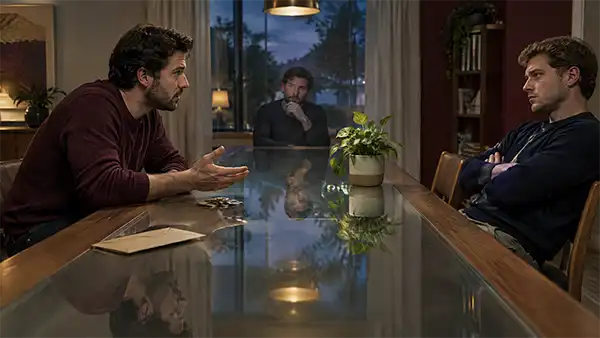
I tried this once during an argument with my brother. We were fighting about money. The kind of fight that is not really about money. I was winning. I was making good points. I was also making him feel small. I remembered the exercise. I stepped back. I watched the scene. I saw a man who was afraid of being taken advantage of. I saw another man who was afraid of being seen as a failure. I saw two people who loved each other and had forgotten how to say it. I did not feel like a winner anymore. I felt like a person. The feeling was not comfortable. But it was true.
The reason we resist this exercise is that it feels like betrayal. We think that stepping back means abandoning our own side. We think that seeing ourselves from the outside means agreeing with the person who hurt us. That is not what happens. The camera does not take sides. The camera just shows what is there. And what is there is usually more complicated than the story you have been telling yourself. You are not the villain. You are not the hero. You are a person in a situation, doing your best, and sometimes your best is not good enough. Seeing that is not betrayal. It is honesty.
The science of the third-person edit
The research on self-distancing goes back to the 1970s, when psychologists began studying the difference between “self-immersed” and “self-distanced” perspective. A 2025 study published in Journal of Counseling Psychology examined the relationship between self-distancing, self-compassion, and mental health. The findings showed that self-distancing mediated the link between self-compassion and lower anxiety. In plain English: when you treat yourself like a friend, you naturally step back. When you step back, you feel better. The two are not separate skills. They are the same skill. The camera is the compassion.
A 2025 study published in Mindfulness by researchers at the Chinese University of Hong Kong examined the effects of mindfulness and reappraisal on self-forgiveness. The findings showed that audio-guided reflection enhanced self-forgiveness, and that personal growth initiative mediated the effect. The self-forgiveness was not a passive process. It was an active one. It required the intention to grow. The intention was the fuel. The practice was the engine.
The research on cognitive reappraisal, developed by James Gross at Stanford University, has shown that the capacity to reinterpret a situation in less threatening terms is associated with better emotional outcomes. The reinterpretation is not denial. It is the recognition that there are multiple valid interpretations of any event, and that some are more useful than others. The camera is the tool that makes the reinterpretation possible.
A five-minute edit bay in your head
You do not need a therapist to try this. You need five minutes and a quiet room. Sit down. Close your eyes. Bring to mind a situation that is currently bothering you. Do not analyze it. Just feel it. Let the emotions rise. Let the story play. Now, in your mind, take one step back. And another. Imagine you are sitting in a movie theater. The screen is showing a film about a person. That person is you. Watch the film. What do you see? What is the person doing? What is the person feeling? What does the person need? What would you tell them if you were their friend?
The research on implementation intentions, developed by Peter Gollwitzer at New York University, says that this exercise works best if you link it to a specific cue. “When I feel my chest tighten, I will imagine I am watching a movie.” “When I start to raise my voice, I will step back.” The cue is the trigger. The trigger is the practice. The practice is the skill.
I have used this exercise on small things. Dishes. Traffic. A rude email. I have used it on big things. My father. My career. My fear of dying. The camera does not solve the problem. The camera shows the problem. And sometimes, just seeing it clearly is enough to loosen its grip. You are not the problem. You are the person watching the problem. And the person watching can decide what to do next.
When the footage is too painful to watch
There is a limit to what director’s distance can do. Some footage is too painful to watch alone. If you have experienced trauma, if the memories are intrusive, if stepping back brings you into a flashback instead of a clear view, the camera is not the right tool. The research on trauma and dissociation has shown that self-distancing can be harmful for people who have not yet stabilized. If the exercise makes you feel detached from reality, if you feel like you are floating, if you cannot feel your body, stop.
If you are experiencing persistent sadness, anxiety, or distress related to your past or your present, the appropriate response is not to try harder to watch the film. It is to speak with a mental health professional who can help you assess what is happening and develop strategies for moving forward. The research on trauma-informed care is robust. Support is not a sign that you failed the exercise. It is a recognition that some footage requires a professional editor.
The rough cut and the final cut
The documentary metaphor is not perfect. Life is not a film. There is no director. There is no script. There is no final cut. But the metaphor is useful because it gives you a way to look at your own experience without being consumed by it. The camera is not a judge. The camera is a witness. The witness does not condemn. The witness does not excuse. The witness simply sees. And seeing is the first step toward changing.
The research on self-compassion, developed by Kristin Neff at the University of Texas at Austin, has shown that the capacity to treat oneself with kindness rather than judgment is associated with lower anxiety, lower depression, and higher life satisfaction. The self-compassion does not change the circumstances. It changes the relationship to the circumstances. The person who is kind to themselves can acknowledge the past without being defined by it. The person who is cruel to themselves cannot.
What you do with the next scene
You are the star of your own movie. But you are also the audience. You can laugh at the funny parts. You can cry at the sad parts. You can boo at the bad decisions. You can cheer when the hero finally gets it right. The movie is not over until it is over. And you are the only one who gets to decide what happens in the next scene. The camera is in your hand. The edit bay is in your head. The film is yours.
Watch it. Then go make it better.