The Invisible Voltage: Why Being Constantly Connected Drains You
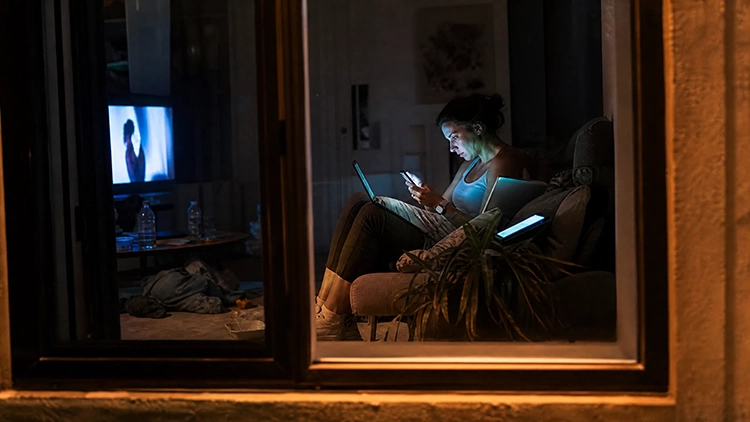
It is 11:42 PM on a Tuesday. The bedroom is pitch black, saved for the cold, pale blue glow illuminated against your face. Your thumb flicks upward on autopilot—once, twice, ten times. You aren’t actually looking for anything. You checked your work email twenty minutes ago, refreshed your news feed twice, and watched three short videos you won’t remember tomorrow.
Your eyes burn slightly. Your neck aches with a subtle, dull pressure. Deep down, a quiet voice whispers: Put the phone on the nightstand and close your eyes.
Instead, your thumb flicks again.
  BEDTIME / STILLNESS ──► (Micro-Anxiety: "What am I missing?")
│
▼
[ Automatic Thumb Scroll ]
│
▼
[ Blue Light & Brain Spike ]
│
▼
[ Delayed Sleep & Exhaustion ]
This late-night paralysis isn’t a lack of discipline. You are experiencing digital stress—a quiet, modern phenomenon where the very tools designed to simplify our lives keep our nervous systems on low-grade, non-stop alert.
The Evolutionary Mismatch in Your Pocket
To understand why your laptop and smartphone feel so mentally exhausting, it helps to look at how your brain was originally built.
For hundreds of thousands of years, the human nervous system adapted to process information in slow, contextual beats: the shift in the weather, the rustle of leaves, or the tone of a neighbor’s voice. Your brain learned to scan for threats, take action, and then settle back into long periods of calm.
       NATURAL EVOLUTIONARY RHYTHM            MODERN DIGITAL INPUT
┌─────────────────────────────┐         ┌─────────────────────────────┐
│ Threat ──► Action ──► Rest  │         │ Stream of Alerts & Signals  │
└─────────────────────────────┘         └──────────────┬──────────────┘
│
▼
┌─────────────────────────────┐
│ Chronic Alert / No Recovery │
└─────────────────────────────┘
Now, place that same evolutionary brain in front of a modern workstation. Within a single hour, you might receive three Slack pings, eight email notifications, two news alerts, and a pop-up calendar reminder.
To your primitive brain, every ping is a subtle signal demanding immediate attention. You aren’t just working; your nervous system is treating every notification like a small, unexpected intruder knocking at your door.
Digital Hypervigilance
A chronic state of physiological arousal caused by the continuous anticipation of incoming digital signals, messages, or news updates, preventing the nervous system from returning to baseline rest.
How Digital Stress Sneaks into the Body
Digital stress rarely shows up as a sudden panic attack. It enters quietly, disguising itself as routine daily fatigue.
Consider what happens during a typical afternoon at work. You are writing a document, but you have six tabs open in your browser. A message pops up in the bottom corner of your screen. You click it, read it, respond, and try to jump back to your document.
Physiologically, your brain doesn’t “multitask.” It rapidly switches focus, leaving behind a trail of attention residue. By 4:00 PM, you haven’t moved from your chair, yet you feel as exhausted as if you had run a marathon.
┌────────────────────────────────────────────────────────┐
│                   ATTENTION RESIDUE                    │
│                                                        │
│  Task A (Report) ──► Ping Interrupts ──► Task B (Email)│
│                            │                           │
│                            ▼                           │
│  Fragmented Focus Remains Trapped on Task A           │
└────────────────────────────────────────────────────────┘
Over time, this continuous friction manifests physically:
- The Silent Tension: Clenched jaws, elevated shoulders, and shallow chest breathing while staring at screens.
- Cognitive Fog: Struggling to recall simple details or retain focus during long conversations.
- The Phantom Urge: Reaching for your phone in line at the grocery store the moment there is five seconds of stillness.
Rethinking Our Relationship with Connection
We often tell ourselves that we can’t disconnect because of our jobs, our families, or the need to stay informed. But there is a clear difference between being available and being continuously exposed.
| The Misconception | The Reality |
| “I need to reply instantly to show I’m productive.” | Instant replies create an expectation of continuous disruption, degrading the quality of your deep work. |
| “Scrolling helps me unwind after a long day.” | Consuming high-speed digital content keeps your visual cortex and brain actively processing, preventing true rest. |
| “I am multitasking effectively.” | Rapid task-switching drains glucose in the brain, speeding up cognitive fatigue and raising stress levels. |
Reclaiming Your Attention: Small, Relatable Boundaries
You don’t need to throw your phone in a lake or move to a cabin in the woods to protect your peace. Reclaiming your energy comes down to creating clear physical and temporal buffers between you and your devices.
[ Unfiltered Notifications ] ──► (Endless Interruption) ──► [ Mental Burnout ]
│
▼
[ Curated Batching & Physical Distance ]
│
▼
[ Sustained Focus & Calm ]
1. Batch Your Incoming Inputs
Instead of leaving your email inbox open all day, close the tab and set specific windows—such as 10:00 AM and 3:00 PM—to review and respond. Communicating through designated windows trains others to respect your focus time while freeing your mind from constant checking.
2. Create Screen-Free Zones
Designate a few sanctuaries in your daily life where technology isn’t invited. Make your dining table and your nightstand phone-free zones. Replacing your phone with a simple analog alarm clock removes the urge to check notifications first thing in the morning.
3. Apply the 50-10 Movement Anchor
For every 50 minutes you spend staring at a screen, step away for 10 minutes. Walk to the window, stretch your spine, or drink a glass of water without bringing your phone along. Give your eyes and mind a chance to reset.
The Immediate Action: The 2-Minute Notification Purge
Take back control of your phone right now with this quick setup:
The 2-Minute Notification Purge
- Pick up your phone and open your notification settings.
- Turn off banner and sound alerts for every app that isn’t a direct communication from a real human (silence news apps, games, shopping apps, and social media notifications).
- Leave alerts on only for direct phone calls or urgent messaging channels.
The Freedom of Unplugging
Technology is an extraordinary tool when it serves your goals, but it becomes a silent drain when it controls your attention.
When you establish quiet spaces in your day, you aren’t missing out on the world. You are simply giving yourself permission to inhabit the one right in front of you.
What is one specific moment in your daily routine—whether it’s morning coffee or the half-hour before bed—where placing your phone in another room might give you back a sense of quiet?