The comfort tax: what you pay for choosing the safe option
The hospital bed in Ohio
The man in the hospital bed is seventy-eight years old. His name is Harold. He is dying, though not quickly. He has time. He has a wife who visits every day, two children who call on Sundays, and a retirement account that will outlast him. By every external measure, he has lived a successful life. He is not unhappy. He is not bitter. He is simply quiet in a way that his daughter noticed six months ago and has not been able to forget.
She asked him what he was thinking about. He said he was thinking about a job he did not take in 1974. He was twenty-seven then. A small company in California had offered him a position. It was risky. It paid less. It had no pension. His father told him to stay where he was. His friends told him he was crazy. He listened. He stayed. The company he did not join became a household name. The man who took the job instead of him retired at fifty-two.
Harold did not tell this story with anger. He told it with the flatness of someone reporting weather. He had lived a good life. He had provided for his family. He had done everything he was supposed to do. But there was a version of Harold that never got to exist. And in the last weeks of his life, that version was the one he thought about.
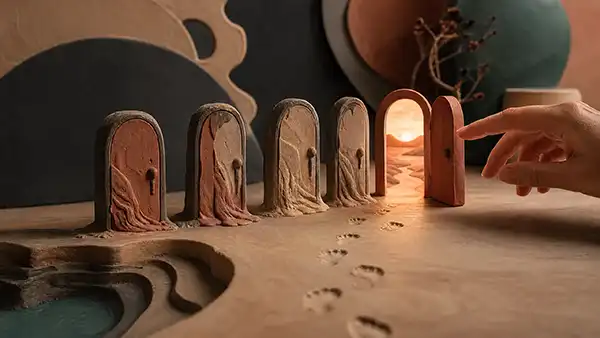
I call the cost of that unrealized version the comfort tax: the invisible price paid for every risk that is avoided in the name of safety. The tax is not charged immediately. It is charged at the end, in the currency of what could have been. And the tax is cumulative. Each small avoidance compounds. By the time the bill arrives, the total is often larger than any loss the risk itself would have produced.
What the research on regret actually shows
The research on regret is unambiguous. Thomas Gilovich at Cornell University and Victoria Medvec at Northwestern University conducted a series of studies in the 1990s that examined how people experience regret over time. Their findings, published in Psychological Review, showed a consistent pattern. In the short term, people regret actions they took—the mistake, the embarrassing comment, the wrong turn. But in the long term, people regret inactions far more. They regret the chances they did not take, the words they did not say, the risks they did not accept.
A 2025 replication of the original studies, conducted with nearly one thousand American participants and published in Emotion, confirmed the pattern. The researchers found that the temporal trajectory of regret is robust. Actions produce more regret in the immediate aftermath. Inactions produce more regret in the long run. And the long run is where most of a life is lived.
Harold’s regret was not about the job he took. It was about the job he did not take. The distinction is not semantic. It is the difference between a mistake and a missed opportunity. A mistake can be corrected. A missed opportunity cannot.
The four reasons we avoid risk
The reasons people avoid risk are not mysterious. They are predictable. And they are not character flaws. They are cognitive defaults. The first is what the source material calls cowardice, though I prefer the term threat amplification: the tendency of the amygdala to magnify the perceived danger of an unfamiliar option while minimizing the danger of the familiar one. The brain evolved to treat novelty as potential threat. The person who stays in the familiar job is not weak. They are following a survival instinct that is poorly calibrated for a world where the familiar job might be the more dangerous choice.
The second reason is reactive thinking. The research on reactive versus proactive decision-making, conducted by researchers at the University of Pennsylvania, has shown that people who operate in a reactive mode respond to immediate stimuli rather than long-term goals. They are not choosing the safe option because they have evaluated it. They are choosing it because it is the option that requires the least immediate processing. The reactive mind does not ask “what do I want in ten years?” It asks “what will make this moment less uncomfortable?” The answer is almost always the safe option. The safe option is the one that does not require the discomfort of uncertainty.
The third reason is environmental influence. The research on social conformity, pioneered by Solomon Asch in the 1950s, has shown that people will override their own perceptions to align with a group. The person who is surrounded by people who play it safe will play it safe. The person whose social circle is risk-averse will become risk-averse. The influence is not always explicit. It is often delivered through the raised eyebrow, the sarcastic comment, the story of the person who tried and failed. The environment does not need to forbid risk. It only needs to make risk feel deviant.
The fourth reason is vision. The research on future self-continuity, conducted by Hal Hershfield at UCLA, has shown that people who feel connected to their future selves make different decisions than people who feel disconnected. The person who can vividly imagine their life at sixty-five is more likely to invest in their health at thirty-five. The person who cannot is more likely to eat the second dessert. The lack of vision is not a lack of intelligence. It is a lack of imagination. And imagination, like every cognitive capacity, can be developed.
The arithmetic of small avoidances
The comfort tax is not charged in a single transaction. It is charged in installments. The decision not to apply for the job that was slightly out of reach. The decision not to have the conversation that might have changed the relationship. The decision not to move to the city that felt unfamiliar. Each decision is small. Each decision is defensible. Each decision is a deposit into an account that will one day be tallied.
The research on compounding behavior, developed by researchers at the University of California, San Diego, has shown that small decisions accumulate into large outcomes. The person who saves fifty dollars a week becomes wealthy. The person who skips fifty dollars a week becomes poor. The same arithmetic applies to risk. The person who takes one small risk a month becomes someone who has taken three hundred and sixty risks by the age of sixty. The person who avoids one small risk a month becomes someone who has avoided three hundred and sixty opportunities.
The arithmetic is not moral. It is mechanical. The outcomes are not judgments. They are results.
What the risk-takers understand that the risk-avoiders do not
The research on risk-taking and success, conducted by researchers at the University of Michigan, has found that successful entrepreneurs are not more tolerant of failure than the general population. They are more tolerant of uncertainty. The distinction matters. Failure is a known quantity. Uncertainty is not. The person who cannot tolerate uncertainty will wait for the conditions to be perfect. The conditions are never perfect. The waiting becomes the answer.
The second thing risk-takers understand is that the downside is often smaller than it appears. The research on affective forecasting, conducted by Daniel Gilbert at Harvard University, has shown that people consistently overestimate the emotional impact of negative events. The person who fears the embarrassment of failure imagines an agony that will not arrive. The failure will sting. It will not destroy. The person who knows this is more willing to act.
The third thing risk-takers understand is that inaction has a cost. The research on opportunity cost has been standard in economics for two centuries, but it has only recently been applied to personal decisions. The person who stays in the job they hate is not avoiding loss. They are incurring a loss. The loss is the difference between the life they are living and the life they could have lived. The loss is invisible because there is no receipt. But it is real.
When the fear is not irrational
There is a version of this argument that becomes a justification for recklessness. It is not. Some risks are genuinely dangerous. The research on decision-making under uncertainty, conducted by Gerd Gigerenzer at the Max Planck Institute for Human Development, has shown that the ability to distinguish between risk that is worth taking and risk that is not is a skill. The skill is not the absence of fear. It is the calibration of fear.
The person who quits their job to start a business with no savings and no plan is not brave. They are impulsive. The person who stays in a job they hate for thirty years because they are afraid of change is not prudent. They are trapped. The middle path is not the safe path. It is the examined path. It is the path that asks: what is the actual probability of failure? What is the actual cost of failure? What is the actual cost of not trying? The questions are not rhetorical. They have answers. And the answers are often different from the fears.
A note on when the fear requires professional support
If the fear of risk has become persistent, if it interferes with sleep, appetite, work, or relationships, if it has produced a sense of paralysis or hopelessness that does not lift, the appropriate response is not to try harder to take risks alone. It is to speak with a mental health professional who can help you assess what is happening and develop strategies for moving forward. The research on anxiety disorders, avoidant behavior, and cognitive behavioral therapy is robust. Support is not a sign that you have failed to be brave. It is a recognition that some fears are too deeply wired to be rewired alone.
The version of you that never got to exist
Harold died two months after the conversation with his daughter. She told me the story at a conference in Chicago. She said the thing that haunted her was not the sadness. It was the flatness. He had accepted the outcome of his life without ever examining the decision that produced it. He had never asked whether the job in California was worth the risk. He had never let himself find out.
The comfort tax is not a punishment. It is a description. It is what happens when the brain’s default settings are allowed to run the show. The default is safety. The default is familiarity. The default is the known. And the known, over a lifetime, can be the most expensive thing you ever choose.
The tax is not inevitable. It can be reduced. Not by taking every risk. By taking the risks that matter. The ones that align with the version of yourself you are trying to become. The version that Harold never got to meet.
The choice is not whether you will pay the tax. You will. The only choice is what you get in return. And that choice, unlike the tax, is available right now.