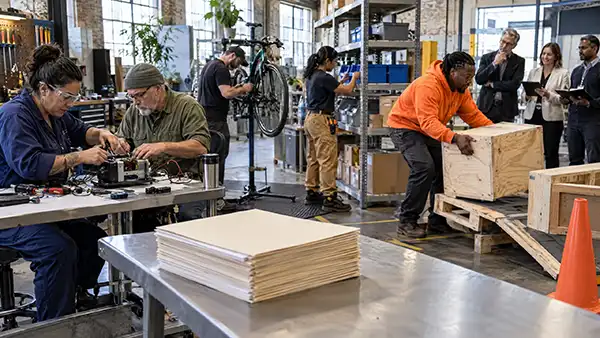
Drowning in applications, starving for talent
The hiring manager in Columbus sat across from me in a conference room that smelled like stale coffee and desperation. She had 347 applications for twelve production operator positions. Three hundred and forty-seven. She scrolled through them on her laptop, her face blank, and told me she would probably hire zero. Not because the applicants were bad people. Because none of them could do the job. This is the paradox that is quietly strangling the American economy right now. We have built a labor market where applications flood in like monsoon rain, but actual qualified talent evaporates before it hits the ground. The Manpower Group surveyed nearly forty thousand employers across nine countries and found the same story repeating in manufacturing, sales, engineering, skilled trades, and hospitality. The shortage is not a myth. It is a structural collapse, and most companies are responding with the exact same broken playbook they have been using for twenty years.
Why the factory floor sits empty
Walk through any industrial park in Ohio, Michigan, or Indiana and you will see the same thing. Machines running at sixty percent capacity. Shifts cut short. Overtime maxed out for the few workers who actually understand the equipment. The production operator role—the one that sounds generic on a job board—is actually a highly technical position that requires mechanical aptitude, quality control literacy, and the ability to troubleshoot problems that do not appear in any manual. Companies post these jobs expecting a flood of qualified candidates. What they get instead is what Wharton professor Peter Cappelli calls Resume Theater, a phenomenon where applicants perform qualifications on paper that they cannot actually execute in practice.
The applications look good. The keywords match. The formatting is clean. But when the candidate shows up for the technical assessment, the illusion collapses. They cannot read a micrometer. They do not understand tolerances. They have never worked a shift where something went wrong at three in the morning and they had to figure it out without a supervisor.
This is not laziness. This is a systemic failure of the pipeline.
Thirty-nine thousand employers told the truth
The data from Manpower’s annual Talent Shortage Survey is brutal in its consistency. Year after year, across multiple countries, the same ten roles appear at the top of the hardest-to-fill list. Skilled trades workers. Engineers. Sales representatives. Production operators. Technicians. Administrative staff. Managers. Restaurant and hotel workers. The list reads like a census of the actual economy, not the economy we pretend exists in tech brochures and LinkedIn posts.
When researchers at the Federal Reserve Bank of New York dug into the micro-data, they found something uncomfortable. The shortage is not evenly distributed. It is concentrated in roles that require specific technical skills combined with reliability, physical presence, and the ability to work irregular hours. These are not jobs that can be done remotely from a couch in Portland. They require bodies in specific places at specific times, and the supply of those bodies has been shrinking for a decade.
The Bureau of Labor Statistics projects that skilled trade openings will grow faster than almost any other category through 2032. The problem is not that people do not want to work. The problem is that the people who could do these jobs have been systematically steered away from them by a culture that treats four-year degrees as the only legitimate path to dignity.
Experience: the impossible requirement
Here is where the logic breaks down completely. Employers say the number one reason they cannot fill these roles is lack of experience. Fair enough. But when you dig into what “experience” actually means in these job postings, it becomes clear that companies are not looking for people who have done the job before. They are looking for people who will not need training. They want plug-and-play workers who can hit the ground running on day one, produce at full capacity by week two, and never require mentorship, correction, or patience.
This is a fantasy.
Peter Cappelli’s research at Wharton has documented how job requirements have inflated across every sector over the last two decades. Positions that used to accept motivated high school graduates now demand bachelor’s degrees. Roles that used to provide on-the-job training now require candidates to arrive fully trained. The result is a labor market where employers complain they cannot find talent while simultaneously refusing to develop any.
The catch-22 is suffocating. You need experience to get the job. You need the job to get the experience. And somewhere in the middle, an entire generation of potentially excellent workers is being filtered out by algorithms that reject anyone who does not check every impossible box.
When keeping people becomes the only strategy
The Manpower data shows something interesting about how companies are responding. The number one solution employers are deploying is not hiring more people. It is trying desperately not to lose the ones they already have. Retention has become the primary strategy, which is a polite way of saying that finding new talent has become functionally impossible.
This makes sense when you look at the economics. Replacing a skilled production operator costs anywhere from fifty to two hundred percent of their annual salary when you factor in recruiting, onboarding, training, and the productivity loss during the ramp-up period. Keeping an existing worker—even one who is not perfect—almost always beats starting over with a stranger.
But retention is not a strategy. It is a holding pattern.
Companies that rely entirely on keeping their current workforce are essentially admitting they have given up on growth. They are choosing stability over expansion, maintenance over innovation. And in an economy where competitors are automating, upskilling, and aggressively recruiting, standing still is the same as falling behind.
The research from the Society for Human Resource Management shows that the most successful companies are not just trying to retain workers. They are redesigning the work itself. They are breaking down roles into smaller, more manageable tasks. They are cross-training employees so that one person can cover multiple functions. They are investing in ergonomics and scheduling flexibility so that the jobs are actually worth staying for.
Training as a desperate last resort
The second most common solution employers report is providing development and training opportunities for existing staff. This sounds good on a slide deck. In practice, it is often a disaster.
Training takes time. It takes money. It takes experienced workers away from production to teach inexperienced workers how to do the job. And in a facility that is already running at reduced capacity because they cannot hire enough people, pulling your best workers off the floor to train new hires feels like cutting off your nose to spite your face.
The data from Brookings Institution on workforce development shows that companies which invest in internal training programs see higher retention, higher productivity, and lower recruiting costs over a three-to-five-year horizon. But that horizon is the problem. Most hiring managers are operating on a three-to-five-week horizon. They need someone yesterday. They do not have time to build a pipeline. They need to plug the hole now.
This short-term thinking is exactly what created the shortage in the first place.
The trades nobody wants to talk about
Let us be honest about something. The hardest-to-fill roles are not glamorous. They are not the jobs that get written about in business magazines or featured in startup origin stories. They are the jobs that require getting up before dawn, working with your hands, dealing with difficult customers, standing on concrete floors for eight hours, or managing the chaotic unpredictability of a restaurant kitchen during a Friday night rush.
These are essential jobs. They are the backbone of the actual economy. But they are also the jobs that an entire generation has been told to avoid.
The cultural message has been clear for thirty years. Go to college. Get a degree. Work in an office. Wear a tie. The alternative—becoming a mechanic, a welder, a production operator, a technician—was framed as a failure, a fallback, a sign that you were not smart enough for the real path.
The result is exactly what you would expect. An entire sector of the economy is starved for talent because we spent three decades convincing young people that these jobs were beneath them.
Now we are surprised that nobody wants to do them.
What the data actually reveals
When you strip away the talking points and the HR jargon, the data tells a very simple story. The talent shortage is not a mystery. It is the predictable outcome of decades of underinvestment in vocational training, cultural disdain for skilled work, and employer demands that have inflated beyond what the labor market can actually supply.
The companies that are solving this problem are not the ones with the biggest recruiting budgets or the flashiest job postings. They are the ones that have fundamentally rethinked their approach. They have partnered with local technical schools. They have created apprenticeship programs that pay people to learn. They have redesigned their jobs to be more flexible, more humane, more worth staying for.
They have stopped expecting the market to hand them perfect candidates and started building the candidates themselves.
The factory in Columbus eventually filled its twelve positions. It took eight months. It required partnering with a local community college, redesigning the onboarding process, and accepting that none of the new hires would be fully productive for at least six months. It was expensive. It was slow. It was uncomfortable.
But it worked.
The hiring manager closed her laptop. She looked at the stack of three hundred and forty-seven applications that had produced zero hires. She pushed the stack aside. She picked up the list of twelve names from the community college program. She started making calls.