You Are Paying a Tax You Never Agreed To
You know the feeling.
It’s 2 a.m. and you’re staring at the ceiling, replaying a conversation you didn’t have. An email you didn’t send. A question you didn’t ask. A line you didn’t cross. And somewhere in that graveyard of hesitation, you started keeping score — a running tally of every moment you shrank instead of stood. You’ve never added it up. You don’t want to know the number.
I’ll add it up for you.
I call it the fear tax — the invisible compounding cost of every avoidance decision you’ve ever made, measured not in dollars but in unlived days, unspoken truths, and unrealized versions of yourself. It’s not a metaphor. It’s a ledger. And most people die without ever seeing the balance.
What fear actually does to your body
Your amygdala doesn’t know the difference between a rattlesnake and a passive-aggressive Slack message.
That’s not a poetic flourish. That’s neurology. The same ancient circuit that kept your ancestors alive — the one that floods your bloodstream with cortisol when you sense danger — fires identically when your boss schedules a “quick chat” and when a predator steps out of the brush. Heart rate climbs. Pupils dilate. Blood leaves your prefrontal cortex — the part that thinks — and rushes to your limbs — the parts that run. The system is not broken. It’s just outdated. It evolved for a world where the threats were physical and the escape routes were obvious. It did not evolve for a world where the threats are social and the escape routes are invisible.
Here’s what that means in practice: the exact moment you most need your cognitive faculties — the high-stakes conversation, the critical decision, the leap of faith — is the exact moment your brain goes offline. Not because you’re weak. Because you’re human.
A 2025 study out of Arizona State University documented something they called “Silent Freeze” — a total motor and social paralysis triggered not by fear of rejection but by a resource-conservation instinct. The brain decides the interaction is too valuable to risk. So it does nothing. It preserves potential by refusing to test it.
You know what that looks like. It looks like the email you drafted and deleted seventeen times. It looks like the “I’ll think about it” that means “I’ll never do it.” It looks like the promotion you didn’t ask for because you were waiting to feel ready.
The readiness lie you keep telling yourself
You are not waiting to be ready.
There is no ready.
A 2026 meta-analysis of “courage interventions” — yes, that’s a real thing — found that courage is not a personality trait. It’s a trainable skill. And the training isn’t meditation or affirmations. It’s incremental exposure. Small wins. Three-second windows of action taken despite the fear spike. The researchers at Clemson, led by Cynthia Pury, have spent twenty years proving this: courage is a voluntary action in pursuit of a worthwhile goal that involves taking on a risk. The risk may or may not trigger fear. But the action is what defines it — not the feeling.
You have been waiting for the fear to disappear before you act. That’s backwards. The action is what makes the fear disappear. Not the other way around.
The workplace is a fear factory (and it’s costing more than you think)
Here’s a number that should bother you: 82 percent.
That’s the share of employees who were at risk of burnout in 2025, according to Gallup. Not a few. Not a handful. Eight in ten workers you know.
And the mechanism isn’t workload. It’s fear. Fear of speaking up. Fear of making a mistake. Fear of being seen as difficult. A 2025 study in Scientific Reports surveyed 805 employees and found that psychological courage — the capacity to confront irrational fears and anxieties — correlated positively with job satisfaction and meaning in work, and negatively with perceived stress. The mediating factor was the behavioral activation system — the brain’s reward circuitry. When courage was high, the reward system engaged and well-being improved. When behavioral inhibition dominated, stress went up and satisfaction cratered.
Read that again. The difference between a job that feels meaningful and one that feels soul-crushing isn’t the salary or the mission statement. It’s whether people feel safe enough to act despite their fear.
A separate study found that fear of failure is negatively related to work performance and that performance pressure intensifies the fear by triggering mental preoccupation with work. The preoccupation doesn’t help. It just makes you anxious while you’re not doing the thing you’re anxious about.
Two men, same fear, different decisions
I want to tell you about two men I met at a conference in Austin.
The first was named Marcus. Mid-forties. Product manager at a tech company. Same job for eleven years. Watched four colleagues get promoted past him. Every time a role opened up, he thought about applying. Every time, he talked himself out of it. Wasn’t ready. Needed one more project. Timing wasn’t right.
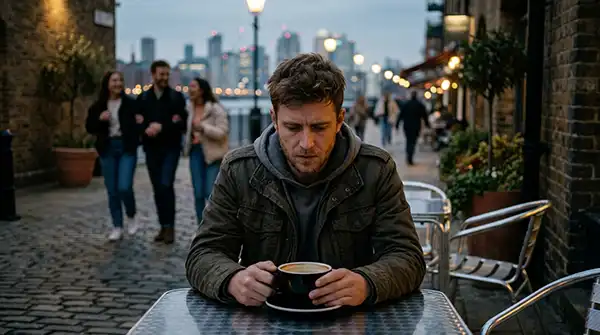
“The timing was never right,” he told me, staring into his coffee. “I was just scared. And I called it patience.”
The second guy was named Derek. Same age. Same industry. Different story. Derek had been fired from two jobs before he was forty. Both times, he’d taken a swing at something bigger and missed. Both times, he’d been devastated for a week and then started looking for the next shot. When I asked him why he kept risking it, he shrugged and said something I’ve never forgotten.
“What’s the worst that happens? I fail again? I’ve already failed twice. It’s not that bad. The first time, I thought it would kill me. It didn’t. Now I know.”
Same fear. Different relationship to it. One man let the fear calcify into paralysis. The other let it metabolize into evidence.
The regret data is not ambiguous
If you want to know what you’ll regret when you’re eighty, the research is already in.
Cornell psychologists Tom Gilovich and Victoria Medvec spent years studying regret across the lifespan. Their finding is one of the most consistent in social psychology: in the long run, people regret inactions far more than actions. The things they didn’t do. The risks they didn’t take. The words they didn’t say. Time doesn’t heal those wounds. It sharpens them. Because you never get to find out what would have happened.
Actions can be forgiven. They can be reframed. They can become stories. Inactions just sit there, silent and permanent, humming with the low-grade static of what-ifs.
The fear tax compounds in one direction: the direction of stagnation. Every avoided conversation makes the next one harder. Every unasked question makes the next ask feel more dangerous. Every time you let fear make the decision, you teach your brain that fear is a reliable guide. And your brain — being a good student — learns the lesson.
What actually breaks the loop
I’m not going to tell you to “feel the fear and do it anyway.” That’s a bumper sticker, not a strategy.
Here’s what the research actually supports.
First: name the fear. Not the surface fear — the deep one. Not “I’m nervous about this meeting.” The real one: “I’m afraid that if I speak up, I’ll be seen as incompetent, and if I’m seen as incompetent, I’ll be excluded, and if I’m excluded, I’ll be alone.” When you name the deep fear, it shrinks. It becomes specific. And specific fears are easier to challenge than vague dread.
Second: shrink the action. Not “have the conversation.” Not “ask for the raise.” Not “apply for the job.” Just the smallest possible first step. Draft the email. Write the first sentence. Open the application. The Arizona State research called this “Success Validation” — the experience of executing a lower-stakes version of the scary thing and discovering that you survived. Small wins generate the confidence to attempt bigger ones. The confidence doesn’t come first. The action does.
Third: give it three seconds. When the fear spikes and your brain starts assembling reasons to retreat, you have a window — roughly three seconds — before the avoidance kicks in and rationalizes itself. In that window, you act. Not perfectly. Not bravely. Just action. The action generates data. The data contradicts the prediction. The prediction weakens.
Fourth: stop calling it patience. Fear is a feeling. Patience is a strategy. They are not the same thing, and confusing them is how people spend a decade waiting for a version of themselves that never shows up.
When it’s more than fear
Some fear is not a signal problem. It’s a symptom. If the avoidance is accompanied by persistent anxiety, panic symptoms, depression, or a sense that you cannot function — that’s not a courage problem. That’s a health problem. And it requires a different response.
Talk to a mental health professional. Not because you’re broken. Because some things are too heavy to carry alone. The research on anxiety disorders and experiential avoidance shows that professional treatment — particularly acceptance and commitment therapy and cognitive behavioral therapy — is effective. The fear is treatable. The avoidance is changeable. But not by willpower alone. And not by reading another article. You need a person, in a room, with training.
That’s not a disclaimer. It’s the most practical thing in this article.
The bill comes due either way
Marcus finally applied for a promotion six months after our conversation. He didn’t get it. He was devastated for a week. And then something shifted. He realized the rejection wasn’t the end of the world. He realized the conversation he’d been dreading was survivable. And for the first time in eleven years, he’d actually tried.
He applied for another role two months later. He got it. Not because he was more qualified. Because he was finally willing to be seen.
Derek, for what it’s worth, is now running his own company. Third attempt. Still not sure it’ll work. Doesn’t care as much anymore.
The fear tax is due every single day. You can keep paying it — quietly, incrementally, in the currency of unlived moments. Or you can stop. The stopping doesn’t require courage in the movie sense. It requires a decision, in a three-second window, to do the smallest version of the thing you’ve been avoiding.
You don’t have to be brave.
You just have to move.
The fear will still be there. It doesn’t go away. It just gets quieter as the evidence against it piles up. And one day you’ll notice that the voice that used to scream has dropped to a whisper, and the whisper is saying something different now.
It’s saying: that wasn’t so bad.
It’s saying: what else have you been avoiding?