The Map You Need Is the One That Shows the Edges
I have spent the last twelve years drawing maps.
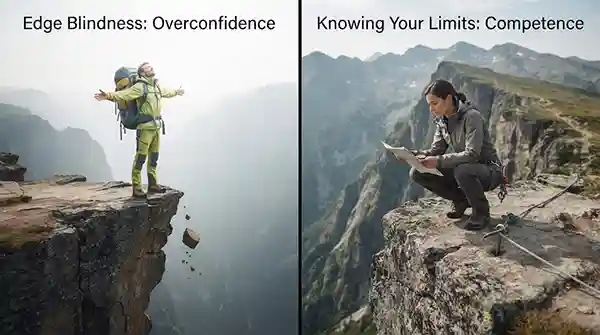
Not the kind you fold into your glove compartment. The kind you build inside your head. Maps of what I can do. Maps of what I cannot. Maps of the territory I have explored and the territory that remains unknown. And I have learned that the most important line on any map is not the one that marks the destination. It is the one that marks the edge.
Most people never draw that line.
They spend their lives expanding outward, adding territory, claiming new ground. They believe that the map should grow forever. They believe that every blank space is an invitation. They believe that the only limit is the one you impose on yourself. And so they wander into territory they are not equipped to survive. They fall off cliffs they did not know existed. They get lost in forests they cannot navigate. And they wonder why they are unhappy.
I call this the edge-blindness problem — the inability to see the boundaries of your own capability. It is not a lack of ambition. It is a lack of cartography. And it is one of the most common and most costly mistakes a human being can make.
The lie that sells a million books
“You can do anything you set your mind to.”
You have heard it. You have probably said it. You might have said it to a child. It is a beautiful sentiment. It is also false. And the falseness is not a minor detail. It is the whole problem.
The research on expertise and skill acquisition tells a different story. Anders Ericsson at Florida State University spent his career studying elite performers. His findings, replicated across domains from music to chess to surgery, showed that the path to mastery is not paved with belief. It is paved with focused, effortful practice, with feedback, with repetition, with the slow accumulation of specific skills. And even then, most people who practice do not become elite. They become competent. Competence is not the same as greatness. And greatness is not available to everyone in every domain.
A 2025 study from the University of Toronto examined what the researchers called “negative capability” — the capacity to recognize what you cannot do. The findings were striking. Leaders who accurately understood their own limits made better decisions, delegated more effectively, and created more resilient teams than leaders who overestimated their capabilities. The study’s authors argued that this capacity is more predictive of long-term success than confidence or optimism.
The reason is simple. When you know what you cannot do, you stop wasting time trying to do it. You stop making decisions that are doomed to fail. You stop putting yourself in positions where failure is the only outcome.
What a professional poker player learned about folding
I spent twenty-three years playing poker for a living. Not the glamorous kind you see on television. The grinding kind. The kind where you spend more time folding than playing. And in those twenty-three years, I learned something that took a decade to understand.
The most important skill in poker is not knowing when to bet. It is knowing when to fold.
The players who lose everything are not the ones who lack talent. They are the ones who cannot tell the difference between a hand they can win and a hand they want to win. They confuse desire with capability. They see a pair of aces and convince themselves they are invincible. They ignore the flush draw on the board. They ignore the tight player who just raised. They ignore every signal that says “you are not going to win this hand.” And they lose.
The players who survive — the ones who make a living, the ones who stay in the game for decades — are the ones who have learned to read the edge. They know which hands are worth playing. They know which hands are not. They know the difference between a calculated risk and a delusion. And they fold. Over and over. They fold more than they play. And they win.
The same principle applies to life. The people who succeed are not the ones who try everything. They are the ones who know what to try, and what to leave alone.
When confidence becomes a weapon
There is a character in every American workplace. The person who has an opinion on everything. The person who knows how to fix the economy, the education system, the local sports team, and your marriage. The person who has never met a topic they could not opine on.
This person is not actually confident. They are performing confidence. The performance is a defense mechanism. If they admit they do not know something, they fear they will be seen as weak, stupid, inadequate. So they fake it. They bluff. They talk over people who actually know.
The research on overconfidence and decision-making has been clear for decades. A 2024 study published in Nature Human Behaviour found that overconfident people are more likely to be promoted, more likely to be elected to leadership positions, and more likely to be perceived as competent. But they are also more likely to make catastrophic errors, more likely to fail when the stakes are high, and more likely to destroy the organizations they lead.
The overconfident do not know what they do not know. That is the problem. They cannot see the gap between their actual ability and their perceived ability because the gap is invisible to them. The skills needed to recognize incompetence are the same skills that are lacking. It is a closed loop. A trap.
The man who borrowed two million dollars
Let me tell you about a friend of mine. Let’s call him David.
David was a real estate agent in Phoenix. He was good. Not great, but good. He made a solid living. He had a comfortable life. And then he decided he was going to become a developer.
Not because he had any experience in development. Not because he had studied the market. Because he had seen other people do it and he wanted their lifestyle. He wanted the bigger house, the nicer car, the respect. He wanted to be the guy who built things, not the guy who sold them.
He borrowed $2 million. He bought a piece of land. He got permits. He started construction. And then he hit every obstacle that every developer hits. Cost overruns. Delays. Permit problems. Contractor disputes. Market shifts. He had no idea what he was doing. He had never seen these problems before. He had no experience to draw on. He had no pattern recognition for what was normal and what was a warning sign.
The project collapsed. He lost everything. His house. His savings. His marriage. His health.
The collapse did not happen because David was stupid. It happened because David could not tell the difference between what he wanted and what he could do. He did not ask himself the question that would have saved him: “Am I qualified to do this?” He asked a different question: “Do I want to do this?” And the answer was yes. So he did.
The limits that are not negotiable
Every human being has limits. This is not a philosophical claim. It is a neurological one. The brain has finite capacity. The body has finite energy. The lifespan has finite duration. No one can do everything. No one can be everything. The people who succeed are the ones who figure out which things they can be, and which things they cannot, and then act accordingly.
The research on expertise, pioneered by Anders Ericsson and continued by researchers around the world, found that elite performers in every domain share one trait. They are brutally honest about their weaknesses. They do not ignore their limitations. They study them. They analyze them. They build systems to compensate for them.
The chess grandmaster knows which positions he plays well and which he does not. The surgeon knows which procedures are within her capabilities and which require a specialist. The investor knows which markets he understands and which are outside his circle of competence.
The person who cannot tell the difference is the person who loses.
A test that takes ten minutes
I have a system. I have been using it for years. And it has never failed me.
Take a piece of paper. Draw a line down the middle. On the left side, write down three things you are genuinely good at. Not things you want to be good at. Not things you have been told you are good at. Things you have evidence for. Things you have tested. Things that have produced results.
On the right side, write down three things you are genuinely not good at. Things you have tried and failed at. Things you have avoided because you knew, deep down, that you did not have the capability.
Do not show this list to anyone. This is for you.
Now, look at the right side. Look at the things you are not good at. Ask yourself a question. Are these things I can learn? Or are these things I should delegate, avoid, or accept as outside my capability?
The answer is not always obvious. Some limitations are learnable. Some are not. The skill is in the distinction.
Why acceptance is not defeat
There is a paradox in the research on goal-setting and achievement. The most effective goals are specific, difficult, and attainable. Notice the third word. Attainable. The research on goal-setting theory, developed by Edwin Locke and Gary Latham, shows that goals that are impossible produce worse outcomes than goals that are difficult but within reach. The impossible goals are demotivating. They produce frustration, anxiety, and learned helplessness.
The same principle applies to self-assessment. The people who succeed are not the ones who set impossible standards for themselves. They are the ones who set standards that are challenging but realistic. They know what they can do. They know what they cannot do. And they do not torture themselves with the things that are outside their reach.
A 2025 study published in the Journal of Personality and Social Psychology found that self-concept clarity — the degree to which people have a clear and confident understanding of who they are — was associated with better mental health, better relationships, and better decision-making. The people who knew themselves, including their limits, were happier than the people who did not.
The finding is not surprising. When you know what you are not, you stop wasting energy on impossible tasks. You stop comparing yourself to people who have capabilities you lack. You stop feeling like a failure for not being able to do everything. You accept yourself as you actually are, and you build a life that fits.
The exception that proves the rule
There is an exception to everything I have written. Sometimes what looks like a limitation is actually a skill in disguise. Sometimes the thing you cannot do is the thing you should not do. Sometimes the failure is the lesson.
The research on post-traumatic growth, developed by Richard Tedeschi and Lawrence Calhoun at the University of North Carolina at Charlotte, shows that people who experience significant adversity sometimes report profound positive changes. Deeper relationships. Greater appreciation for life. Increased personal strength. The growth does not justify the suffering. But it does happen.
The question is not whether you have limits. Everyone does. The question is what you do with them. Do you deny them? Do you fight them? Do you accept them and build a life that works with them instead of against them?
The sentence that saves you
The most useful sentence in the English language is not “I can do anything.” It is “I know what I can do, and I know what I cannot.”
The second sentence is harder to say. It requires honesty. It requires humility. It requires the willingness to disappoint people who believe in you more than you believe in yourself. It requires the willingness to disappoint yourself.
But it is the sentence that saves you. From the job you should not take. The relationship you should not pursue. The investment you should not make. The fight you should not pick. The dream that is not actually your dream.
The knowing is the wisdom. The acceptance is the freedom. And the life that follows is not smaller. It is more focused. More honest. More yours.
I folded a lot of hands in twenty-three years. More than I played. But the hands I played were the right ones. The ones I could win. The ones that made me money. The ones that kept me in the game.
That is the whole thing. Not knowing when to bet. Knowing when to fold. Not knowing what you are. Knowing what you are not.
The rest is just noise.