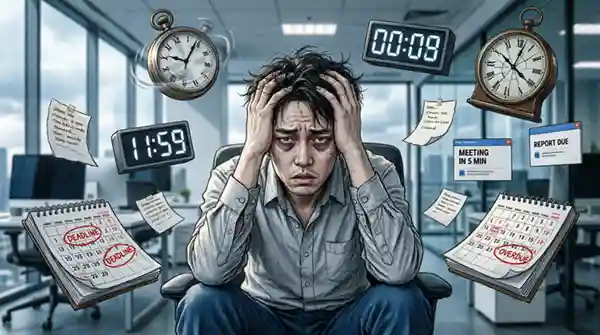
You’re Not Lazy. You’re Time-Poor and It’s Making You Sick
The first time I realized I was time-poor, I was sitting on my own couch.
It was a Sunday. The windows were open. My phone was face-down on the coffee table. And I was doing absolutely nothing — which is to say, I was doing the thing I had been telling myself for months that I needed to do. I was resting. And it felt like dying.
My chest was tight. My jaw was clenched. A voice in the back of my head — a voice that sounded suspiciously like my own — kept repeating a single sentence. You are wasting time. You are wasting time. You are wasting time. I lasted eleven minutes before I picked up the phone and started answering emails that would not be read until Monday. I felt better immediately. I also felt worse. The contradiction did not bother me at the time because I did not have the language for it. I did not know that I was experiencing something that researchers have been documenting for decades. I did not know that the feeling had a name.
It does. It is called time poverty. And according to the data, most of the people reading this are drowning in it.
What Is Time Poverty and Why Does It Feel So Bad?
Time poverty is the chronic feeling that you do not have enough time to do the things you need or want to do. The term was coined by Claire Vickery in 1977, but it has only recently gained traction as a serious area of study. A 2025 survey of nearly 2,000 employees found that 62 percent of U.S. workers do not take all their allotted vacation days, letting roughly one-third of their paid time off go to waste. A separate poll found that 47 percent of Americans left PTO on the table in 2024, with the top reason being work.
These are not lazy people. These are people who are afraid. And what they are afraid of is the same thing I was afraid of on my couch: the feeling that stopping is a form of falling behind.
The research on chronic time pressure is unambiguous. A 2025 study published in BMC Psychology surveyed 7,570 individuals across six European countries and found that chronic time pressure was a significant predictor of symptoms of depression, anxiety, and stress, accounting for between 5 and 24 percent of the variance in those outcomes. Feeling chronically harried was universally associated with increased symptoms across every country studied.
The finding that should stop you cold is this: subjective feelings of time poverty have a stronger negative effect on well-being than being unemployed. Read that again. Feeling like you never have enough time is worse for your mental health than not having a job.
The Health Consequences Nobody Warned You About
Time poverty is not just a feeling. It is a physiological event. Individuals living with chronic time pressure experience reduced sleep quality and have an increased likelihood of developing physical illness, including high blood pressure. A 2015 study published in Occupational and Environmental Medicine found that time pressure was associated with long-term sickness absence.
The mechanism is not mysterious. When you feel time-poor, your nervous system stays in a state of low-grade activation. The stress response that is designed to be brief and adaptive becomes prolonged and maladaptive. Cortisol stays elevated. Sleep gets disrupted. The immune system weakens. And the thing that would actually help — slowing down, resting, sleeping — feels impossible because slowing down feels like the thing that will make everything worse.
I call this temporal dysphoria — the persistent, low-grade unease that accompanies the feeling of never having enough time. It is not anxiety in the clinical sense. It is not depression. It is something more subtle. It is the background hum of a life lived in a state of permanent catch-up. And it is corrosive precisely because it is so easy to normalize.
Why Rest Feels Like a Crime
I want to tell you about Laura Mayer. She is a podcast executive who wrote a book called Tryhard: A Cautionary Tale of Clocking In and Spinning Out. In the book, she describes fainting on the New York City subway during her morning commute. When she regained consciousness and called her husband, who took her to the emergency room, her thoughts were not on her health. They were on the meeting she had missed. Even after clinicians diagnosed the episode as a panic attack, she did not slow down. She showed up for work the day after her wedding. “Working,” she wrote, “was the addiction I found while dodging another.”
Mayer’s story is extreme. But the mechanism is not. The research on productivity guilt describes a specific cognitive pattern. People who experience it have what psychologists call conditional self-worth — the belief that they are only valuable when they are producing. They use busyness to numb uncertainty. They have internalized the message that rest is selfish or weak. And they compare themselves to others who seem, from the outside, to be optimized and effortless.
The result is a nervous system that has learned to associate stillness with threat. “Hustle culture has blurred boundaries, normalized exhaustion, and quietly turned burnout into a symbol of ambition,” one therapist told the Deccan Chronicle. “For a lot of young professionals, being busy is directly linked to self-worth.”
The logic is circular. You rest. You feel guilty. You work to relieve the guilt. You get tired. You rest. You feel guilty again. The loop never ends because the guilt is not about the work. The guilt is about the belief that your worth is contingent on your output.
How Workaholism Rewires Your Brain
The American Psychological Association published a feature in 2026 on workaholism that should be required reading for every manager in America. The article noted that “workaholism” and “work addiction” are not clinical terms, but psychologists agree that being all-consumed by work leads to real mental, physical, social, and even occupational consequences.
The key components are working excessively and working compulsively. Without the compulsive element, you are just a hard worker. The compulsion is what turns a healthy drive into a pathology.
“Workaholism is really worth taking seriously,” said Malissa Clark, a psychologist at the University of Georgia who has been studying the phenomenon for fifteen years. “It has real consequential negative outcomes for individuals, for their partners and families, and for organizations.”
The mechanisms are several. Some people use work to avoid difficult emotions. Some use it to feel in control. Some have a deep insecurity that they are trying to outrun. Some are simply responding to a culture that rewards overwork and punishes boundaries. In almost every case, the behavior is serving a function. It is not random. It is not laziness or its opposite. It is a strategy that worked at some point and became a cage.
The Productivity Guilt Trap
There is a phrase that keeps showing up in the research on this topic. It is called “toxic productivity.” The term describes the anxiety, guilt, and unrealistic expectations that quietly eat away at cognitive well-being. A 2025 article on the subject described it as a condition in which rest does not restore you — it triggers guilt.
The CBT approach to productivity guilt is not complicated. It involves identifying the unhelpful beliefs that drive the behavior and testing them against evidence. Someone experiencing productivity guilt might hold beliefs like “I am only valuable when I am producing” or “If I stop, everything will fall apart” or “Rest is something I have to earn.” These beliefs are not facts. They are rules that were learned, often in childhood, often from environments that praised output over presence.
The work is to notice the rule, question the rule, and practice acting against it. Not all at once. Not perfectly. But in small, deliberate steps.
What Actually Helps When You Feel Time-Poor
The research points toward a set of practices that are not complicated. They are not easy. But they are evidence-based.
The first practice is to schedule rest like you would schedule a meeting. Protected, non-negotiable blocks. The goal is not to find time for rest. The goal is to defend the time that already exists.
The second practice is to separate your identity from your output. Write down a list of values that have nothing to do with work. Read it when the guilt starts to rise.
The third practice is to challenge “should” thoughts. CBT-style evidence testing. When you think “I should be working right now,” ask yourself: what is the evidence that this is true? What would happen if I did not? Would I still be a person worth caring about?
The fourth practice is to take micro-rests without your phone. Five minutes counts. The phone is not rest. The phone is a different kind of work.
The fifth practice is to normalize boundaries in whatever way you can. If you are a manager, model leaving on time. If you are a parent, let your children see you rest. If you are a friend, tell your friends that you are not available at certain hours and mean it.
A 2025 survey by Wondr Health found that employees ranked time off and mental health days as the most effective resource for reducing stress and anxiety, followed by flexible work hours and remote options. The resources are known. The barriers are cultural and psychological.
When Feeling Behind Becomes a Clinical Problem
There is a limit to what self-directed strategies can accomplish. If the patterns of guilt, overwork, and chronic time pressure are accompanied by persistent depression, anxiety, panic attacks, or a sense of hopelessness that does not lift, the appropriate response is not to try harder to manage your calendar. It is to speak with a mental health professional who can help you assess what is happening.
The research on workaholism, productivity guilt, and chronic time pressure is robust. These patterns are treatable. But they often require treatment that is delivered by someone trained to deliver it.
This is not a disclaimer. It is the same logic that runs through everything else in this piece. You do not try to fix a broken bone with a time management system. You go to a doctor.
A Different Way to Measure a Life
I want to end with something small.
I still have the couch. I still have the phone. I still have the voice that tells me I am wasting time when I am doing nothing. The voice has not gone away. It probably never will.
But I have learned something that I did not know on that Sunday afternoon. I have learned that the voice is not telling me the truth. The voice is telling me a story. The story is that my worth is contingent on my productivity. The story is that rest is something I have to earn. The story is that if I stop, everything will fall apart.
The story is a lie. The work does not fall apart when I rest. The work is still there. The world is still there. I am still there.
The rest is not the reward for finishing. The rest is part of the process. And the process, unlike the list of things you have not done yet, is the only thing you actually have.