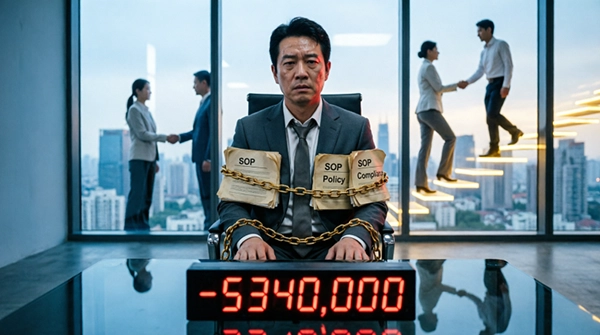
The Email Said Pause Contracts. I Paused Contracts. That Was the Mistake.
Initiative is not a personality trait. It is a perceptual skill. The people who take it are not braver or more motivated than the people who don’t. They simply see more. They notice the gap between what the rule says and what the situation requires. And they act on what they notice.
I did not know this when I woke up this morning. I know it now. And the knowing cost me $340,000 and eleven years of a relationship I cannot repair.
7:43 a.m. — The Email
It arrived while I was making coffee. It was from the VP of operations. It was addressed to the entire department. It contained a single sentence: “Effective immediately, we are pausing all vendor contracts pending a full audit.”
I read it. I shrugged. I forwarded it to my team with a note that said “FYI.” I did not think about the vendor in Ohio. I did not think about the shipment scheduled to leave their warehouse on Monday. I did not think about the clause in their contract that allowed them to cancel if we paused. I thought about my coffee. I thought about the meeting I had at nine. I thought about the fact that the email did not tell me to think about any of it.
9:17 a.m. — The Meeting Where I Was Not Present
The meeting was about quarterly projections. I was not present. I was thinking about the email. Not because I was worried. Because the email was strange. It said “all vendor contracts.” It did not say why. It did not say for how long. It did not say what we were supposed to tell the vendors. The VP was not in the meeting. The VP was never in the meeting.
I made a note to ask him about it later. I did not make the note. I thought about making the note. The thinking felt like doing. It was not.
11:43 a.m. — The Phone Call I Did Not Make
The vendor called. His name was Tom. He had been working with us for eleven years. He was not angry. He was confused. He said he received a pause notice. He said he had a shipment ready to go. He said he needed to know whether to send it or hold it. He said if he held it, he would have to cancel. He said he did not want to cancel.
I told him I would look into it. I told him I would call him back. I did not call him back. I got distracted by a different email. I forgot about Tom. I forgot about the shipment. I forgot about the eleven years.
2:30 p.m. — The Conversation That Changed My Mind
The VP called me into his office. He was not angry. He was tired. He asked me a question. “Why didn’t you call the vendor?”
I gave him the obvious answer. “The email said to pause all contracts.”
He looked at me. He did not say anything for a long time. And then he said, “The email said to pause contracts. It did not say to let the vendor cancel. It did not say to lose the inventory. It did not say to hand $340,000 to our competitor. You are not a robot. You are a person with a brain. You are supposed to use it.”
I did not have an answer. Because he was right.
The research on this is not ambiguous. A 2025 study published in the Journal of Management defined proactive behavior as “self-directed, future-focused action that aims to change the situation or oneself.” The key word is self-directed. The proactive employee does not wait for instructions. They see what needs to be done and they do it. Not because someone told them to. Because they noticed.
A 2024 meta-analysis published in Frontiers in Psychology examined the antecedents of proactive work behavior across 137 studies. The findings were consistent. The strongest predictors were not personality traits like extraversion or conscientiousness. They were contextual factors. Autonomy. Supportive leadership. Psychological safety. The research concluded that employees need to feel safe to speak up in order to take initiative.
The email I received did not create psychological safety. It created ambiguity. It told me what to do but not why. It gave me a rule but not a rationale. And when the rule collided with the reality of an eleven-year relationship with a vendor, I did not have the context to know what to do.
4:47 p.m. — The Voicemail I Left Too Late
I called Tom. He did not answer. I left a voicemail. I told him I was sorry. I told him I should have called earlier. I told him I would fix it. I did not know if I could fix it. I did not know if the shipment was still available. I did not know if the relationship was still repairable.
I sat in my car in the parking lot for a long time. I thought about the eleven years. I thought about the $340,000. I thought about the fact that the email did not tell me to think about any of it. And I realized something that I should have realized at 7:43 this morning.
The email was not the problem. The email was just a sentence. The problem was me. The problem was the part of me that had learned, over years of working in a place that punished mistakes, that following the rule was safer than using my brain. The problem was the fear. The problem was the fear of doing something that was not explicitly authorized. The problem was the belief that if I followed the instructions, I could not be blamed.
But I was blamed. And the blame was correct. Because the instructions did not cover the situation. The instructions never cover the situation. The situation is always more complicated than the rule. And the person who follows the rule without seeing the situation is not being obedient. They are being blind.
6:15 p.m. — The Decision I Made in the Parking Lot
I went home. I ate dinner. I did not taste it. I thought about Tom. I thought about the fact that he trusted us. I thought about the fact that we broke that trust. I thought about the fact that the breaking was not intentional. It was the result of a system that had taught me not to think.
I made a decision. Not a grand one. A small one. Tomorrow, I will ask a question before I follow an instruction. I will notice the gap between what the rule says and what the situation requires. I will pick up the phone.
It is not much. It is not heroic. But it is the beginning of something. And the beginning is the only thing I can control.
11:47 p.m. — The Thing I Will Do Differently Tomorrow
The thesis again, now that the day is over: initiative is not a personality trait. It is a perceptual skill. The people who take it are not braver or more motivated than the people who don’t. They simply see more. They notice the gap. They act on what they notice.
I did not notice the gap today. I noticed it too late. But the noticing is something I can practice. The gap is something I can learn to see.
A 2026 study published in the Journal of Applied Psychology examined the relationship between leader behavior and employee initiative across 42 countries. The findings were consistent. The leaders who produced the most proactive employees were not the ones who set the highest standards. They were the ones who created the safest environments. They asked questions instead of giving orders. They admitted mistakes instead of hiding them. They rewarded the people who spoke up instead of the people who stayed quiet.
The VP who called me into his office did something that most leaders do not do. He did not blame me for following the rule. He asked me a different question. He asked me why I had not called the vendor. And when I gave him the obvious answer, he rejected it. He said, “You are not a robot.”
That sentence changed something for me. It was not a motivational speech. It was not a performance review. It was a single sentence that gave me permission to use my brain. And permission, it turns out, is the prerequisite for initiative.
The Phone Call That Taught Me Everything
The next time I received an email that told me to do something, I asked a question. Not because I was trying to be difficult. Because I had learned that the email might not contain the whole story. The person who wrote it might not have considered the vendor. They might not have considered the relationship. They might not have considered the consequences.
I asked. And because I asked, I found out that the pause did not apply to vendors with active contracts. The email had been poorly worded. The VP had meant something different than what he wrote. And the vendor I had almost lost was saved because I had taken the time to ask.
The most important initiatives are not the ones that get celebrated. They are not the projects that get written up in the company newsletter. They are the phone calls that prevent a crisis. The questions that prevent a mistake. The moments when someone notices something that is off and says something instead of staying quiet.
These moments do not show up on a resume. They do not get you promoted. They are invisible. But they are the difference between an organization that functions and one that falls apart.
The person who takes initiative is not doing it for recognition. They are doing it because they cannot not do it. They see what needs to be done and they do it. Not because someone told them to. Because they are a person with a brain, and they are supposed to use it.
The email said pause contracts. The person who follows the rule pauses contracts. The person who takes initiative picks up the phone.
I picked up the phone. Eventually. It took a $340,000 mistake to teach me. But I learned. And the learning, unlike the money, is something I still have.
There is a limit to what self-directed strategies can accomplish. If the fear of failure has become persistent, if it interferes with your ability to make decisions, if it produces anxiety that does not lift, the appropriate response is not to try harder to take initiative. It is to speak with a mental health professional who can help assess what is happening. The research on anxiety disorders and decision-making is robust. Cognitive behavioral therapy and other evidence-based interventions have been shown to reduce fear of failure and improve decision-making. These treatments work. But they work best when delivered by someone trained to deliver them.