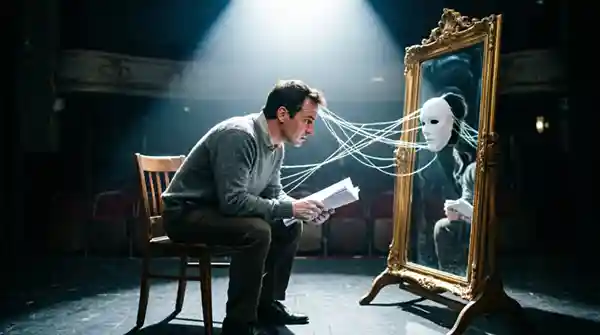
How to Stop Living in Your Head and Start Living Your Life
The fantasy is always better. That is the problem. In your head, you are the hero. You say the right thing. You get the promotion. You win the argument. You are admired, desired, and understood. The fantasy is warm. It is safe. It is available at any moment, on any train, in any meeting, during any conversation that has become boring or painful. And that is why it is so dangerous. Because the real world is cold. It is uncertain. It is full of people who do not cooperate with your script. So you retreat. You go back inside. You rehearse a life you are not living. And the life you are actually living passes you by.
I have been watching this pattern for years. Not as a clinician. As an observer. A traveler through the strange landscape of the human mind. What I have found is that the line between healthy imagination and self-destructive fantasy is not a wall. It is a blur. And most people do not realize they have crossed it until they are already lost.
Why your brain prefers fantasy to reality
The brain is a prediction machine. It is constantly generating models of what is likely to happen next. When the real world is unpredictable, the brain seeks predictability. Fantasy provides it. In fantasy, you control the variables. In fantasy, the outcome is known. In fantasy, you are never rejected, never embarrassed, never caught off guard.
Eli Somer, a professor at the University of Haifa, coined the term “maladaptive daydreaming” in 2002. He described it as “extensive fantasy activity that replaces human interaction and interferes with academic, interpersonal, or vocational functioning.” The key word is “replaces.” The fantasy does not supplement reality. It substitutes for it. It becomes the primary source of emotional satisfaction. And once it becomes the primary source, the real world becomes a distraction from the fantasy rather than the other way around.
A 2025 study published in the Journal of Clinical Psychology examined the prevalence of maladaptive daydreaming in a sample of 1,200 adults. The findings showed that approximately 2.5 percent of the general population met the criteria for maladaptive daydreaming. The rate was higher among younger adults and among those who reported childhood emotional neglect. The researchers concluded that fantasy serves as a compensatory mechanism for unmet needs. The fantasy provides what the real world does not. And the more the real world fails to provide, the more attractive the fantasy becomes.
The problem is not the fantasy itself. The problem is the feedback loop. The more time you spend in the fantasy, the less time you spend building a real life that could meet your needs. The less you build, the more you need the fantasy. The cycle repeats. The room gets smaller. The world outside the window gets farther away.
What maladaptive daydreaming actually looks like
The stereotype is the teenager who stares out the window during class, lost in a world of superheroes and romance. The stereotype is not entirely wrong. But it is incomplete. Maladaptive daydreaming does not always look like staring out a window. It often looks like productivity. It looks like scrolling. It looks like planning. It looks like the person who is always busy, always working, always preparing for a future that never arrives. The fantasy can be a fantasy of success. The fantasy can be a fantasy of revenge. The fantasy can be a fantasy of being understood. The content matters less than the function. The function is escape.
A 2025 study published in Consciousness and Cognition examined the neural correlates of maladaptive daydreaming. The researchers found that individuals with high levels of maladaptive daydreaming showed increased activity in the default mode network, the brain system associated with self-referential thought and mind-wandering. They also showed reduced connectivity between the default mode network and the executive control network, the system responsible for directing attention to external tasks. In other words, the brain was more practiced at going inward than at coming outward. The inward motion had become the default.
This is why the advice to “just focus” does not work. The person who is lost in fantasy is not lacking focus. They are focusing on the wrong thing. They are focusing on the internal world, which is rich, controllable, and rewarding. The external world, by contrast, is unpredictable, effortful, and often disappointing. The brain chooses the reward. The choice is not conscious. It is physiological. And it can be changed, but only through the slow retraining of attention.
The social cost of living in your head
The most painful consequence of maladaptive daydreaming is not the lost time. It is the lost connection. The person who lives in their head is not present. They are physically in the room, but psychologically somewhere else. They nod at the right moments. They say the right words. But they are not there. And the people who love them can feel the absence.
The research on social connection and well-being has consistently found that the quality of relationships is the strongest predictor of long-term happiness. A 2025 study published in The Lancet Public Health by researchers at Johns Hopkins University found that social isolation was associated with a significantly increased risk of dementia, independent of other risk factors. The isolation is not always physical. It can be attentional. The person who is surrounded by people but does not see them is isolated. The person who is alone but sees the world is connected.
The person who lives in fantasy is both isolated and connected. They are connected to the characters in their head. They are isolated from the people in the room. And the isolation deepens over time. The real people become less interesting, less cooperative, less satisfying. The fantasy people become more. The real people stop calling. The fantasy people never leave. And the person wakes up one day to discover that they have built a life that exists only in their imagination.
How to tell the difference between dreaming and escaping
Not all fantasy is maladaptive. Daydreaming is normal. It is creative. It is restorative. It is a way of processing experience and rehearsing possibilities. The difference between healthy daydreaming and maladaptive daydreaming is not the content. It is the function. Healthy daydreaming supplements reality. Maladaptive daydreaming replaces it.
The test is simple. Ask yourself what you are avoiding. When you slip into the fantasy, what are you escaping from? A difficult conversation? A boring task? A feeling of loneliness? If the fantasy is a way of taking a break, it is healthy. If the fantasy is a way of never coming back, it is a problem.
The research on experiential avoidance, developed by researchers including Steven Hayes at the University of Nevada, Reno, has shown that the attempt to avoid uncomfortable internal experiences is one of the primary drivers of psychological distress. The avoidance provides short-term relief. It produces long-term damage. The person who escapes into fantasy to avoid loneliness does not become less lonely. They become more lonely. They have practiced being alone. They have lost the skills of connection.
Small steps that pull you back to earth
The exit from maladaptive daydreaming is not a single decision. It is a practice. It is the gradual retraining of attention from the internal world to the external one. The retraining is uncomfortable. The external world is less rewarding at first. It is less predictable. It is less kind. But it is real. And the realness is the point.
The first step is to notice. You cannot change what you do not see. The person who slips into fantasy without noticing is not in control. They are on autopilot. The noticing is the interruption. When you catch yourself drifting, name it. Say to yourself: “I am drifting.” The naming is not a judgment. It is a recognition. It creates a small gap between the impulse and the action. And in that gap, choice becomes possible.
The second step is to ground yourself in your body. The fantasy lives in the head. The body is always in the present. The research on interoception, the sense of the internal state of the body, has shown that people who are better at detecting their own physiological signals are also better at regulating their emotions. The practice is simple. Notice your feet on the floor. Notice your breath. Notice the temperature of the air on your skin. The body is the anchor. The anchor brings you back.
The third step is to engage. The fantasy is a substitute for connection. The antidote is connection. Call a friend. Go for a walk. Join a group. Do something that requires you to be present with other people. The research on behavioral activation, developed by Peter Lewinsohn at the University of Oregon, has shown that starting with small, achievable actions is one of the most effective ways to overcome the paralysis that accompanies depression. The action does not need to be meaningful in itself. It needs to be real. The real action produces evidence. The evidence produces motivation.
The fourth step is to build a life that does not require escape. The fantasy is a symptom of an unmet need. The need is real. The fantasy is a counterfeit. The work is to identify the need and find a real way to meet it. If you are lonely, build relationships. If you are bored, find challenge. If you feel powerless, take action. The fantasy will lose its grip when the real world starts to provide what the fantasy was providing.
When fantasy is a symptom, not a habit
There is a limit to what self-directed change can accomplish. Some fantasy is not a habit that can be broken. Some fantasy is a symptom of a clinical condition. Maladaptive daydreaming is not currently recognized as a standalone diagnosis in the Diagnostic and Statistical Manual of Mental Disorders, but it is frequently associated with ADHD, anxiety disorders, depression, and trauma. If the fantasy is compulsive, if it interferes with sleep, appetite, work, or relationships, if the effort to stop is producing distress rather than progress, the appropriate response is not to try harder to control it alone.
It is to speak with a mental health professional who can assess what is happening and recommend an appropriate course of care. The research on anxiety, depression, and trauma is robust. Effective treatments exist. Seeking help is not a sign that you have failed to be disciplined. It is a recognition that some patterns are not the kind you can think your way out of. They are the kind that require a guide.
The reality that is waiting for you
The fantasy is a rehearsal. But you cannot rehearse forever. The stage is waiting. The audience is waiting. The life you have been postponing is waiting. It will not wait indefinitely. The people in your life will not wait indefinitely. The opportunities will not wait indefinitely. The fantasy will always be there, offering its warm and predictable embrace. The question is whether you will choose it again, or whether you will choose the cold, uncertain, beautiful reality of a life that is actually yours.
The first step is not a grand gesture. It is a small one. It is the decision to stay in the room for one more minute. To listen to one more sentence. To ask one more question. To be present for one more moment. The moment is the beginning. The beginning is available. The available is yours.
You have been living in your head. The door is open. You can come back down to earth. The earth is waiting.