The Negativity Bias Is Not Your Fault (But It Is Your Problem)
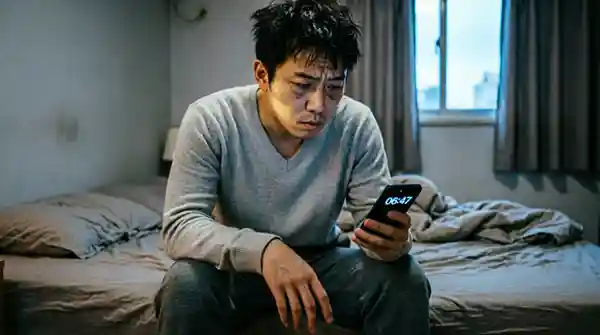
The thought arrived at 6:47 a.m., before my feet hit the floor. You’re going to blow it today. No evidence. No warning. Just the verdict, delivered by a voice that sounded like my own but wasn’t. I lay there for a minute, letting it settle. Then I got up, made coffee, and started writing this. Not because I have the answer. Because I have the question. Why does the brain insist on replaying the worst-case scenario when the day hasn’t even started yet?
Monday: the reflex you never chose
Roy Baumeister and his colleagues published a review in 2001 called “Bad Is Stronger Than Good.” The title says everything. Across dozens of studies, they found that negative events have a greater psychological impact than positive ones. A single criticism can erase a dozen compliments. A single failure can overshadow a string of successes. The brain is not designed to be happy. It is designed to keep you alive. And keeping you alive means paying more attention to what might go wrong than to what might go right.
Rick Hanson, a psychologist who writes about the neuroscience of happiness, put it in a way I haven’t been able to forget: “The mind is like Velcro for negative experiences, and Teflon for positive ones.” The image is perfect. The bad sticks. The good slides off.
A 2025 study published in Nature Human Behaviour examined the neural mechanisms of this bias. The researchers found that the amygdala, the brain’s threat-detection center, responds more strongly to negative stimuli than to positive stimuli, even when the stimuli are equally intense. The response is not conscious. It is not a choice. It is a reflex. The reflex fires before you can think.
Tuesday: what the brain scans actually show
A SPECT study of 1,984 people with anxiety disorders found that stronger negativity bias is linked to measurable changes in brain function. The changes were most pronounced in areas responsible for focus, decision-making, and emotional regulation. Persistent negative thinking doesn’t just affect how you feel. It influences how your brain works.
The study, published in Depression and Anxiety, found that people with anxiety disorders showed lower activity in the prefrontal cortex, the region responsible for top-down control, and higher activity in the amygdala. The pattern was consistent across the sample. The brain was stuck in threat-detection mode, unable to shift into problem-solving mode.
A 2026 study published in Sport, Exercise, and Performance Psychology examined how negativity bias manifests in competitive athletes. The researchers conducted two interviews with 31 adult athletes over a competitive season and identified three themes: negative events were more accessible, more vivid, and more memorable; they seized attention for better or worse; and they contaminated the overall experience. The athletes didn’t choose to focus on the negative. The negative chose them.
Wednesday: why the bias exists
The negativity bias is not a malfunction. It is an evolutionary adaptation. The ancestors who ignored the rustle in the grass did not become ancestors. The ones who assumed it was a predator survived. You are the descendant of the anxious. The reflex is in your blood.
But the reflex is not destiny. A 2025 study published in Humanities and Social Sciences Communications examined whether high lexical construal levels could reduce negativity bias in online reading. The researchers found that when participants processed words at a higher construal level—when they focused on the abstract, general meaning rather than the concrete, specific details—the negativity bias was attenuated. Positive words were processed more efficiently. The automatic advantage for negative words was reduced.
The finding suggests something important. The bias is not fixed. It can be shifted by changing how you process information. Not by denying the negative. By changing the level at which you engage with it.
Thursday: the practice that changes the signal
Gratitude is one of the best-studied counterweights to negativity bias. A 2024 article from University of Utah Health explained it simply: “Gratitude counteracts the negativity bias by helping us focus on the good things in our lives.” The research on gratitude interventions has consistently found that the practice reduces symptoms of depression and anxiety while increasing well-being.
A 2026 article in the American Bar Association newsletter described a ten-minute weekly practice. Write two short lists. Three good things that happened. Three things you’re grateful for. The first list trains you to notice what went right, including your own part in it. The second points outward, to the people who made it possible. Together, they push back on the bias from two directions.
The practice is not complicated. It is not time-consuming. It is not expensive. The problem is that it feels too simple to work. The person who is stuck in the negativity loop wants a dramatic solution. The brain doesn’t do dramatic. It does repetition. Small, consistent practices build new neural pathways over time. The pathway is the change.
Friday: cognitive reappraisal and the flexible brain
Cognitive reappraisal is the practice of reinterpreting a situation in a way that changes its emotional impact. It is one of the most studied emotion regulation strategies in psychology. A 2025 randomized controlled trial published in Scientific Reports examined the effects of a five-week cognitive reappraisal training on college students. The participants practiced reinterpreting negative emotional situations in a more positive light, twice a week for five weeks. The findings showed that the training reduced emotional distress and produced measurable changes in the brain’s resting-state functional connectivity.
The mechanism is not positive thinking. It is flexibility. The person who can reinterpret a situation is not denying the difficulty. They are expanding the range of possible meanings. A rejection can mean “I’m not good enough.” It can also mean “this wasn’t the right fit.” A failure can mean “I’m a failure.” It can also mean “I learned something I didn’t know before.” The event is the same. The meaning is different. And the meaning determines the response.
Saturday: the story I didn’t tell myself
I have been practicing this for three months. Not perfectly. Not consistently. But enough. The voice at 6:47 a.m. still arrives. It still says the same thing. But I have started to notice something. The voice is not a verdict. It is a prediction. And predictions can be wrong.
The research on cognitive reappraisal flexibility and variability, conducted by Birgit Kleim and colleagues at the University of Zurich, found that the ability to flexibly apply reappraisal strategies across different situations predicted better mental health outcomes in response to real-life stressors. The person who has only one strategy is fragile. The person who has several is resilient.
I have been building my strategies. Not because I am disciplined. Because I am tired of being stuck. The practice is the exit. The exit is slow. The exit is available.
Sunday: when the bias is not a habit
There is a limit to what self-directed change can accomplish. Some negativity is not a habit that can be broken. Some negativity is a symptom of a clinical condition. If the sadness is persistent, if it interferes with sleep, appetite, work, or relationships, if the effort to think differently is producing distress rather than progress, the appropriate response is not to try harder to be positive. It is to speak with a mental health professional who can assess what is happening and recommend an appropriate course of care.
The research on cognitive behavioral therapy, acceptance and commitment therapy, and other evidence-based approaches is robust. Seeking help is not a sign that you have failed to discipline your mind. It is a recognition that some patterns are not the kind you can think your way out of. They are the kind that require a guide.
Monday: the same morning, a different thought
The thought arrived at 6:47 a.m. You’re going to blow it today. I lay there for a minute. Then I did something different. I didn’t argue with it. I didn’t try to replace it with something positive. I just asked: What else could be true? The answer came slowly. You might not blow it. You might do fine. You might even do well. The thought didn’t disappear. It just made room for other thoughts. And that, I am learning, is how it works. Not by eliminating the negative. By refusing to let it be the only voice in the room.
The bias is real. The reflex is real. The practice is real. The practice is available. The available is now.