Anger Management That Actually Works: A Skeptic’s Guide
The light turns red. You slam the brakes. Your heart is pounding. The driver in front of you is checking his phone, oblivious to the fact that his momentary distraction has just triggered a physiological cascade in your body that will take at least twenty minutes to fully resolve. You honk. You curse. You consider following him. You do not. But the anger stays with you for hours. It colors your morning. It shortens your patience. It makes you a slightly worse version of yourself for the rest of the day.
This is not a character flaw. It is a nervous system doing exactly what it evolved to do. And the research on what actually helps is more specific than most people realize.
Inside the brain during an anger spike
The amygdala is a small, almond-shaped cluster of neurons deep in the brain. It has one job: detect threats. When it perceives a threat—physical or social—it fires. It does not wait for the prefrontal cortex, the brain’s reasoning center, to weigh in. It does not consult logic. It does not consider context. It just fires. And when it fires, it triggers a cascade of hormones: adrenaline, noradrenaline, cortisol. The heart rate spikes. The muscles tense. The digestive system shuts down. The body prepares for fight or flight.
A 2026 review published in Translating Affective Neuroscience into Clinical Practice describes anger as a continuum from assertiveness through frustration, irritability, anger, aggression, and finally rage. As arousal escalates, the prefrontal cortex’s braking systems weaken. The person who is mildly frustrated can still access logic. The person who is enraged cannot. The braking system has failed.
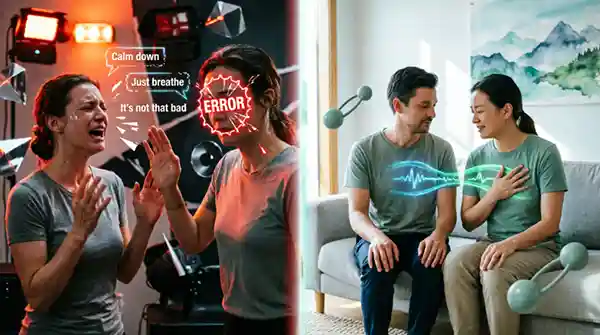
This is why the advice to calm down is useless. You cannot reason with a brain that has already decided it is under attack. The reasoning center is offline. The threat center is in control. The only thing that works is interrupting the cascade before it completes.
Three ways people handle anger (and why two fail)
The American Psychological Association identifies three main ways people respond to anger: expressing, suppressing, and calming.
Expressing anger in an assertive, non-aggressive way is the healthiest option. But most people do not express anger. They explode. They attack. They say things they regret. The difference between assertion and aggression is the difference between “I feel frustrated when this happens” and “You always do this, you idiot.” One invites conversation. The other invites war.
Suppressing anger is the second option. You swallow it. You push it down. You tell yourself you are fine. You are not fine. The research on emotional suppression, developed by James Gross at Stanford University, has consistently found that suppression is associated with poorer outcomes than reappraisal. Suppressors experience higher levels of negative emotion, lower levels of positive emotion, impaired memory, and reduced social connection. The anger does not disappear. It goes underground. It leaks. It becomes passive aggression, chronic resentment, or a sudden explosion over something trivial.
Calming is the third option. You soothe yourself from the inside. You take a deep breath. You count to ten. You remove yourself from the situation. The APA recommends simple relaxation tools: deep breathing from the diaphragm, relaxing imagery, slow repetition of a calming word like relax or take it easy. These techniques work. But they work best when they are practiced before the anger arrives, not after the amygdala has already fired.
I call the gap between trigger and response the anger gap. The anger gap is the space where choice lives. The person who can widen that gap—even by a few seconds—has more control than the person who cannot. The gap is trainable. It is not a personality trait.
How your thoughts pour gasoline on the fire
Anger is not caused by events. It is caused by interpretations of events. A driver cuts you off in traffic. That is an event. You interpret it as a personal attack, a sign of disrespect, proof that the world is full of selfish idiots. That interpretation produces the anger. The event did not produce it. The story did.
The research on cognitive distortions, developed by Aaron Beck at the University of Pennsylvania, has identified the specific thinking patterns that fuel anger. All-or-nothing thinking: “You never listen.” Overgeneralization: “This always happens to me.” Mind reading: “He did that on purpose.” Catastrophizing: “This is a disaster.” Personalization: “They are doing this to spite me.” These distortions are not random. They are habits. They are the grooves that anger has worn into your mind.
The APA recommends several cognitive strategies. Don’t use words like always or never when discussing problems. Focus on goals and how to achieve them rather than dwelling on the problem. Use logic. Remind yourself that the world is not out to get you. That the situation is frustrating, not catastrophic. That you are angry, not under attack.
A 2025 study published in The Journal of Positive Psychology examined the efficacy of benefit-finding and compassion-focused reappraisal on hostility. The findings showed that both strategies significantly reduced hostility across measures of directed anger. The mechanism was not distraction. It was reinterpretation. The participants learned to see the situation differently, and the different seeing produced a different feeling.
What the research says about the strategies that actually work
The most effective anger management strategies share a common structure. They interrupt the automatic response. They create a gap between the trigger and the reaction. And in that gap, choice becomes possible.
Mindfulness is one of the most studied strategies. A 2025 meta-analytic review published in ScienceDirect examined the associations and effects of mindfulness on anger and aggression. The findings showed that across experimental studies, mindfulness significantly reduced anger and aggression, with medium-to-large effect sizes. Dispositional mindfulness was inversely associated with both anger and aggression levels. The researchers concluded that mindfulness is an effective strategy for regulating anger and aggressive behavior across various contexts and populations.
The mechanism is not relaxation. It is awareness. Mindfulness teaches you to notice the anger as it arises, before it becomes a reaction. You learn to observe the sensation in your body—the tight chest, the clenched jaw, the heat in your face—without immediately acting on it. The observation is the interruption. The interruption is the choice.
A 2025 randomized controlled trial published in ScienceDirect examined the effect of a coping with anger psychoeducation program on nursing students. The findings showed that the cognitive-behavioral approach-based program reduced trait anger, anger in, and anger out, and increased anger control. The program was not therapy. It was education. It was teaching people what anger is, where it comes from, and what to do with it. The education worked.
Ask yourself this one question
There is a question that therapists use with clients who struggle with anger. It is not a technique. It is a lens. The question is: what is the anger protecting you from?
Anger is often a secondary emotion. It is a cover for something more vulnerable: fear, shame, grief, rejection, helplessness. The person who rages at their partner for being late is not angry about the lateness. They are afraid of being abandoned. The person who explodes at a colleague for a minor mistake is not angry about the mistake. They are ashamed of their own perceived inadequacy. The person who screams at a driver who cuts them off is not angry about the traffic. They are carrying a weight they cannot name, and the traffic is the only thing they can safely attack.
The research on emotion differentiation has shown that people who can distinguish between similar emotional states experience better emotional regulation. The person who can say “I am not angry, I am afraid” has already taken the first step toward managing the anger. The naming is the beginning.
Keep a log, change the pattern
One of the most practical tools in anger management is also one of the simplest. It is the anger log. You write down the trigger. You write down what you were thinking. You write down what you were feeling in your body. You write down what you did. And you write down what you wish you had done instead.
The log is not a punishment. It is a map. It shows you the patterns you cannot see when you are inside them. The trigger that always gets you. The thought that always precedes the explosion. The physical sensation that is your early warning signal. The behavior that always follows. Once you can see the pattern, you can interrupt it.
The research on self-monitoring has consistently found that the act of recording behavior changes the behavior. The person who writes down what they eat eats differently. The person who writes down when they get angry gets angry less often. The awareness is the mechanism. The mechanism is the beginning.
Breathe to buy yourself a second
The simplest intervention is also the most underrated. It is the breath. Not the deep, dramatic breath of someone trying to calm down. The quiet, unnoticed breath of someone who has learned to create a gap between the trigger and the response.
The physiological mechanism is the vagus nerve. When you exhale slowly, the vagus nerve is activated, which slows the heart rate and shifts the nervous system toward parasympathetic dominance. The parasympathetic system is the brake. The amygdala is the accelerator. The breath is the pedal that engages the brake.
The research on heart rate variability has shown that people with higher vagal tone—the measure of how well the parasympathetic system is functioning—are better at regulating their emotions. The vagal tone can be improved through practice. Slow breathing, meditation, and physical exercise all increase vagal tone. The improvement is not dramatic. It is cumulative. The person who practices slow breathing every day for a month will have a different nervous system than the person who does not.
What is the anger costing you?
There is a concept in behavioral economics called the sunk cost fallacy. It describes the tendency to continue investing in something because of what you have already invested, even when the investment is no longer wise. The same pattern applies to anger. You have invested so much energy in being angry that you cannot imagine not being angry. The anger has become part of your identity.
The research on anger and health has shown that chronic anger is associated with increased risk of cardiovascular disease, impaired immune function, and shortened lifespan. The research on anger and relationships has shown that chronic anger is one of the strongest predictors of divorce and social isolation. The research on anger and career has shown that people who cannot regulate their anger are less likely to be promoted and more likely to be terminated.
The anger is not free. It costs you. The question is whether you are willing to pay the price. The price is your health, your relationships, your career, your peace of mind. The anger offers a momentary sense of power, a momentary sense of justice, a momentary sense of control. But the moment passes. The cost remains.
When anger is not a habit but a disorder
There is a limit to what self-directed strategies can accomplish. Some anger is not a habit that can be broken. Some anger is a symptom of a clinical condition. Intermittent explosive disorder (IED) affects an estimated 7.3 percent of U.S. adults at some point in their lives. It is characterized by recurrent, impulsive, aggressive outbursts that are disproportionate to the triggering event. The outbursts are not premeditated. They are not instrumental. They are explosions.
A 2025 comprehensive review and meta-analysis published in Clinical Psychology and Psychotherapy examined psychological and pharmacological treatments for IED. The findings showed that cognitive behavioral therapy is the most effective psychological intervention. Selective serotonin reuptake inhibitors, particularly fluoxetine, demonstrated notable efficacy in managing irritability. Mood stabilizers and antipsychotics are also used off-label. The prognosis improves with consistent therapy and medication adherence. It worsens when untreated.
Only 13.9 percent of people with IED obtain any treatment from a mental health service provider. The vast majority manage it alone, often for years. They do not need to. The research on treatment is robust. Effective help exists.
If the anger is persistent, if it interferes with sleep, appetite, work, or relationships, if the outbursts are causing harm to yourself or others, the appropriate response is not to try harder to control it alone. It is to speak with a mental health professional who can assess what is happening and recommend an appropriate course of care. Seeking help is not a sign of weakness. It is a recognition that some patterns are not the kind you can think your way out of.
The same light, the same driver, a different response
The light turns red. You slam the brakes. Your heart is pounding. The driver in front of you is checking his phone. But this time, something is different. You notice the heat in your chest. You name it. You say to yourself: this is anger. You take one slow breath. You wait. The light turns green. You drive. The anger is still there. But it is not driving.
The practice is not a cure. It is a direction. The direction is toward the gap. The gap is where the choice lives. The choice is yours.