How to keep your brain sharp: the science of novelty, movement, and social connection
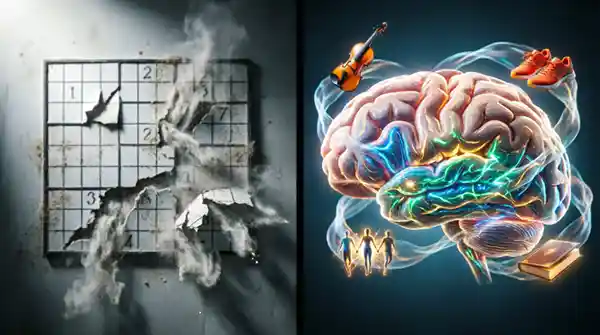
The brain does not care about Sudoku the way you think it does. It cares about novelty. It cares about challenge. It cares about the unexpected. The research on cognitive aging has moved past the simple idea that any mental activity is good mental activity. The newer evidence points to something more specific: the brain responds to what is new, what is difficult, and what forces it to build connections it did not have before. I call this contralateral living: the deliberate practice of using the non-dominant side of your body for routine tasks, which forces the brain to abandon its automatic pathways and construct new ones. It is one tool among several. But it is a useful place to start.
Why your brain needs novelty more than Sudoku
Doing the same crossword puzzle every morning is not exercise. It is rehearsal. The brain is efficient. Once a task becomes automatic, the neural activity required to perform it drops. The task feels productive because it is familiar. It is not building new capacity.
The research on cognitive reserve, developed by Yaakov Stern at Columbia University, has shown that the brain can withstand age-related changes by building redundant connections. The people with the highest reserve are not necessarily those with the most education or the highest IQ. They are the ones who have continued to challenge their brains across a lifetime. Novelty is the mechanism. Repetition is the maintenance. Both matter, but novelty drives growth.
A 2025 study in The Journals of Gerontology: Series B examined the effects of novel cognitive activities on memory in older adults. Participants who learned a new skill—digital photography, quilting, or both—showed significant improvements in memory compared with participants who engaged in familiar activities like crossword puzzles or listening to classical music. The familiar activities were pleasant. They were not growth-producing. The novel activities were frustrating. They were also effective.
The non-dominant hand trick: what it does and does not do
Using your non-dominant hand for daily tasks is a simple form of contralateral living. Brush your teeth with the other hand. Write your grocery list with the other hand. Stir the pot with the other hand. The task is trivial. The neural demand is not.
When you use your dominant hand, the motor program is consolidated. The movement is smooth, automatic, and cheap. When you switch hands, the brain cannot rely on the old program. It has to recruit new pathways, coordinate new muscles, and tolerate a period of clumsiness. That discomfort is the signal that learning is happening.
The research on neuroplasticity has shown that the adult brain remains capable of forming new connections throughout life. The rate slows. The conditions required become more specific. But the capacity remains. A 2025 study in Neural Plasticity found that non-dominant hand training in healthy adults produced measurable changes in cortical thickness and improved performance on tasks requiring cognitive flexibility. The changes were modest. They were real.
The caveat matters. Using your non-dominant hand is not a treatment for Alzheimer’s disease. It is not a cure for memory loss. It is a small, accessible practice that supports the general health of the brain. If you are concerned about persistent memory problems, difficulty with familiar tasks, or changes in mood or personality, the appropriate response is to speak with a neurologist or a qualified medical professional who can assess what is happening. The research on dementia is robust. Early evaluation matters. Self-directed brain games are not a substitute for clinical care.
Learning a language: the strongest cognitive workout
If there is a single cognitive activity with the strongest evidence behind it, it is learning a new language. The research of Ellen Bialystok at York University in Toronto has consistently found that bilingualism is associated with a delay in the onset of dementia symptoms. The delay is not a cure. It is a postponement. In a world where the disease has no cure, postponement is valuable.
Bialystok’s studies compared monolingual and bilingual adults and found that the bilingual group showed symptoms of dementia an average of four to five years later than the monolingual group. The mechanism appears to be cognitive reserve. Managing two languages requires constant inhibition, switching, and monitoring. That constant demand builds a buffer. The buffer does not prevent the disease. It delays the point at which the disease becomes visible.
A 2025 study in Neurobiology of Aging examined the effects of short-term language learning in older adults. Participants who completed an eight-week introductory Spanish course showed improvements in attention and working memory compared with a control group. The improvements were not dramatic. They were measurable. The learning was the intervention. The intervention was the novelty.
Puzzles, chess, and games: useful but oversold
Crossword puzzles, Sudoku, chess, and bridge are not useless. They are pleasant. They are engaging. They are better than passive television. But the evidence that they prevent cognitive decline is weaker than the marketing suggests. The problem is that once you become good at a puzzle, the puzzle stops being novel. The brain adapts. The challenge fades. The exercise becomes rehearsal.
The research on transfer effects has shown that practicing a specific cognitive task improves performance on that task and similar tasks. It does not reliably improve general cognitive ability. The person who gets better at Sudoku gets better at Sudoku. They do not necessarily get better at remembering names, planning complex projects, or resisting distraction.
The practical implication is not to abandon puzzles. It is to hold them lightly. If you enjoy chess, play chess. If you enjoy bridge, play bridge. But do not mistake the enjoyment for prevention. The prevention comes from novelty. The novelty comes from doing something you are not yet good at.
The loneliness risk that rivals smoking
Social connection is not a soft variable. It is a hard health variable. A 2025 study published in The Lancet Public Health by researchers at Johns Hopkins University found that social isolation was associated with a significantly increased risk of dementia, independent of other risk factors including depression, hypertension, and diabetes. The effect size was substantial. The risk was comparable to the risk associated with smoking.
The research on social engagement and cognitive aging has shown that people who maintain diverse social networks have slower rates of cognitive decline than people who are isolated. The mechanism is not mysterious. Conversation requires attention, memory, and flexible thinking. It requires reading facial expressions, interpreting tone, and responding in real time. It is a cognitive workout that does not feel like a workout. The workout is the point.
A 2024 study in The Journals of Gerontology: Series B found that participation in social activities—church groups, volunteer organizations, book clubs, walking groups—predicted better cognitive performance in older adults. The effect was independent of baseline cognitive ability. The activity was the intervention. The intervention was the connection.
If you are experiencing persistent loneliness, or if you are caring for someone with dementia and feeling isolated, the appropriate response is not to try harder to manage alone. It is to speak with a mental health professional or a social worker who can connect you with support. The research on caregiver burden and social isolation is robust. Support is not a sign of failure. It is a recognition that some loads are heavier than individual effort can carry.
Exercise that grows the hippocampus
Physical exercise is the most reliable intervention for brain health. The research on exercise and cognition has consistently found that aerobic activity improves attention, memory, and executive function. It increases blood flow to the brain, stimulates the release of growth factors including BDNF, and promotes the formation of new neurons in the hippocampus.
Kirk Erickson at the University of Pittsburgh conducted a landmark study that examined the effects of moderate aerobic exercise on hippocampal volume in older adults. The findings showed that participants who walked for forty minutes three times a week for one year had a two percent increase in hippocampal volume. The control group, which did stretching and toning, had a one percent decrease. The hippocampus is the region responsible for forming new memories. It shrinks with age. Exercise reversed the shrinkage.
The recommendation that emerges from the research is not complicated. Walk. Swim. Cycle. Dance. The form matters less than the consistency. The goal is moderate intensity, the kind that makes you slightly breathless but still able to talk. Thirty to forty-five minutes, three to five times a week. The exercise is the medicine. The medicine is free.
When memory changes are not normal aging
It is normal to forget a name and remember it later. It is normal to misplace your keys and find them in the usual place. It is normal to walk into a room and forget why you went there. It is not normal to forget what keys are for. It is not normal to get lost in a familiar neighborhood. It is not normal to repeat the same question within minutes because you do not remember asking it.
The distinction between normal aging and something more serious is not always obvious. The Alzheimer’s Association reports that one in three seniors dies with Alzheimer’s or another dementia. The disease is not a normal part of aging. It is a progressive brain disorder. The risk increases with age, but age alone does not cause it.
If you are concerned about your memory, or the memory of someone you love, do not wait. Speak with a doctor. The evaluation may include cognitive testing, a neurological examination, and blood work to rule out reversible causes including vitamin deficiencies, thyroid disorders, and medication side effects. The earlier the evaluation, the more options are available. There is no cure. There is support. There is management. There is dignity.
Building a brain-health plan that actually sticks
The research points toward a set of practices that are more reliable than any single intervention. The practices are not glamorous. They are not expensive. They are available to anyone willing to make the effort.
Use your non-dominant hand for one routine task each day. Learn a few words of a new language. Take a walk. Call a friend. Do something you are not yet good at. The task does not need to be grand. It needs to be new. The novelty is the mechanism.
The brain is not a muscle. It does not grow through simple repetition. It grows through challenge, through novelty, through the discomfort of doing something unfamiliar. The discomfort is not a sign that something is wrong. It is a sign that something is happening. The happening is the point. The point is the life.