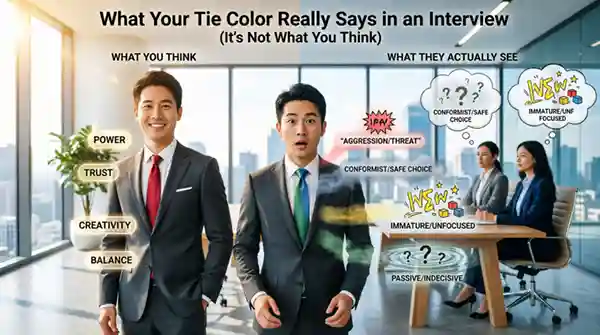
The knot that speaks before you do
The tie is a strange artifact. It serves no practical function. It does not keep you warm. It does not hold your pants up. It does not protect you from the elements. It is a strip of fabric, tied in a specific way, worn around the neck, and it communicates something before you open your mouth. That is its only job. And it is remarkably good at it.
I call this chromatic authority: the perceived power, competence, and trustworthiness conferred by a specific color choice in professional dress, operating through learned associations rather than any inherent property of the fabric. Chromatic authority is not about the tie itself. It is about what the observer projects onto the tie. The tie is a screen. The observer is the projector.
A tie manufacturer in London once commissioned a psychologist to study this. The psychologist, Ludwig Lowenstein, surveyed two thousand men about their tie choices and their perceptions of others’ ties. The findings were published in a style guide that circulated widely. Purple was the worst. It signaled arrogance and gaudiness. Green suggested greed and jealousy. Red, blue, and yellow were the good colors. They hinted at reliability, strength, and optimism. The guide advised job seekers to avoid expensive, shiny, boldly patterned ties because they might create a sense of overwhelming superiority in the eyes of the interviewer. Conservative printed ties were safer. Bow ties were reserved for clowns.
This is folk wisdom dressed as science. And it is not entirely wrong.
What the research actually shows
The academic literature on tie color is thinner than the style guides suggest, but it is not empty. A 2015 study by Robin Kramer, published in SAGE Open, tested whether wearing a red tie affected perceptions of a political leader. Participants watched a video of a politician delivering a speech. The tie was digitally changed to red or blue. The results showed no effect of tie color on ratings of leadership or dominance. When the politician wore blue, he was rated slightly more believable, but the effect disappeared after statistical correction. The study concluded that in video stimuli, other factors—movement, facial expression, tone of voice—overwhelm the tie.
But the same study tested static images. Previous research had found that red clothing can influence perceptions in photographs. A 2014 study by Bashir and Rule found that a red tie increased perceptions of dominance and leadership potential. A 2013 study by Maier and colleagues found that red enhanced perceptions of attractiveness. The effect is real. It is just fragile. It survives in a photograph. It disappears in a video. It is a signal that competes with a dozen other signals, and it often loses.
The broader research on attire is more robust. A 2025 study published in the Journal of Nonverbal Behavior examined how formal versus casual attire influenced first impressions. Participants rated individuals wearing formal dress as significantly higher in status and dominance than those wearing casual dress. The effect was consistent across contexts. Formal attire did not just signal professionalism. It signaled power. The tie is part of that uniform. It is not the whole uniform. But it is the most visible, most variable, most semiotic part.
The research on color psychology more generally supports the idea that colors carry learned associations. Red is associated with danger, passion, and dominance. Blue is associated with calm, trust, and competence. Green is associated with nature, health, and—in some contexts—jealousy. These associations are not universal. They are cultural. They are learned. They can be changed. But they are real enough to influence behavior in the moments when people are forming judgments quickly.
Why red is not a power tie
The red power tie is a myth that refuses to die. It is repeated in business magazines, in style guides, in the advice columns that tell you to wear red when you want to project confidence. The research does not support the myth. Red does not make you look more powerful. It makes you look more aggressive. It makes you look more dominant. Those are not the same thing.
Dominance is about forcing compliance. Power is about earning trust. The red tie might help you in a negotiation where you need to intimidate the other side. It will not help you in a job interview where the interviewer is asking themselves whether they want to spend eight hours a day with you. The Durham University study that Kramer cited found that red ties were associated with anger, aggression, and dominant behavior. The researchers warned that people should think carefully about wearing red in social situations and important meetings. The warning was clear. The myth persisted anyway.
The reason is that the myth is more appealing than the evidence. The red power tie is a simple story. Put on the tie, feel the power. The reality is messier. The tie does not give you power. It gives you a signal. The signal is interpreted differently by different people in different contexts. The man who wears a red tie to a job interview may think he is projecting confidence. The interviewer may see aggression. The gap between intention and perception is the space where careers are made and unmade.
When the signal backfires
The Peckham Rye guide warned that expensive, shiny, boldly patterned ties could create an overwhelming sense of superiority. The warning was about class, not color. A tie that costs more than the interviewer’s suit is not a signal of competence. It is a signal of privilege. It says: I am not like you. I do not need this job. That message is rarely well received.
The same logic applies to purple. The guide called purple the worst color because it signaled arrogance and gaudiness. But purple is also the color of royalty, of creativity, of individuality. In a creative industry, a purple tie might be an asset. In a conservative law firm, it might be a liability. The signal is not in the color. It is in the match between the color and the context.
A 2024 study on salesperson appearance, published in Industrial Marketing Management, found that attire influences customer perceptions in ways that are moderated by gender and context. The effect is not simple. A tie that reads as professional in one setting reads as pompous in another. The person who wears the same tie to every occasion is not projecting consistency. They are projecting a failure to read the room.
The most dangerous signal is the one you do not know you are sending. The tie you choose because you like it may be communicating something you did not intend. The interviewer who sees a green tie and thinks “greedy” is not responding to the tie. They are responding to an association they learned somewhere, from someone, at some point. The association may be unfair. It may be inaccurate. It is still real.
The limits of sartorial signaling
The tie is not a magic wand. It cannot make you competent. It cannot make you likable. It cannot make you trustworthy. It can only amplify or dampen the signals you are already sending with your words, your posture, your eye contact, and your handshake. The tie is a multiplier. If the underlying signal is strong, the tie can enhance it. If the underlying signal is weak, the tie cannot save it.
A 2021 study published in the Journal of Business Research found that the effect of attire on interview outcomes was mediated by perceived professionalism. The attire did not directly cause the hiring decision. It influenced the perception of professionalism, which influenced the decision. The chain was long. The tie was one link. The other links—the resume, the answers, the rapport—were stronger.
This is why the advice to “wear a blue tie to your interview” is both true and useless. It is true that blue is associated with trust and competence in many Western contexts. It is useless because the association is weak, and because the interviewer is evaluating a hundred other things at the same time. The blue tie will not get you the job. The absence of a blue tie will not lose you the job. The tie is a detail. Details matter. But they matter less than the whole.
The research on first impressions supports this. The brain forms judgments in milliseconds. Those judgments are based on the whole person—face, posture, expression, attire—not on a single accessory. The tie contributes to the whole. It does not determine the whole. The person who obsesses over the tie while ignoring the handshake has misunderstood the assignment.
What to wear instead
There is no universal tie color. There is only the tie that fits the context, the person, and the message. If the context is conservative, the tie should be conservative. Navy, burgundy, grey, muted patterns. If the context is creative, the tie can be more expressive. If the context is uncertain, the tie should be forgettable. The goal is not to be noticed for the tie. The goal is to be noticed for the person wearing it.
The research on color and context suggests a few general principles. Darker colors read as more authoritative. Lighter colors read as more approachable. Muted colors read as more sophisticated. Saturated colors read as more assertive. These are tendencies, not rules. The person who understands the tendencies can choose deliberately. The person who ignores them is choosing by accident.
The most important principle is consistency. The tie should match the rest of the outfit, and the outfit should match the role the person is playing. A candidate for a senior executive position who wears a loud, novelty tie is not projecting creativity. They are projecting a failure to understand the norms of the environment they are trying to enter. The same tie on a graphic designer might be an asset. The context determines the meaning.
The Peckham Rye guide advised job seekers to wear conservative printed ties. The advice was not about color. It was about risk. The conservative tie is less likely to trigger a negative association. It is less likely to distract. It is less likely to be remembered. In a job interview, being forgotten is often better than being remembered for the wrong reason.
The tie you cannot take off
The tie is a relic. It belongs to a world of offices and hierarchies and formal rituals that are slowly disappearing. The pandemic accelerated the decline. Remote work made the tie optional. Casual Friday became casual every day. The tie is no longer a requirement. It is a choice. And choices are always more revealing than requirements.
When you choose a tie, you are choosing to participate in a ritual that is older than you are. You are choosing to signal something about yourself to people who may or may not be paying attention. You are choosing to accept the rules of a game that you did not write. The choice is not neutral. It is a statement.
The statement can be conformity. The statement can be rebellion. The statement can be indifference. The tie does not care. The tie is just fabric. The meaning is in the wearing.
The most useful thing about the tie is that it is optional. When something is optional, the decision to wear it becomes meaningful. The person who wears a tie to a meeting where no one else is wearing one is sending a message. The message might be respect. The message might be hierarchy. The message might be insecurity. The tie does not specify. The observer does.
The research on nonverbal communication has shown that clothing influences perceptions of competence, but the effect is small and context-dependent. The tie is a subset of clothing. The effect is even smaller. The tie will not make you a leader. The tie will not make you a follower. The tie will make you a person who is wearing a tie. That is all.
But that is not nothing. In a world where most people dress casually, the person who wears a tie is making an effort. The effort is visible. The effort is a signal. The signal says: I take this seriously. I take you seriously. I take myself seriously. The signal is not always accurate. But it is always read.
The tie is a small thing. It is a knot of fabric. It is a color. It is a pattern. It is a decision. The decision is yours. The meaning is theirs. The gap between the two is the space where you live. The tie does not close the gap. It only makes it visible.
Wear the tie if you want to. Do not wear it if you do not. But know what you are doing. Know that the choice is a signal. Know that the signal is being read. Know that the reader is not you. The tie is not a cure. It is a question. The question is: who are you trying to be? The answer is not in the tie. The answer is in the wearing.