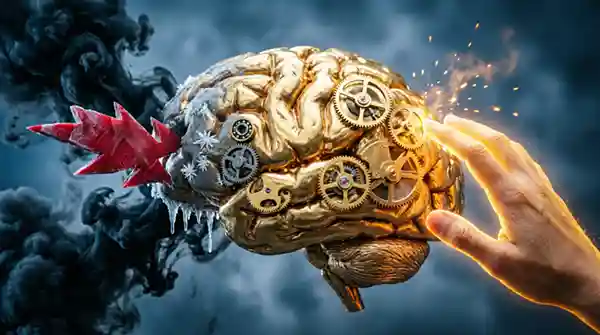
Rejection Drops Your IQ by 25%. Here’s What to Do About It
I bombed a job interview once.
Not because I was unprepared. I had rehearsed. I had the answers. I had the firm handshake and the eye contact and the whole nine yards. But somewhere in the middle of the second question, my brain just… stopped.
The words were there. The thoughts were there. But I couldn’t string them together. I felt like I was trying to run underwater. I walked out of that building feeling like I’d lost twenty IQ points in a conference room.
Turns out I had.
The study that should be on every HR brochure
In 2002, a team of researchers led by Roy Baumeister at Case Western Reserve University published a paper in the Journal of Personality and Social Psychology that should have changed how we think about rejection. The title was clinical: “Effects of social exclusion on cognitive processes: Anticipated aloneness reduces intelligent thought.” But the findings were anything but.
They ran three studies. In the first, participants were told—based on a bogus personality test—that they would end up alone in life. Not that they might. That they would. In the second, they were told they’d have stable, fulfilling relationships. In the third, they got the same treatment but with a twist: some participants were told they’d experience a series of non-social misfortunes—accidents, injuries, that sort of thing.
Then everyone took an IQ test.
The results were brutal. The people told they’d be alone scored significantly lower on IQ and on Graduate Record Examination performance. The decline wasn’t in simple information processing. That stayed intact. It was in complex cognitive tasks—effortful logic, reasoning, the stuff that requires you to hold multiple ideas in your head and manipulate them. Speed dropped. Accuracy dropped. Both at once.
And here’s the part that should make you sit up: the people who were told they’d suffer accidents and injuries? They performed fine. The cognitive impairment was specific to social exclusion. It wasn’t about bad news. It wasn’t about fear. It was about being told, even temporarily, that you don’t belong.
Baumeister summed it up in an interview with New Scientist: “People really are designed to get along with others. When you’re excluded, it has significant effects.”
What’s actually happening in your brain
The mechanism isn’t mysterious. It’s just cruel.
Naomi Eisenberger at UCLA has spent her career studying what she calls social pain—the painful feelings that follow rejection, exclusion, or loss. Her research, published in journals like Science and Nature Reviews Neuroscience, has shown that social pain relies on some of the same neural regions that process physical pain. The dorsal anterior cingulate cortex. The anterior insula. These aren’t metaphor centers. They’re the brain’s actual pain matrix.
When you get rejected, your brain processes it the way it would process a broken bone. That’s not a poetic observation. It’s a functional one. The brain treats social exclusion as a threat to survival because, for most of human history, it was. Being cast out of the tribe meant death. The brain doesn’t know the difference between a bad performance review and a predator.
So it mobilizes resources. It floods you with stress hormones. It narrows your attention. It prioritizes threat detection over abstract reasoning. And while all of that is happening, the prefrontal cortex—the part responsible for executive function, working memory, and complex problem-solving—gets starved of the resources it needs.
You can’t think straight because your brain is too busy trying to survive.
The working memory connection
A 2015 study in the Journal of Experimental Social Psychology examined the effects of ostracism on higher-order cognitive abilities. The findings were consistent with Baumeister’s earlier work. Ostracized participants showed decreased working memory, impaired decision-making, and reduced task persistence. Basic attention was unaffected. The damage was specific to the cognitive systems that require effort and control.
Working memory is the scratchpad of the mind. It’s what allows you to hold a conversation while remembering what you were going to say next. It’s what allows you to solve a problem while keeping the goal in mind. It’s what allows you to read a paragraph and remember what the first sentence said.
When working memory is impaired, everything that depends on it falls apart. You lose the thread of arguments. You forget why you walked into a room. You can’t follow instructions. You feel stupid.
You’re not stupid. You’re rejected.
The speed-accuracy tradeoff
Here’s where it gets even more interesting.
A 2021 study in Scientific Reports used the Cyberball paradigm—a computer game where participants are either included or excluded by other players—to examine the effects of social exclusion on the attention network. The results were surprising. The excluded group showed shorter response times and better executive control performance than the included group.
Wait. What?
The researchers found that excluded individuals showed a stronger ability to detect and control conflicts. They were faster. More efficient. It looked like social exclusion had actually improved their cognitive performance.
But here’s the catch. The tasks were simple. Conflict detection on a computer screen. Press the left button or the right button. That’s not the same as writing a report, giving a presentation, or solving a complex problem.
The research suggests that social exclusion may heighten vigilance—the brain’s alert system goes into overdrive—while simultaneously impairing the higher-order thinking that requires deliberate, controlled effort. You become hyper-aware of threats and completely unable to think abstractly. That’s not a bug. That’s a feature of a brain designed for survival in a hostile environment.
It’s just useless in a conference room.
Who gets hit hardest
Not everyone responds to rejection the same way.
Research on rejection sensitivity—the tendency to expect, perceive, and respond to rejection with intense distress—has shown that people high in this trait experience more severe cognitive effects. A 2024 thesis from the University of South Florida examined the relationship between rejection sensitivity and higher-order cognitive functions. The findings suggested that individuals with high rejection sensitivity showed differences in neural markers associated with inhibition and conflict monitoring.
The implication is that people who have been rejected more—who have learned to expect it—are more vulnerable to its cognitive costs. It’s a vicious cycle. You get rejected. Your brain stops working as well. You perform worse. You get rejected again. Your brain stops working even more.
This is why chronic loneliness is so devastating. It’s not just an emotional state. It’s a cognitive one. And it compounds.
The Baumeister experiment you can run on yourself
You don’t need a lab to test this. You’ve already run the experiment on yourself. You just didn’t call it that.
Think about the last time you felt excluded. Maybe it was a meeting where your ideas were ignored. Maybe it was a social event where you couldn’t find anyone to talk to. Maybe it was a text message that went unanswered for three days.
What happened to your thinking?
If you’re like most people, you experienced some version of the Baumeister effect. You got quieter. Slower. Less creative. More defensive. You couldn’t access the mental resources you usually rely on. You felt, in a word, dumber.
The research says you weren’t imagining it.
What to do when your brain is under attack
The first thing is to recognize what’s happening. The cognitive fog after rejection isn’t a sign that you’re actually less intelligent. It’s a sign that your brain is in survival mode. That awareness doesn’t fix it, but it helps. It stops the spiral. It prevents you from adding self-criticism to the pile of stress.
The second thing is to give it time. The Baumeister studies found that the cognitive effects were measurable immediately after the rejection manipulation. They didn’t test how long they lasted. But subsequent research on ostracism suggests the acute effects fade within minutes to hours. The brain recalibrates. The threat passes. The prefrontal cortex comes back online.
The third thing is to reconnect. This sounds soft. It’s not. If social exclusion is what triggers the cognitive impairment, social inclusion is what reverses it. A conversation with a friend. A moment of genuine connection. Even a brief interaction with a stranger who treats you like a person. These aren’t just nice things. They’re cognitive interventions.
A 2025 study in Cortex examined how individual differences in inhibitory control shape neural and psychological responses to ostracism. The researchers found that people with better inhibitory control—the ability to suppress impulsive reactions—showed more resilient responses. They bounced back faster. Their brains recovered more quickly.
You can train inhibitory control. It’s a skill. It’s built through practice.
The bottom line
Baumeister’s research is almost twenty-five years old. It’s been cited thousands of times. It’s been replicated and extended and refined. And it still hasn’t made it into the mainstream conversation about how we treat each other.
Rejection isn’t just hurtful. It’s cognitively expensive. It makes people worse at their jobs. It makes them worse at solving problems. It makes them worse at being the person they want to be.
That’s not a reason to avoid all rejection. You can’t. Rejection is part of life. It’s part of growth. It’s part of putting yourself out there.
But it is a reason to take it seriously. To understand that when you exclude someone—from a conversation, from a team, from a social circle—you’re not just hurting their feelings. You’re impairing their mind.
And it’s a reason to be gentle with yourself when you’re the one on the outside. Your brain isn’t broken. It’s doing exactly what it evolved to do. It’s protecting you.
The problem is that the protection comes at a cost. The cost is clarity. The cost is creativity. The cost is the ability to think your way out of the situation that’s causing the pain.
The fix isn’t to think harder. It’s to remember that you’re not actually alone. That the exclusion is temporary. That the fog will lift.
And then to find someone who sees you. Not because you need to be saved. Because your brain needs to remember what safety feels like.
That’s not weakness. That’s biology.