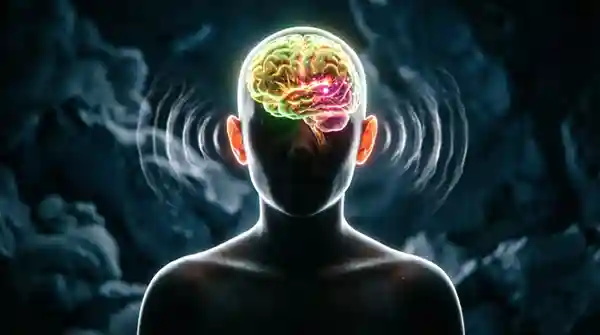
The first time I heard about the Ray Charles effect, I thought it was a myth.
The idea that blindness sharpens hearing is one of those folk beliefs that feels true but has always been slippery to prove. Blind musicians seem to have an almost supernatural ear. Stevie Wonder. Ray Charles. Andrea Bocelli. But is that because blindness actually rewires the brain, or because people who lose one sense simply pay more attention to the others?
For decades, the answer was fuzzy. Human studies were suggestive but inconclusive. Brain imaging showed changes in blind subjects, but imaging can’t get to the level of individual neurons. Behavioral studies showed better sound localization in blind people, but basic auditory thresholds—the softest sound you can hear—seemed largely unaffected.
Then a team at Johns Hopkins and the University of Maryland did something that no one had done before. They took healthy adult mice, put them in complete darkness for a week, and then measured the response of individual neurons in the auditory cortex. What they found upended a century of conventional wisdom about the adult brain.
The dogma that said adult brains can’t change
For most of the twentieth century, the prevailing view in neuroscience was that the adult brain is essentially fixed. The critical periods—the windows of developmental plasticity when the brain is most malleable—close early in life. Once they close, the circuits are locked in. You can’t teach an old dog new tricks.
This wasn’t a casual assumption. It was supported by decades of research. In the 1960s, David Hubel and Torsten Wiesel at Harvard showed that if you close one eye of a kitten during a critical period, the visual cortex permanently rewires to favor the open eye. Do the same thing to an adult cat, and nothing happens. The window has closed.
The same logic applied to hearing. The auditory cortex has its own critical period, roughly corresponding to the first few years of life. This is why children who learn Mandarin as toddlers can hear tonal distinctions that adult learners struggle with forever. The brain’s sound-processing circuits are calibrated early, and after that, they’re resistant to change.
This was the dogma. And for a long time, it held.
But there were cracks. In the 1990s and 2000s, researchers began to find evidence that the adult brain wasn’t as rigid as everyone thought. Studies of blind humans showed that their visual cortex—the part of the brain that normally processes sight—was being recruited to process sound and touch. The brain wasn’t just compensating. It was reorganizing.
The question was how. And whether it could be harnessed.
What happens when you put a mouse in the dark
In 2014, Hey-Kyoung Lee at Johns Hopkins and Patrick Kanold at the University of Maryland published a study in Neuron that answered the question in a way no one expected.
They took healthy adult mice—not young ones, not genetically modified ones, just normal adult mice—and divided them into two groups. One group lived in a normal light-dark cycle. The other group was placed in complete darkness for six to eight days.
Then they measured the responses of individual neurons in the primary auditory cortex. They played tones of different frequencies and intensities. They watched how the brain cells reacted.
The results were startling.
“The neurons in visually deprived animals can ‘hear’ much softer sounds,” Lee said. “They also have much finer discrimination ability as far as identifying pitch goes.”
The dark-exposed mice weren’t just hearing better in some vague, behavioral sense. Their auditory neurons were firing faster, more powerfully, and with greater precision. They had developed more synapses—more connections—between the thalamus and the auditory cortex. The brain had rewired itself.
The most important detail was where the change occurred. The researchers focused on the thalamocortical recipient layer of the auditory cortex—the layer that receives direct input from the thalamus, the brain’s sensory switchboard. This layer was believed to be immutable in adults. It wasn’t supposed to change after the critical period closed.
It changed.
The mechanism: excitation, inhibition, and a layer of control
The follow-up research, published over the next decade, began to map the cellular machinery behind the change.
A 2024 study in iScience confirmed that the effects were real and measurable in behavior. The researchers trained mice on auditory detection tasks and found that dark exposure improved performance on low and mid frequencies. In mice with age-related hearing loss, dark exposure actually reduced the decline in high-frequency hearing.
A 2026 paper in eNeuro went deeper, identifying a specific circuit mechanism. The key players were layer 6 corticothalamic neurons—cells that regulate the flow of information between the cortex and the thalamus. These neurons act like volume knobs, controlling how much sensory information gets through.
Dark exposure, the researchers found, selectively weakened the excitatory inputs onto these neurons. It didn’t touch the inhibitory inputs. The result was a shift in the balance of excitation and inhibition, particularly in the inputs coming from layer 4—the layer that first receives sensory information.
The effect was a bit like turning down the noise-canceling headphones so you can hear the music more clearly. By reducing the activity of the gain-control circuit, the brain allowed the auditory cortex to process sounds with greater sensitivity and discrimination.
“By reducing recruitment of the L6 gain-control circuit,” the authors wrote, “this reconfiguration may bias cortical processing toward enhanced sensory discrimination while preserving sensitivity.”
In plain English: the brain turned up the volume on hearing by turning down the brakes.
The Ray Charles effect, explained
This is where the story gets interesting for anyone who isn’t a neuroscientist.
The 2014 study was published around the same time that researchers were trying to understand why blind musicians often have such extraordinary ears. The connection wasn’t lost on the scientists.
“There’s some evidence that if you don’t have vision, you can locate sound better,” Lee noted. But she was careful to distinguish between correlation and causation. Human studies couldn’t get to the level of individual synapses. The mouse studies could.
What the mouse studies showed was that the brain doesn’t need to be blind from birth to rewire itself for better hearing. It just needs a period of visual deprivation. A week in the dark was enough to trigger changes that were supposed to be impossible in adults.
The changes were temporary. After the mice were returned to normal light, their hearing gradually reverted to baseline. But for that week in the dark, their brains had done something remarkable. They had broken the rules.
The 19th-century physicians who saw it first
The scientists weren’t the first to notice.
In the late 1800s, physicians studying sensory deprivation in blind patients noted that blindness often seemed to sharpen the other senses. A French physician named Xavier Bichat, writing in the early 1800s, observed that blind individuals developed “a fineness of touch and hearing that seems to compensate for the loss of sight.”
These observations were largely dismissed as anecdotal. Without the tools to measure brain activity, there was no way to test them. The idea that blindness enhanced hearing became a cultural trope—the blind musician, the blind piano tuner—but not a scientific finding.
The 2014 study changed that. It provided a cellular mechanism for something that had been observed for centuries. The brain, even in adulthood, retains the capacity to reorganize across the senses. It just needs the right conditions.
What this means for hearing loss and cochlear implants
The most practical implication of this research is for people with hearing loss.
Cochlear implants work well in young children. The brain’s auditory system is still plastic, so it can learn to interpret the electrical signals the implant sends. But adults who receive implants often struggle. Their auditory cortex has already been shaped by years of normal hearing, and it’s resistant to the new input.
The Johns Hopkins research suggests a potential workaround. If a brief period of visual deprivation can reopen the critical period for auditory plasticity, it might be possible to use darkness therapy to help adults adapt to cochlear implants.
“We can perhaps use this to benefit our efforts to recover a lost sense,” Lee said. “By temporarily preventing vision, we may be able to engage the adult brain to change the circuit to better process sound.”
Kanold was more cautious. “We don’t know how many days a human would have to be in the dark to get this effect, and whether they would be willing to do that,” he said. “But there might be a way to use multi-sensory training to correct some sensory processing problems in humans.”
Multi-sensory training. That’s the key phrase. The research doesn’t suggest that blindfolding yourself for a week is a practical therapy for hearing loss. It suggests that the brain’s sensory systems are more interconnected than we thought, and that we can exploit that interconnectedness to help people who are struggling.
The bigger picture: your brain is not fixed
The most important takeaway from this research isn’t about hearing. It’s about the brain.
For most of the twentieth century, the dominant view was that the adult brain is essentially hardwired. The critical periods close, the circuits lock in, and that’s that. You can learn new facts, but you can’t rewire the fundamental architecture.
The Johns Hopkins research, and the decades of work that followed, challenge that view. The adult brain retains a surprising degree of flexibility. It can reorganize across sensory modalities. It can strengthen synapses that were supposed to be fixed. It can do things that the textbooks said were impossible.
The catch is that it needs the right conditions. Darkness, in this case. But the principle is broader. The brain responds to what it’s asked to do. If you ask it to process sound more carefully—by removing visual input—it will. If you ask it to learn a new language, it will. If you ask it to navigate a new city, it will.
The brain is not a machine with fixed specifications. It’s a living system that adapts to its environment. The question is what environment you’re giving it.
What the research doesn’t say
Let me be clear about the limits.
The studies were done on mice. Mice are not humans. Their sensory systems are different. Their critical periods are different. Their brains are different.
The darkness exposure was total. The mice were in complete darkness, not dim light. They couldn’t see anything.
The effects were temporary. The mice reverted to baseline after returning to normal light. Darkness therapy, if it ever becomes a clinical tool, would likely need to be repeated.
And the research doesn’t suggest that darkness is a cure for hearing loss. It suggests that it’s a tool for enhancing auditory processing. The distinction matters.
If you’re experiencing hearing loss, the first step is still to see an audiologist. Get your hearing tested. Explore the options that are already available. The darkness research is promising, but it’s not a substitute for standard care.
The takeaway
The next time you find yourself in a dark room—a movie theater, a quiet bedroom, a power outage—pay attention to what you hear.
The refrigerator humming. The distant traffic. The sound of your own breathing. These sounds are always there, but you usually don’t notice them because your brain is busy processing what you see.
Take away the visual input, and the brain doesn’t just sit idle. It reallocates. It sharpens the remaining senses. It does something that was supposed to be impossible for an adult brain.
The darkness isn’t empty. It’s full of sound. You just have to be willing to listen.