That’s the Point.
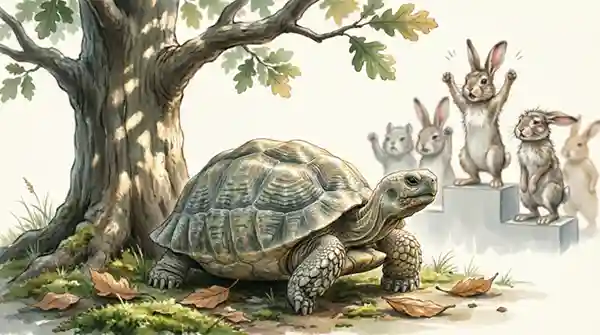
You know the story. The hare races ahead, gets cocky, takes a nap, and the tortoise plods past him to victory. The moral is always the same: slow and steady wins the race.
But here is the question nobody asks. What if the hare had not napped? What if the hare had crossed the finish line first, leaving the tortoise somewhere in the dust, still walking, still sweating, still moving forward?
Would the tortoise have been a failure?
The answer matters more than the fable suggests. Because most of us are not the hare. We are not the fastest, the most talented, the most gifted. We are the tortoise. And the tortoise does not always win.
The question is what the tortoise does with that.
The psychology of learning goals versus performance goals
Carol Dweck at Stanford has spent her career studying what she calls achievement goals. Her framework, developed in the 1980s, distinguishes between two orientations. Learning goals are about developing competence. Performance goals are about demonstrating it.
The distinction sounds academic. It is not. A 2011 study published in Learning and Instruction examined what happens after failure, depending on which goal a person was pursuing. Participants with performance-avoidance goals—the desire to avoid looking incompetent—showed low achievement after failure. The mechanism was not lack of ability. It was the high degree of negative self-related thoughts that flooded their minds.
People who pursue learning goals, by contrast, show a different pattern. They interpret failure as information. They ask what went wrong and what could be done differently. They do not conclude that they are stupid. They conclude that the strategy needs adjustment.
The tortoise who finishes last but finishes is pursuing a learning goal. The tortoise is not measuring themselves against the hare. The tortoise is measuring themselves against the version of themselves that stayed home.
The regret that haunts the things you didn’t do
In 2026, Sunil Contractor at the University of Denver published a study in the Journal of Personality and Social Psychology that examined the conditions under which people feel more regret for action versus inaction. The findings were more nuanced than the old “no pain, no gain” narrative suggests.
People who make a choice—whether to act or not—for a justified reason minimize self-blame and reduce counterfactual thinking, leading to lower regret. The key variable is not the action itself. It is the sense that the decision was made deliberately, with intention.
But there is a pattern that emerges across decades of regret research. A 2023 study in Judgment and Decision Making found that action-oriented individuals experienced more regret for inaction—staying home—than for action—going out. The people who were prone to act regretted the things they did not do.
The tortoise who loses the race but tried has something that the tortoise who never entered does not have. The tortoise has the knowledge that they showed up. That knowledge does not erase the disappointment. But it changes the story. The story is not “I failed.” The story is “I tried.”
What entrepreneurs know about failure that the rest of us don’t
The entrepreneurial world has a complicated relationship with failure. On the one hand, everyone says failure is a learning opportunity. On the other hand, the metrics of success are exits, valuations, and growth.
A 2022 conceptual paper published in Frontiers in Psychology examined how entrepreneurs recover from business failure. The researchers focused on something called psychological capital—a positive psychological state characterized by self-efficacy, optimism, hope, and resilience. They found that high levels of psychological capital mediate the relationship between the negative consequences of failure and the ability to learn from it.
In plain English: the failure does not teach you. The way you process the failure teaches you.
The entrepreneurs who bounce back are not the ones who pretend the failure did not hurt. They are the ones who acknowledge the hurt and then ask what it means. They are the ones who treat the failure as a chapter, not the whole book.
The tortoise who loses the race has the same opportunity. The race is over. The hare has crossed the line. The tortoise can either conclude that they are slow and always will be, or they can conclude that they tried something hard and survived.
The science of process focus
Alexandra Freund and Marie Hennecke at the University of Zurich published a paper in Current Directions in Psychological Science that examined the difference between focusing on the process of goal pursuit and focusing on the outcome. Their conclusion was unambiguous. When pursuing goals that are demanding in terms of skill or self-regulation, focusing on the process is more adaptive. Focusing on the outcome can even be detrimental to achievement.
The reason is not mysterious. Outcome focus ties your emotional state to a result you cannot fully control. Process focus ties your emotional state to the effort you are putting in. The effort is within your control. The outcome is not.
The tortoise who focuses on the finish line will be miserable if the hare crosses first. The tortoise who focuses on the running—the rhythm of the legs, the breath, the feel of the road—has already succeeded at the only thing they can control.
The two kinds of happiness
Psychologists distinguish between two types of well-being. Hedonic well-being is about pleasure and comfort. Eudaimonic well-being is about meaning and self-realization. The distinction was formalized by Richard Ryan and Edward Deci at the University of Rochester in a 2001 review that has become foundational in the field.
The tortoise who loses the race is not pursuing hedonic well-being. The tortoise is not comfortable. The tortoise is not having fun. The tortoise is pursuing something else—the knowledge that they showed up, that they tried, that they did not quit.
That is eudaimonic well-being. And it is available to anyone who is willing to try something hard, even if they fail.
Grit and the long game
Angela Duckworth at the University of Pennsylvania published a study in 2007 that introduced the concept of grit—perseverance and passion for long-term goals. Across six studies involving more than 2,000 participants, grit predicted success outcomes including educational attainment, grade point average, retention at West Point, and ranking in the National Spelling Bee. Grit accounted for an average of 4 percent of the variance in success outcomes, independent of IQ and conscientiousness.
Four percent does not sound like much. But in a world where intelligence and talent are distributed unevenly, four percent that is within your control is a lot. Grit is not about winning every race. It is about staying in the race long enough for the races that matter.
The tortoise has grit. The tortoise keeps going. The tortoise does not stop because the hare is faster.
When the pressure becomes too much
There is a limit to how much failure a person can absorb. The research on stress and coping, from Hans Selye’s work in the 1930s to the modern study of allostatic load, has shown that chronic, unrelenting stress can overwhelm the body’s ability to recover. The same is true for the psychological stress of repeated failure.
If the failures have piled up, if the effort no longer feels meaningful, if the exhaustion has become constant, the appropriate response is not to try harder. The appropriate response is to speak with a mental health professional who can help you assess what is happening and what needs to change.
The research on depression, anxiety, and burnout is clear. Early intervention matters. The strategies in this article are tools. They are not a substitute for care when the weight is more than a person can carry alone.
The tortoise you do not see
The tortoise does not know that the hare has stopped. The tortoise does not know that the finish line is close. The tortoise only knows that the road is long and the sun is hot and the legs are tired.
And still, the tortoise keeps going.
That is the part of the story that matters. Not the winning. The going. The tortoise who loses the race is not a failure. The tortoise who loses the race is a person who has learned the only lesson that actually matters.
Success is not crossing the line first. Success is being the kind of person who keeps walking.