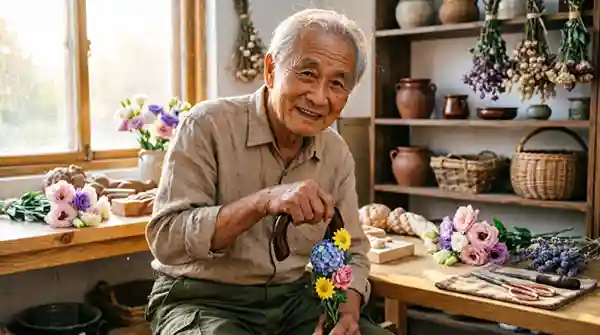
At 89, She Turned a Walking Cane Into a Business—and a Reason to Smile
The story of Pearl Malkin is usually told from the beginning. The vertigo. The black cane. The artificial flowers. The Kickstarter campaign. The happy ending.
I want to tell it backward. Because the ending is the only place to start.
Why 248 Strangers Backed a Cane With Flowers on It
In January 2013, a Kickstarter campaign went live. The goal was $3,500. The product was a line of walking canes decorated with artificial flowers. The creator was an eighty-nine-year-old woman named Pearl Malkin. The campaign raised $5,039 from 248 backers. It was not a tech startup. It was not an app. It was a cane with flowers on it. And it worked.
The numbers matter. Not because they are large. Because they are small. $5,039 is not venture capital. It is a community saying yes to something that made them smile. A 2026 study in the Academy of Management examined later-life entrepreneurship and found that motivations often transcend the traditional necessity-opportunity dichotomy, frequently catalyzed by “biographical disruption events such as divorce, job loss, or illness.” Pearl’s disruption was not financial. It was physical. And then it was emotional.
The cane was the catalyst. The flowers were the response.
A Black Cane, a Broken Heart, and a Box of Artificial Flowers
Pearl did not start a business because she wanted to be an entrepreneur. She started a business because she hated the cane.
After eye surgery, she experienced vertigo. Her grandchildren bought her a cane to help her walk. It was black. It was ugly. It was a symbol of everything she did not want to be. Old. Fragile. Dependent.
A 2025 study in Frontiers in Public Health examined older artisans and their attributions of mental health and well-being to their creative work. The researchers found that engagement in creative activities “may positively affect the social determinants of health by promoting mental, physical, and social well-being.” The craft is not the point. The meaning is the point. The cane was not a medical device. It was a statement. And Pearl decided to change the statement.
How Grief Became the Foundation of a Business
The obituary of Pearl Malkin will mention the business. It will mention the flowers. It will mention the Kickstarter. It will not mention the daughter.
Pearl lost her daughter to brain cancer when she was fifty-nine. The loss was not a footnote. It was the foundation. The business did not come out of nowhere. It came out of grief.
A 2025 study in Innovation in Aging examined coping with late-life loss and bereavement. The researchers identified activities that were “healing and fostered meaning, purpose, and ego integrity.” The activities were not therapy. They were craft. They were creation. They were the things that allowed the person to hold the loss and the life at the same time.
Pearl told interviewers that she wanted to make people smile. She did not say she wanted to heal herself. But the research says that is what happened. The act of making something beautiful out of something ugly is not just a business strategy. It is a grief strategy.
Crafting Through Loss: What the Research Actually Says
The research on crafting and well-being in older adults has grown significantly in the last decade. A 2026 pilot study in Europe PMC evaluated a community woodcarving program for older adults. The findings were specific. Anxiety and depressive symptoms decreased. Resilience increased. Mood improved within sessions. The researchers concluded that woodcarving was a “feasible, low-cost, non-pharmacological community intervention.”
Pearl did not carve wood. She decorated canes. But the mechanism is the same. The hands are moving. The mind is focused. The outcome is visible. The process is controllable. These are the conditions that produce flow. And flow is the opposite of rumination.
If you are experiencing persistent grief that does not lift, if the loss has become a weight you cannot carry alone, that is not a craft problem. That is a health problem. The research on grief, depression, and bereavement is robust. Professional support helps. A therapist can help you navigate the loss without losing yourself in it. That is not weakness. That is wisdom.
When Your Grandson Becomes Your Business Partner
Pearl did not do this alone. Her grandson, Adam London, helped her set up the Kickstarter. He helped her with the logistics. He became her business partner.
The research on intergenerational entrepreneurship is limited, but the existing studies suggest that the combination of older wisdom and younger energy can be powerful. A 2024 study on senior entrepreneurship in Singapore found that the entrepreneurial arena provided a platform where seniors “not only overcame the challenges of new start-ups and contributed to economic growth but also fostered their creativity, resilience, patience, and adaptability.” The business was not just about the canes. It was about the relationship.
Adam did not expect to go into business with his grandmother. He told a reporter that the last thing he expected to do was sell canes with his “grandma.” But he did it. And the doing changed both of them.
A Kitchen Table, Sixty Dollars, and the Economics of Joy
The canes were sold for sixty dollars each. They were not cheap. They were not mass-produced. They were made by hand, one at a time, on a kitchen table. The business model was not scalable. It was not designed to be. It was designed to be sustainable. For Pearl, sustainable meant meaningful.
She told a reporter that when she walked around the city, everyone’s face was closed. But when they saw her cane, they smiled. The cane was a conversation starter. It was a reason to connect. The product was not the cane. The product was the smile.
A 2026 AARP article on older entrepreneurs noted that “older adults prove they have the potential to fuel the next wave of breakthrough ideas.” The breakthrough is not always technological. Sometimes it is a flower on a cane. Sometimes it is a reason to say hello. The innovation is not the object. It is the interaction.
What the Obituary Will Not Say
Pearl Malkin was eighty-nine when she started Happy Canes. She is not eighty-nine anymore. The story does not tell us what happened next. The Kickstarter ended. The canes were sold. The business may have continued. It may have stopped. The archives do not say.
What the archives do say is that she made something. She made something out of nothing. She made something out of grief. She made something out of a black cane and a box of artificial flowers. And she made people smile.
The research on late-life creativity and entrepreneurship is clear. The capacity to create does not disappear with age. It often deepens. The experience of loss does not close the door to purpose. It often opens it. The resources are not always financial. They are often relational. They are often emotional. They are often the things that cannot be measured.
Pearl’s story is not a template. It is a case study. The case study of a woman who decided that the cane was not going to define her. She was going to define the cane. And in doing so, she defined something else. She defined what it means to keep going. She defined what it means to make something beautiful. She defined what it means to smile when the world gives you a reason to frown.
The obituary will say she was an entrepreneur. The obituary will say she founded Happy Canes. The obituary will say she was eighty-nine. The obituary will not say what it cost her. The obituary will not say what it gave her. The obituary will not say that the flowers were not decoration. They were defiance.