Why is it that we can intellectually recognize our talents, list our achievements, and receive praise from those around us, yet still carry a quiet, persistent fear of being exposed as inadequate?
We spend our lives trying to outrun a shadow. Some of us dread professional failure; others live in constant terror of romantic abandonment. On the surface, these fears appear to be about external events—the exam we might fail, the partner who might leave. In reality, they are symptoms of a deeper, systemic fracture. We do not trust our own nervous system to survive the emotional fallout of these events. We call this a lack of self-confidence, but clinically, it is a deficit of self-trust.
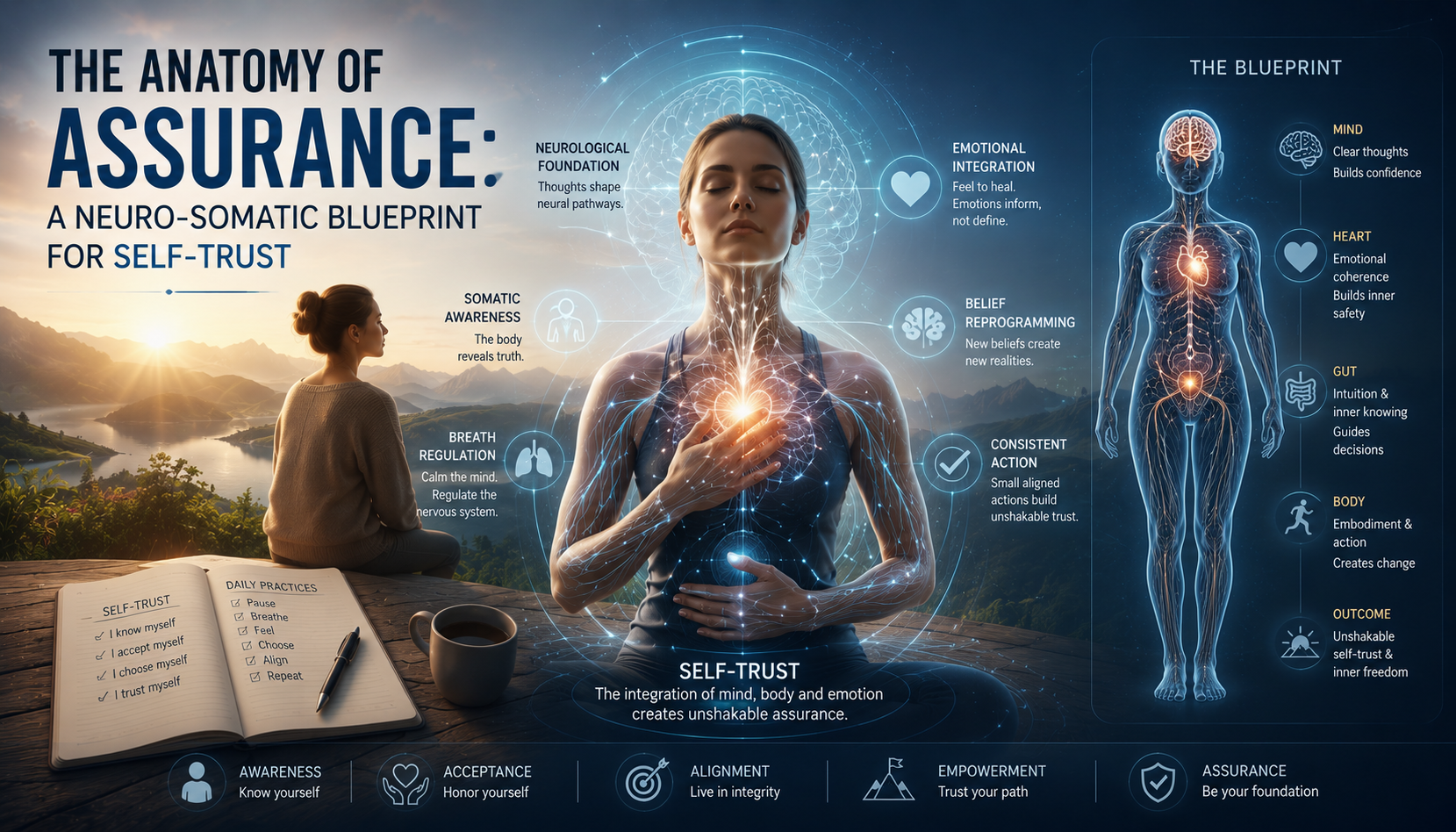
When you do not trust yourself, the world becomes a hostile landscape where every interaction is a potential threat. Yet, rebuilding this trust is not a matter of aggressive self-help or empty affirmations. It requires a precise, systematic realigning of your internal blueprint.
The Ecology of Self-Rejection
Before we can trust ourselves, we must address how we perceive our own biology. Consider this paradox: we expect our minds to perform with absolute clarity while harboring a deep, unconscious resentment toward the physical and psychological vessel housing that mind.
[Unconscious Self-Rejection] ---> High Allostatic Load (Chronic Stress) ---> Hyper-Vigilance ---> Paralyzing Self-Doubt
Your nervous system is designed to protect you. If you constantly send it signals of self-rejection—by criticizing your physical form, denying your limitations, or masking your true personality—your brain interprets this internal hostility as an environmental threat. This chronic state of threat increases your allostatic load, keeping you in a state of hyper-vigilance.
To break this loop, self-acceptance must be treated not as a moral victory, but as a biological necessity. Only when the brain registers that it is safe within its own skin can it de-escalate the defense mechanisms that present as chronic self-doubt.
The Exhaustion of Social Masking
Much of what we call social anxiety is actually the sheer metabolic cost of cognitive masking. When we prioritize how others perceive us over our own reality, we force our prefrontal cortex to run complex, exhausting simulations of other people’s minds.
- The Inauthenticity Tax: Trying to satisfy everyone is a mathematical impossibility that drains cognitive reserve.
- The Imitation Trap: Mimicking an idealized version of someone else creates a psychological dissonance. Your brain knows it is playing a role, which reinforces the subconscious belief that your true self is inherently inadequate.
When we drop the mask and accept the discomfort of not being universally liked, we reclaim an immense amount of neural energy. True autonomy begins when we realize that the opinions of others are merely projections of their own internal conditioning, completely independent of our objective worth.
The Neurology of “Now” and the Power of Boundaries
Chronic worry about the future is often a misdirected attempt by the nervous system to find safety. When we obsess over whether a relationship will last or a career path will succeed, we are attempting to solve an unpredictable future using a stressed, over-activated brain.
+-----------------------------------------------------------------+
|                    THE SELF-TRUST TRIAD                         |
+-----------------------------------------------------------------+
|  1. RADICAL CANDOR    --> Face mistakes without emotional abuse.|
|  2. SOMATIC BOUNDARY  --> Say 'no' to others to say 'yes' to self.|
|  3. INTUITIVE ALIGNMENT--> Trust visceral, non-linear signals.   |
+-----------------------------------------------------------------+
Self-trust requires us to anchor ourselves in the immediate present. This does not mean ignoring the future; it means recognizing that your capacity to handle the future is built entirely on how you respond to the present.
This requires a delicate balance of boundaries. It means introducing a healthy measure of “constructive selfishness”—understanding that protecting your own energy is not an act of cruelty, but a prerequisite for genuine connection. When we set boundaries, we teach our nervous system that we are capable of protecting ourselves.
Re-establishing the Feedback Loop
To permanently anchor self-trust, we must change how we process feedback and mistakes. The brain learns through prediction errors. When you make a mistake, your brain updates its internal model of the world.
If you meet your mistakes with harsh self-punishment, your brain associates learning with pain and stops trying to grow. If, instead, you treat mistakes as neutral data points and accept constructive criticism with open curiosity, you complete the learning loop.
By rewarding your small victories—not with grand gestures, but with simple, intentional moments of rest and integration—you reinforce the neural pathways of achievement.
Self-trust is not the belief that you will never fail. It is the quiet, unwavering certainty that you can survive the failure, learn from the data, and begin again.