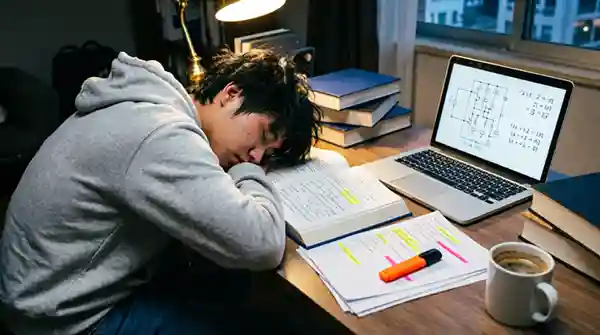
Sleep vs. Cramming: What the Research Says About Academic Success
The field guide author learns to classify. Not to judge. To observe the patterns, name the categories, and describe the conditions under which each thrives. The academic sleep debate is a perfect specimen. On one side, the cramming culture: late nights, early mornings, the belief that hours of study are a zero-sum game against hours of rest. On the other side, the sleep science: the data showing that the brain consolidates memory during sleep, that deprivation impairs attention and executive function, that the trade-off between study time and sleep time is not a trade-off at all.
The field guide author does not take sides. The field guide author describes the terrain.
Sleep Duration and GPA: What 165,750 Students Revealed
The first specimen is the relationship between sleep duration and academic performance. The data is not ambiguous.
A 2025 study published in Psychology in the Schools analyzed data from 165,750 primary and secondary school students in Jiangsu province, China. The finding was an inverted-U-shaped relationship. More sleep was not always better. Less sleep was not always worse. There was an optimal range. For primary school students, the optimal amount was nine to ten hours. For secondary school students, it was eight to nine hours.
The same study found that the association between sleep duration and academic performance was stronger in students with lower academic performance. The students who were struggling the most were the ones who benefited most from adequate sleep.
A separate 2025 study published in npj Science of Learning analyzed data from 54,102 eighth-grade students across 717 middle schools in Shanghai. The finding was specific: around eight hours of sleep was most strongly associated with higher academic performance, particularly in mathematics and science. The positive association was more evident among lower-achieving students. Girls generally required slightly longer sleep than boys to achieve their best performance in most subjects, except mathematics.
The field guide author’s note: the optimal range is not a single number. It is a territory. The territory shifts with age, with gender, with the subject being studied. The cramming culture ignores the territory. The sleep science maps it.
The Inverted U: Why More Sleep Isn’t Always Better
The second specimen is the shape of the relationship. The inverted U is not intuitive. We are told that sleep is good. We assume that more sleep is better. The data says otherwise.
The 2025 Psychology in the Schools study found that the relationship between sleep duration and academic performance was not linear. It was curvilinear. The performance increased as sleep increased, up to a point. After that point, the performance plateaued and then declined.
The field guide author has observed this pattern in other domains. Water is essential. Too much water is fatal. Exercise is beneficial. Too much exercise is damaging. The dose-response curve is rarely a straight line.
The practical implication is not that students should sleep less. It is that the optimal amount is a target, not a maximum. The student who sleeps twelve hours is not necessarily more prepared than the student who sleeps nine. The student who sleeps twelve hours may be sleeping because of depression, because of illness, because of a sleep disorder. The extra sleep is not a solution. It is a symptom.
Screen Time, Blue Light, and the Sleep Debt Crisis
The third specimen is the mechanism. Why are students sleeping less? The research points to screens.
A 2024 consensus statement from the National Sleep Foundation convened a 16-person multidisciplinary expert panel. The panel reviewed 2,209 articles, narrowed them to 522 relevant empirical articles and 52 review articles, and examined 35 experimental and intervention studies. The consensus was clear: screen use impairs sleep health among children and adolescents. The content of screen use before sleep impairs sleep health. Behavioral strategies and interventions may attenuate the negative effects.
The mechanism is not just the light. A 2023 study in PLOS ONE described the pathways. Time spent in front of the screen comes at the expense of sleep duration. Bright light and electromagnetic radiation during the evening inhibit melatonin production, altering circadian rhythms. Psychophysiological arousal from video gaming or social media use before bedtime impairs pre-sleep relaxation and delays sleep onset.
A 2025 study from the University of Pittsburgh School of Medicine added a new dimension. The researchers analyzed over 1,000 surveys and brain scans from adolescents. They found that white matter connections between brain regions controlling emotion regulation, memory, and attention were weaker and more disorganized in teens who spent more time on screens and did not get sufficient sleep. Those teens also had higher depression scores.
The field guide author’s note: the screen is not the enemy. The timing is. The content is. The displacement is. The screen is a tool. The tool is being used in a way that interferes with a biological need. The interference is the problem.
School Start Times: The Policy That Could Change Everything
The fourth specimen is the structural variable. Individual behavior change is difficult. Structural change is more effective.
The Society for Public Health Education adopted a resolution in January 2025 calling for healthy school hours. The resolution cited data showing that deficient sleep increases the risk of substance use, poor mental health, obesity, cardiovascular problems, and injuries in adolescents. It noted that during puberty, the circadian rhythm shifts several hours later, and most adolescents cannot fall asleep before 11 p.m. or wake naturally before 8 a.m..
The resolution stated that adolescents need eight to ten hours of sleep for optimal mental and physical health, but only 23 percent of high school students get at least eight hours on school nights. School start times before 8:30 a.m. prevent adolescents from getting the sleep they need, and 83 percent of high schools start before 8:30 a.m..
The policy response has begun. In 2019, California became the first state to mandate later school start times for all middle and high schools. The law instructed districts to implement start times no earlier than 8 a.m. for middle schools and 8:30 a.m. for high schools. Florida followed with similar legislation.
The field guide author’s note: the start time is not a detail. It is a structural determinant of sleep. The individual student cannot change the start time. The individual student can only adapt. The adaptation is often insufficient.
Sleep Interventions That Actually Work
The fifth specimen is the intervention. What can be done?
A 2025 cluster randomized trial published in the Journal of Sleep Research tested a school-based universal intervention program for middle school students. The program was called SLEEPS (Sleep to Enhance Educational Performance in Schools). It leveraged the social-cognitive influences of peers, caregivers, and teachers on adolescents’ sleep hygiene. Eight middle schools in the United States were randomly assigned to treatment or control. The treatment group showed significantly larger improvement in sleep-related beliefs and self-efficacy, daytime sleepiness, and internalizing symptoms. Students with less baseline belief about sleep hygiene improved more.
An earlier program, the Young Adolescent Sleep Smart Program, was tested in a randomized controlled trial. The intervention was effective in improving sleep health efficacy, sleep hygiene, time in bed, and bedtimes. It also maintained grades. The participants reported a significant decrease in internalizing behavior problems.
The field guide author’s observation: the interventions that work are not the ones that tell students to sleep more. They are the ones that change the beliefs, the norms, and the environment. The belief that sleep matters. The norm that sleeping is not laziness. The environment that makes sleep possible.
When Sleep Problems Require Professional Help
The field guide author must include a specimen that is often overlooked. Not all sleep problems are behavioral. Some are clinical.
The research on adolescent sleep and mental health is clear. A 2025 study from the University of Pittsburgh found that the association between screen time and depression was driven by shorter sleep and worse white matter organization. The intersection of screen time and sleep quality held the key to brain function and mental health.
If a student is sleeping twelve hours and still exhausted, if the sleep is not restorative, if the fatigue is accompanied by low mood, loss of interest, or difficulty functioning, that is not a sleep hygiene problem. That is a signal. The research on sleep disorders, depression, and anxiety in adolescents is robust. Professional support helps. A doctor or a mental health professional can assess what is happening and recommend an appropriate course of care. That is not weakness. That is wisdom.
The Field Guide’s Conclusion: Two Cultures, One Biology
The field guide author returns to the comparison. The cramming culture and the sleep science are not two equal sides of a debate. They are two cultures with different assumptions.
The cramming culture assumes that time is fungible. An hour of sleep can be traded for an hour of study. The output will be the same, or better, because the study is focused on the material.
The sleep science assumes that time is not fungible. The brain needs sleep to consolidate what was studied. The hour of sleep is not lost time. It is the time when the studying becomes learning.
The data supports the second assumption. The inverted U. The optimal range. The memory consolidation. The white matter. The structural determinants. The interventions that work. The evidence is not ambiguous. The culture is.
The field guide author does not prescribe. The field guide author describes. The description is this: the students who sleep enough learn better. The students who do not sleep enough learn less. The trade-off is an illusion. The illusion is costly.
The field guide author closes the notebook. The specimen has been classified. The classification is not a verdict. It is a map. The map is available to anyone who wants to read it. The reading is the first step. The first step is the only one that matters.