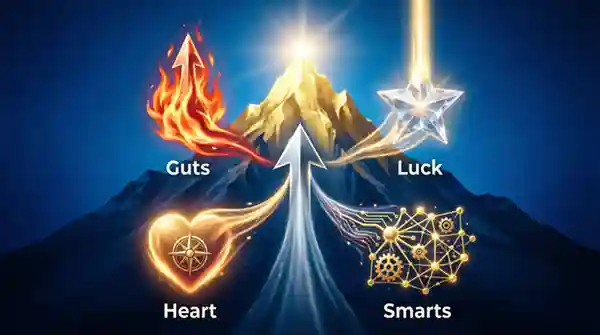
Heart, smarts, guts, luck: the four forces that shape success, and how they actually interact
The most honest answer to “what drives success” is that no single factor does. Heart, smarts, guts, and luck are not separate traits stacked in a person’s favor; they are an ecology. Each one changes how the others behave. A high-smarts, low-guts leader stalls. A high-heart, low-smarts founder burns out building the wrong thing. Luck matters, but it tends to find the people who are already moving. The research on leadership, motivation, and decision-making has been circling this insight for decades, and the business literature has finally started to catch up.
I call this the factor ecology: the dynamic relationship among heart, smarts, guts, and luck, where strength in one domain compensates for weakness in another, and weakness in one can neutralize the advantages of the rest. The ecology is not a formula. It is a set of trade-offs.
Interview: a venture partner in Austin explains the four-factor test
I sat down with a venture partner in Austin who has been backing founders for eighteen years. He uses a four-factor screen. Not because the categories are scientific. Because they are useful.
“Heart is the reason the company exists beyond the spreadsheet,” he said. “Smarts is the ability to see the pattern before the market does. Guts is the willingness to make the call when the data is incomplete. Luck is the acknowledgment that timing and birth and geography are not evenly distributed. The mistake people make is thinking one factor is enough.”
He paused. “It is not.”
The research supports the pause. A 2020 study in the Journal of Business Venturing found that entrepreneurial passion alone did not predict venture success; it predicted persistence. Persistence was necessary but not sufficient. The founders who succeeded had passion plus a cognitive advantage (pattern recognition) plus a tolerance for risk. The factors were multiplicative, not additive.
What the heart factor actually buys you
Heart is not the same as enthusiasm. Enthusiasm is a mood. Heart is a commitment to a purpose that survives the mood. The 2025 Idaho study on goal hierarchies found something adjacent: when a goal is deeply important to a person, a small failure does less damage to commitment. When the goal is shallow, a single slip can collapse the whole structure. Heart is the thing that makes the goal load-bearing.
The older anchor is Robert Vallerand’s 2003 work on harmonious and obsessive passion. Harmonious passion is integrated into identity without crowding out the rest of life. Obsessive passion is rigid and contingent. Both produce effort. Only one produces sustainable judgment.
Cirque du Soleil is the usual example. Guy Laliberté built a circus without animals, without stars, and without a business plan. That is heart. But it is not only heart. The company succeeded because the creative vision was paired with a sharp reading of an underserved market: adults who wanted spectacle without the guilt of a traditional circus. Heart without smarts is a hobby. Smarts without heart is a consulting deck.
Smarts: the pattern that hides in plain sight
Smarts in the leadership literature is not IQ. It is pattern recognition under uncertainty. The eBay and Amazon examples are useful because both Meg Whitman and Jeff Bezos saw something that others dismissed. Whitman saw that a peer-to-peer marketplace could work if trust was engineered. Bezos saw that the internet was not a channel; it was a new retail physics.
A 2019 study in Strategic Management Journal examined how founders identify opportunities. The finding was not that smarter founders saw more opportunities. It was that they saw different ones. They had richer mental models, which allowed them to connect dots that others had not connected. The connection was not magic. It was a byproduct of exposure and reflection.
The older research here is Herbert Simon’s work on bounded rationality in the 1950s. Simon argued that decision-makers do not optimize; they satisfice. They use mental shortcuts. The quality of the shortcut depends on the quality of the mental model. Smarts is the quality of the model.
Guts: the willingness to be wrong in public
Guts is not recklessness. Recklessness is ignoring risk. Guts is seeing the risk clearly and acting anyway. The distinction matters because it separates the founder who bets the company on a hunch from the founder who makes a calculated call with incomplete information.
A 2021 meta-analysis in the Journal of Management examined the relationship between risk propensity and entrepreneurial outcomes. The finding was curvilinear. Moderate risk-taking outperformed both extreme caution and extreme risk. The sweet spot was not bravery. It was calibrated courage.
Michael Yavonditte’s decision to compete with Google’s AdSense is the example the business press loves. But the more instructive part is not the competition. It is the sequence. He did not start with a grand declaration. He started with a product that solved a narrow problem. The guts came after the smarts. The heart came after the guts. The ecology was not a checklist. It was a sequence of commitments, each one creating the conditions for the next.
Luck: the factor that refuses to be ignored
Warren Buffett calls it the ovarian lottery. He is right. Being born in the right country at the right time with the right cognitive endowments is not a merit. It is a draw. The 2024 research on luck and leadership, including Richard Wiseman’s work, has shown that self-described lucky people behave differently. They notice more. They talk to more people. They recover faster from setbacks. Luck is not a force that acts on you. It is a pattern that responds to how you move.
The older research on locus of control is relevant. Julian Rotter’s 1966 work found that people with an internal locus of control cope better with setbacks. But an internal locus of control does not mean denying luck. It means recognizing that luck is not an excuse. The person who attributes everything to luck stops moving. The person who attributes everything to effort burns out. The ecology requires both.
The category-breaker factor: what the four-factor model misses
The four-factor model is useful, but it misses one category. Some leaders are not strong in heart, smarts, guts, or luck in the conventional sense. They are category breakers. Richard Branson is dyslexic. Steve Jobs was difficult. They did not fit the template. They broke it.
The research on cognitive diversity and leadership has shown that non-standard profiles often produce non-standard solutions. A 2022 study in Academy of Management Discoveries found that leaders with atypical career paths and unconventional backgrounds were more likely to introduce radical innovations. The finding does not mean that conventional leaders cannot innovate. It means that the ecology has another dimension: the willingness to be an outlier.
When the ecology is out of balance
The most common failure mode is not a lack of any single factor. It is an imbalance. The high-heart, low-smarts founder builds a product nobody needs. The high-smarts, low-guts leader sees the opportunity and lets someone else take it. The high-guts, low-heart leader wins the battle and loses the team. The high-luck, low-everything-else leader gets the break and cannot execute.
The 2020s research on founder well-being has added a new layer. A 2023 study in the Journal of Business Venturing found that founders who scored high on passion but low on self-regulation were more likely to experience burnout. The heart was not enough. The ecology needed a regulator. The regulator was not a fifth factor. It was the interaction among the four.
What to do if your ecology is lopsided
First, name the weakness without turning it into an identity. If you are low on guts, you are not a coward. You are a person who has not yet practiced the specific behavior of acting under uncertainty. Practice is not a personality transplant. It is a series of small exposures.
Second, borrow the missing factor. If you are high on heart and low on smarts, find a partner who sees patterns you miss. If you are high on smarts and low on guts, find a partner who can make the call. The borrowing is not weakness. It is ecology design.
Third, use the loss frame. The Idaho research found that framing a goal around what you are trying to avoid protects commitment better than framing it around what you hope to gain. The loss frame is not pessimism. It is a stabilizer.
Fourth, acknowledge luck without bowing to it. The ovarian lottery is real. So is the fact that lucky people behave in ways that make luck more likely. The acknowledgment is not a concession. It is a calibration.
A note on when the problem is not the ecology
If the imbalance is producing persistent distress—if the lack of a factor has become a source of shame, if the striving has become compulsive, if the disappointment has become hopelessness—the appropriate response is not to try harder to fix the ecology alone. It is to speak with a mental health professional who can help you assess what is happening. The research on burnout, anxiety, and depression in high-achieving populations is robust. Support is not a failure of guts. It is a recognition that some loads are too heavy for one person’s ecology.
The interview ends
The venture partner in Austin walked me to the door. He said something I have not been able to shake. “The founders who last are not the ones with the most of any one factor. They are the ones who know which factor they are short on and build around it.”
He did not say build it. He said build around it.
The distinction is the ecology. You do not have to be the strongest. You have to be the most honest about where the strength is missing. The honesty is the first move. The first move is available. The ecology is already in motion. The question is whether you are designing it or just living in it.