The Digital Algae: Why Cleaning Your Subconscious Is the Ultimate Rebellion of the Modern Age
There is a quiet, invisible accumulation that settles over your mind before you even wake up in the morning.
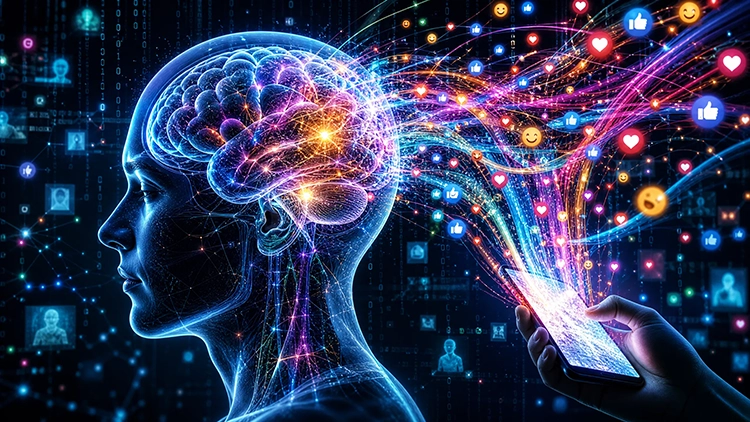
Consider the first five minutes of an ordinary day. Before your feet touch the floor, your thumb reaches for a glowing rectangle, and within seconds, your nervous system is flooded by algorithms designed to make you feel inadequate, hungry for distraction, and subtly convinced that your life is missing a product you didn’t want yesterday.
We spend our lives believing we are making independent choices—choosing what to buy, what to read, what to care about—while a billion-dollar architecture of artificial intelligence quietly maps our insecurities and feeds them back to us in high definition.
Standard culture tells us to practice better time management or delete a social media app for a weekend. But surface-level detoxes fail because we are fighting a systemic tidal wave with a paper cup. True mental clarity does not come from hiding from technology; it comes from waking up to the invisible leash it holds on our desires.
The Biology of the Overloaded Brain
When we are subjected to a continuous, high-speed barrage of digital stimuli, our brains undergo a profound cognitive shift. Behavioral neuroscience and neurobiology show that chronic data saturation overwhelms the prefrontal cortex—the seat of analytical thought, willpower, and conscious decision-making—forcing the brain to hand the steering wheel over to the autopilot of primitive conditioning.
As neuroscientist Sinan Canan notes, when the brain loses its ability to test the reality of incoming information, we stop acting as conscious agents and start functioning as reactive data points.
The Attention Economy Trap
A systemic state of cognitive capture where relentless digital stimulation and predictive AI algorithms bypass conscious awareness, turning human attention into a harvested commodity and reducing complex inner lives to predictable behavioral patterns.
In everyday life, this looks like buying your twenty-fifth shirt simply because an algorithm whispered that your wardrobe was outdated, or finding yourself trapped in a digital rabbit hole at midnight while your body screams for rest.
We judge ourselves for lacking self-control, forgetting that we are playing a game designed by experts whose entire job is to harvest our focus. Safety in the modern world requires recognizing that your attention is not just a personal asset; it is the primary battleground of human sovereignty.
Breaking the Illusion of Choice
To reclaim our minds, we must abandon the most dangerous modern illusion: the belief that every desire we feel actually belongs to us.
Consider how we handle consumer habits. We convince ourselves that purchasing that new gadget, tracking that new trend, or keeping up with endless digital noise is a sign of freedom. Yet, as Dr. David Hawkins observed in Power vs. Force, true inner liberation is rare not because it is intellectually impossible, but because the modern world is relentlessly optimized to keep us distracted by the superficial.
Imagine walking through a crowded marketplace where every vendor has spent millions of dollars learning how to whisper your exact name, your deepest insecurities, and your secret vanities.
When you stop treating every impulse as an authentic command from your soul, the spell begins to break. You realize that wanting less is not a deprivation; it is the ultimate reclamation of your own mind.
The Architecture of Digital Hygiene
Reclaiming the sanctity of your subconscious does not require retreating to a cabin in the woods or throwing your phone into the sea. It requires micro-boundaries and intentional friction against the machinery of consumption.
Consider how easily we sanitize our physical food while leaving our mental diet completely unprotected:
| The Default Digital Loop | The Conscious Shift | The Resulting Aliveness |
| Reaching for your phone the moment you wake up | Pausing in silence for three minutes before letting the world in | Restoring autonomy to your morning nervous system |
| Buying out of boredom, anxiety, or algorithmic priming | Asking “Do I actually need this, or am I just trying to numb a feeling?” | Breaking the emotional consumption cycle |
| Consuming endless, frictionless streams of outrage and ads | Curating a deliberate, slow-media diet of books, art, and nature | Re-engaging analytical thought and deep focus |
| Treating your attention as an infinite public dumping ground | Setting strict boundaries around digital availability and inputs | Cultivating a quiet, sovereign inner sanctuary |
Notice how none of these shifts require monastic isolation. They require a daily, deliberate refusal to let algorithms dictate what you value, what you fear, and what you desire.
A Quiet Inventory for the Modern Mind
You do not need a digital detox retreat to start cleaning the windows of your perception. Let us clear the noise right here, right now, with a simple, unsparing reflection.
- The Pause: Put aside your screen, drop your shoulders away from your ears, and take one slow, deliberate breath down into your ribs.
- The Confession: Ask yourself with radical honesty: What did I consume today—whether news, products, or opinions—that was chosen for me by an algorithm rather than my own soul?
- The Softening: Take a blank piece of paper and write down one digital or consumer habit you are ready to prune this week—a notification you will turn off, a feed you will unfollow, or an impulse purchase you will let dissolve.
- The Turn: Remember that life is lived in the space between stimulus and response. When you choose to step off the conveyor belt of endless consumption, you are not missing out on the world; you are finally stepping back into your own life.