Workplace Stress: A Radio Conversation About What Actually Works
HOST: You are listening to The Long Shift. I am your host. Today we are talking about something that most people experience and almost nobody names correctly. Stress. Not the good stress. The other kind. The kind that follows you home. The kind that sits on your chest at 3 a.m. The kind that turns a job you used to love into a place you dread walking into.
My guest today is a researcher who has spent the last fifteen years studying the intersection of work and health. She asked me not to use her name because she still works inside a large organization and does not want to be the person who said the quiet part out loud. I am going to call her Dr. M.
DR. M: That is fine. The quiet part needs to be said.
What are the workplace stress statistics for 2026?
HOST: Let us start with the numbers. Because the numbers are not subtle.
DR. M: They are not. Gallup’s latest State of the Global Workplace report, published in 2026, found that only 20 percent of employees worldwide are engaged at work. That is the lowest level since 2020. Sixty-four percent are not engaged, and 16 percent are actively disengaged. And 40 percent of employees globally reported experiencing a lot of stress the previous day.
HOST: Forty percent.
DR. M: Forty percent. And that number has held above pre-pandemic levels for years. It is not a blip. It is a baseline.
HOST: What does that baseline cost?
DR. M: Gallup estimates that low engagement and poor wellbeing cost the world economy roughly $10 trillion a year. That is about nine percent of global GDP. The American Psychological Association has found that 57 percent of U.S. workers report burnout from work-related stress. Aflac’s latest report put moderate-to-very-high job stress at 72 percent, a six-year high.
What is the WHO definition of burnout?
HOST: Let us talk about the word burnout. Because it gets used casually. “I am so burned out.” What does it actually mean?
DR. M: The World Health Organization has a specific definition. Burnout is an occupational phenomenon, not a medical condition. It results from chronic workplace stress that has not been successfully managed. It has three dimensions. Exhaustion. Mental distance or cynicism about the job. And reduced professional efficacy.
HOST: So it is not just being tired.
DR. M: It is not. Tired is a feeling. Burnout is a pattern. The exhaustion is the most visible part, but the cynicism and the reduced efficacy are just as important. A person can be exhausted and still care. A person can be checked out and not yet exhausted. Both are warning signs.
Who is most affected by workplace burnout?
HOST: Who is getting hit hardest?
DR. M: The data is consistent across multiple sources. Younger workers. Eagle Hill Consulting’s 2025 survey found burnout rates of 66 percent among Gen Z, 58 percent among millennials, 53 percent among Gen X, and 37 percent among baby boomers. Managers are also absorbing a disproportionate share. Manager engagement dropped to 22 percent in 2025, down nine points since 2022.
HOST: Why managers?
DR. M: Because they are caught in the middle. They are responsible for their team’s wellbeing and their own performance metrics. They are often the ones delivering bad news, absorbing frustration, and trying to protect their people from the chaos above them. The research on the demand-control-support model shows that female managers are particularly at risk because they face higher demands without a corresponding increase in control.
What are the physical symptoms of chronic stress?
HOST: What about the physical cost? Because stress is not just a feeling in your head.
DR. M: No, it is not. The research on chronic stress and cardiovascular disease is robust. A 2025 study using data from the UK Biobank, with nearly 400,000 participants, found that chronic stress from financial difficulties was associated with elevated risks of stroke, coronary heart disease, myocardial infarction, and heart failure. The mediators included body composition, lifestyle factors like smoking and sedentary behavior, immune markers like C-reactive protein, and metabolic factors like HbA1c.
HOST: So the stress is not just making people miserable. It is making them sick.
DR. M: It is making them sick. And the sickness is expensive. The WHO estimates that depression and anxiety cost the global economy $1 trillion a year in lost productivity. That is separate from the $10 trillion engagement figure. The costs are layered.
What workplace stress interventions actually work?
HOST: Let us talk about what actually helps. Because there is no shortage of advice. Meditation apps. Wellness programs. Resilience training. What does the evidence actually support?
DR. M: The evidence supports a combination of approaches, and it supports them with important caveats. The most rigorous review I have seen is the one published in The Lancet Public Health in 2025. It analyzed 88 meta-analyses covering 339 interventions. The finding was that mental health and stress management interventions produced the most consistent effects. Mindfulness-based interventions, in particular, showed the strongest average effect.
HOST: Mindfulness.
DR. M: Mindfulness. But here is the caveat. The same review found that only 21 percent of the intervention studies were of even moderate quality. The rest were weaker. And the long-term effects are largely unknown because most studies do not follow participants for long enough.
HOST: So the evidence is promising but thin.
DR. M: The evidence is promising and thin. The other thing the evidence shows is that individual interventions are not enough on their own. A 2025 meta-analysis of workplace digital mental health interventions found small but significant effects on depression, anxiety, and stress. The effects were larger when the interventions included person support, expert design, and video content. But the effect sizes were small. The conclusion was that these tools are useful, but they are not a substitute for changing the conditions that produce the stress in the first place.
Why do companies invest in wellness programs instead of fixing the job?
HOST: That sounds like a polite way of saying the problem is the job, not the person.
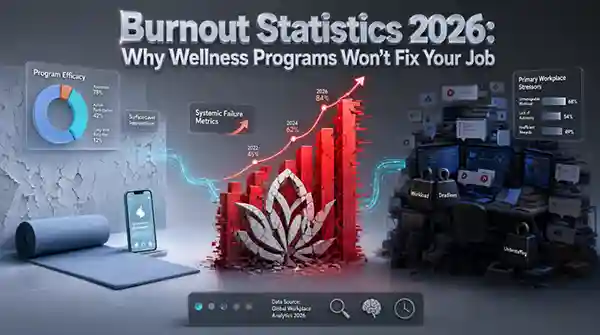
DR. M: That is exactly what it is saying. The WHO’s guidelines on mental health at work are explicit about this. They recommend organizational interventions that change the way work is designed, organized, and managed. They recommend training managers to support their teams. They recommend individual interventions for people who are already struggling. But the organizational interventions come first.
HOST: Why do companies keep investing in individual wellness programs and not organizational change?
DR. M: Because individual programs are easier. They are cheaper. They do not require anyone in leadership to admit that the way they run the place might be part of the problem. A meditation app is a lot less threatening than a conversation about workload, autonomy, and whether the performance metrics are achievable.
Does the four-day workweek reduce burnout?
HOST: What does the research say about the four-day workweek? Because that seems to be the intervention that everyone is talking about.
DR. M: The four-day workweek trials have produced some of the most promising results in the field. A six-country trial published in Nature Human Behaviour in 2025 found that a four-day week cut burnout scores by 0.44 points on a five-point scale. That is a meaningful effect. But it is important to note that the trials involved organizations that volunteered to participate, and the follow-up periods were relatively short. The evidence is encouraging. It is not definitive.
When should you seek professional help for work stress?
HOST: Let us talk about the mental health line. Because there is a difference between being stressed and being in crisis.
DR. M: There is. And it is important to name it clearly. Stress is a normal response to pressure. Burnout is a pattern of chronic stress that has not been managed. Depression and anxiety are clinical conditions that require professional assessment and care. The line between them is not always obvious, but it is real.
HOST: What should someone do if they are not sure which side of that line they are on?
DR. M: They should talk to a professional. A doctor. A therapist. Someone who can assess what is happening and recommend an appropriate course of care. This is not a failure of resilience. It is the same logic as going to a doctor when a physical symptom does not resolve. The research on depression, anxiety, and burnout is robust. Effective treatments exist.
HOST: What about the people who are listening and thinking, “This is my job. I cannot change my job. I cannot change my manager. I cannot change the workload. What do I do?”
DR. M: The first thing is to recognize that the problem is not you. The research is clear that the conditions of work are the primary drivers of burnout. The second thing is to look for the levers you can actually pull. The demand-control-support model says that control and support can buffer the effects of demand. If you cannot reduce the demand, can you increase your control over how the work is done? Can you increase the support you receive from a colleague, a mentor, or a manager? These are not solutions to the systemic problem, but they are buffers.
What should managers do differently?
HOST: What about the people who manage other people? What should they be doing differently?
DR. M: The research on leader-targeted stress management interventions is clear. A 2025 meta-analysis found significant effects on mental health and work outcomes when leaders were trained in stress management and supportive behaviors. The training works. But the training has to be accompanied by structural changes. A manager who has been trained to listen but is still expected to manage an impossible workload is not going to be able to help their team.
HOST: If you could change one thing about the way we talk about workplace stress, what would it be?
DR. M: I would stop framing it as an individual problem. The language of resilience, grit, and self-care puts the burden on the person who is struggling. The research says the burden belongs on the system. That does not mean individuals have no agency. It means the agency is not the solution. The solution is changing the conditions.
HOST: That is a hard message for a Monday morning.
DR. M: It is. But it is also a liberating one. If the problem is not you, then the shame is not yours to carry. And the people who can change the conditions are the people who need to hear the message.
HOST: Dr. M, thank you for your time.
DR. M: Thank you for asking the question.
HOST: You have been listening to The Long Shift. The numbers are not subtle. The solutions are not simple. But the conversation is the first step. And the first step is the only one that matters.
END OF BROADCAST.