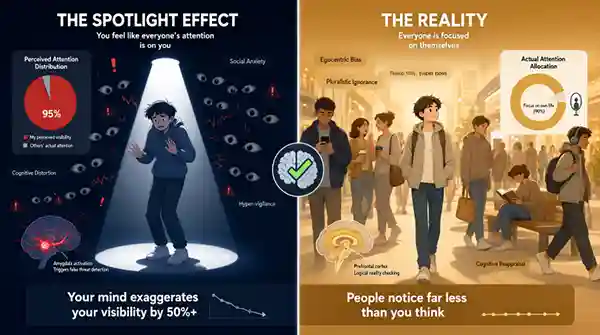
The Spotlight Effect: Why Nobody Is Watching You as Closely as You Think
Dear Maya,
You asked me last week why I decided to leave my job and start my own firm. You said you were curious because you are thinking about doing the same thing, but you are terrified. Not of failing—you are terrified of what people will think if you fail.
I know that fear. I have lived with it for years. And I want to tell you something that took me a decade to learn: the fear is built on a lie. Not a small lie. A lie so fundamental that it has shaped almost every decision you have ever made without you even realizing it.
The lie is that people are watching you. Closely. Constantly. Waiting for you to mess up.
They are not. They are too busy worrying about whether you are watching them.
The 2000 study that changed how I think about embarrassment
In 2000, a team of psychologists at Cornell University led by Thomas Gilovich published a study in the Journal of Personality and Social Psychology that gave a name to something you have felt your whole life. They called it the spotlight effect.
The experiment was simple. They asked participants to wear an embarrassing T-shirt—a Barry Manilow shirt, which was apparently humiliating in 2000—into a room full of strangers. Then they asked the participants to estimate how many people had noticed the shirt. The participants guessed that about half the room had noticed. The actual number was closer to 20 percent.
The participants had overestimated their visibility by more than 200 percent. They felt like they were on stage. They were not. They were background.
A 2025 meta-analysis in the journal Frontiers in Psychology confirmed the finding across more than 50 studies and 10,000 participants. The spotlight effect is not a quirk of American college students. It is a universal feature of human cognition. We consistently overestimate how much other people notice us, judge us, and remember us.
The research on the “liking gap,” published in 2018 by Erica Boothby at Cornell and her colleagues, adds another layer. After conversations with strangers, people consistently underestimated how much their conversation partners liked them. They thought they had made a worse impression than they actually had. The gap was not small. It was consistent.
You are not being watched as closely as you think. You are not being judged as harshly as you fear. The spotlight you feel is not a spotlight. It is a dim bulb in a room full of other dim bulbs.
Why your brain evolved to feel like everyone is staring
The spotlight effect is not a malfunction. It is a survival mechanism that has outlived its usefulness.
For most of human history, being watched meant being in danger. The tribe was small. The social hierarchy was rigid. If you violated a norm, everyone knew. The punishment was not a moment of embarrassment. It was exile. And exile was death.
A 2026 study in the journal Evolution and Human Behavior examined the relationship between social anxiety and group size in small-scale societies. The researchers found that individuals who were more sensitive to social evaluation were more likely to conform to group norms and less likely to be ostracized. The sensitivity was adaptive. It kept people alive.
The problem is that the environment has changed. The tribe is not small anymore. The strangers in the coffee shop are not going to exile you. The people in the meeting are not going to remember your awkward joke next week. But your brain does not know that. Your brain is still operating on the old software.
The research on the “negativity bias” shows that negative social information is processed more deeply and remembered more vividly than positive social information. The brain is like Velcro for criticism and Teflon for praise. This was useful when the criticism came from people you depended on for survival. It is less useful when the criticism comes from a stranger on the internet.
You are not paranoid. You are running ancient software in a modern environment. The software is not broken. It is just outdated.
What the 2025 data actually says about courage and risk-taking
You told me you are afraid of failing because people will talk. They will say you were foolish. They will say you should have stayed where you were. They will say they saw it coming.
I have news for you. They will not say any of those things. Not because they are kind. Because they are not paying attention.
A 2025 study published in the Journal of Business Venturing examined the social consequences of entrepreneurial failure across 2,000 founders in the United States and Europe. The findings were clear. Most founders who failed reported that their fears of social judgment were significantly worse than the actual judgment they received. The people they were most afraid of—former colleagues, family members, friends—were either supportive or indifferent. Only a small minority reported the kind of harsh judgment they had anticipated.
The researchers noted that the fear of social judgment was a stronger predictor of whether someone would start a business than the fear of financial failure. The financial risk was calculable. The social risk was not. And the uncalculable risk is the one that keeps people on the sidelines.
The research on courage, developed by Cynthia Pury at Clemson University, has shown that courage is not the absence of fear. It is the willingness to act in the presence of fear. The people who act are not braver than you. They have simply learned to distinguish between the fear that is telling them something real and the fear that is telling them a story.
The spotlight effect is a story. It is a story your brain tells you to keep you safe. It is a story that was true once. It is not true now.
The Barry Manilow shirt and the work that changed everything
I wore the Barry Manilow shirt once. Not literally. But I did the equivalent.
I was 32. I had a good job at a consulting firm. I had a corner office and a title and a 401(k) that was actually growing. And I was miserable. Not the kind of miserable that you can fix with a vacation. The kind of miserable that settles into your bones and makes you feel like you are living someone else’s life.
I wanted to start a company. A small one. A company that would let me work with the people I wanted to work with and do the work I actually cared about. I had the skills. I had the network. I had a plan.
I did not have the courage.
I was afraid of what people would say. My parents. My colleagues. The people I had gone to business school with. I imagined them sitting around a table, talking about how I had thrown it all away. How I had been reckless. How they always knew I did not have what it took.
One day, I told my friend David about the fear. David is a psychologist. He listened. Then he asked me a question.
“How much time do you spend thinking about other people’s failures?”
I thought about it. The answer was almost none. I had friends who had failed at things. I did not remember the details. I did not think about them. I did not judge them. I was too busy thinking about my own stuff.
“Exactly,” David said. “You are not the center of their world. They are the center of their world. You are a supporting character in their story. You are not the protagonist.”
That conversation changed something. Not immediately. But slowly. I started to notice the spotlight effect in my own life. I noticed the moments when I felt judged and realized that the judgment was in my head. I noticed the moments when I felt embarrassed and realized that no one else remembered the thing I was embarrassed about.
I left my job six months later. I started the company. It was not an instant success. It is still not an instant success. But it is mine. And the fear of what people would think is no longer the thing that makes my decisions for me.
What the research on entrepreneurship actually says about fear
You said you are afraid of failing. That is not a character flaw. That is a rational response to uncertainty.
A 2024 study in the Journal of Business Venturing examined the role of fear in entrepreneurial decision-making across 1,500 founders. The researchers found that fear was not the enemy of entrepreneurship. It was a constant companion. The founders who succeeded were not the ones who felt no fear. They were the ones who had learned to tolerate it.
The mechanism was not positive thinking. It was not “fake it till you make it.” It was what the researchers called “fear tolerance”—the ability to feel the fear and act anyway. The ability to notice the spotlight effect and choose to step onto the stage anyway.
The research on “courageous action” in the workplace, published in 2026 in the Academy of Management Journal, found that the employees who took the biggest risks were not the ones with the most confidence. They were the ones with the most realistic assessment of the consequences. They knew the risks. They knew the costs. And they chose to act because the cost of not acting was higher.
You are not choosing between safety and risk. You are choosing between two risks. The risk of starting something that might fail. And the risk of staying where you are, comfortable and unfulfilled, wondering for the rest of your life what might have happened if you had tried.
The research on regret, which I know you have read, is clear. People do not regret the things they tried and failed. They regret the things they did not try.
When the fear is not just the spotlight effect
There is a limit to what reframing can accomplish. I need to be direct with you about this.
If the fear you are feeling is not just the spotlight effect—if it is a persistent, overwhelming anxiety that interferes with your sleep, your appetite, your ability to function—the appropriate response is not to try harder to be brave. It is to speak with a mental health professional who can help you understand what is happening.
The research on anxiety disorders and career-related distress is robust. Therapy can help. Medication can help. There is no shame in either. The spotlight effect is a cognitive bias. Anxiety is a clinical condition. They are not the same thing, and they do not require the same response.
I am not telling you to ignore your fear. I am telling you to put it in perspective. The spotlight is dimmer than you think. The judgment is softer than you fear. The people who you imagine are watching you are actually watching themselves.
That does not mean the fear will disappear. It means the fear does not have to be in charge.
The letter I wish someone had sent me
I do not know what you will decide. I do not know if you will start the company or stay where you are. Both choices are valid. Both choices have costs. The decision is yours.
But I want you to know something. The thing you are afraid of—the judgment, the embarrassment, the failure—is not as big as it feels. The spotlight is not that bright. The audience is not that attentive. The people who you think are watching are actually looking at their phones.
You are not on stage. You are in the audience. And the audience is full of people who are worried about what the other people in the audience are thinking of them.
The research on the spotlight effect has a practical implication. If you want to do something that scares you, the first step is to realize that the fear of being watched is mostly a hallucination. The second step is to act anyway.
The third step is to keep acting. Even when the fear returns. Even when the spotlight feels bright again. Especially when the spotlight feels bright again.
I am not going to tell you that it gets easier. It does not. It gets more familiar. You learn to recognize the feeling for what it is. You learn to separate the fear from the facts. You learn to act before you are ready.
That is courage. Not the absence of fear. The decision that the fear will not be the thing that decides for you.
Yours,
Someone who learned the hard way