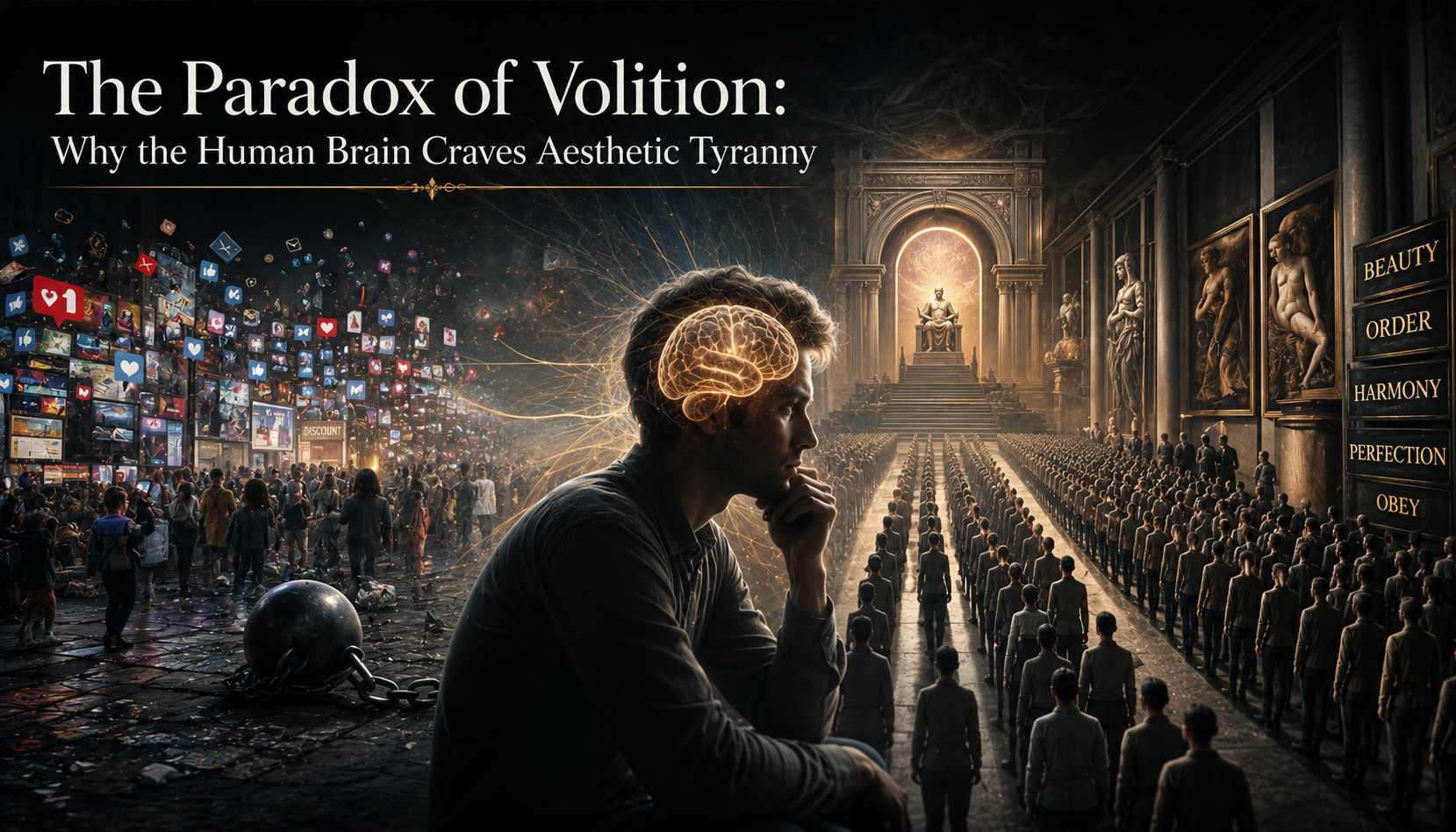
Why do we willingly pay a premium to enter a prison of another man’s design?
Consider the device currently resting in your hand or sitting on your desk. It dictates how you transfer files, determines which software you are permitted to run, and isolates you within a closed technological ecosystem. By all objective metrics, your operational freedom has been systematically restricted. Yet, instead of feeling resentful, you likely feel a quiet sense of elevation, even pride. You perceive this restriction not as a limitation, but as an expression of an elevated lifestyle.
This reveals a profound psychological paradox: the human nervous system frequently interprets strict external constraints as a form of deep psychological liberation. We claim we want infinite options, but our biology secretly map options as cognitive exhaustion. When a creator removes the burden of choice through uncompromising, authoritative design, our brain experiences this restriction as a profound act of therapeutic care.
The Neurological Economy of Curated Constraint
To understand why millions voluntarily adopt a single creator’s vision, we must look at the energetic architecture of the prefrontal cortex. The brain accounts for roughly two percent of body weight but consumes twenty percent of its metabolic energy. A significant portion of this energy is expended on filtering ambient noise and making trivial micro-decisions.
[Infinite Choice Environment]  --> High Predictive Error --> Cognitive Fatigue (Anxiety)
[Authoritarian Curation]      --> Low Predictive Error  --> Neurological Ease (Security)
In an uncurated environment, the brain must constantly minimize predictive error, processing endless variables to determine the utility, safety, and aesthetic harmony of an object. When an object is engineered with absolute, unyielding clarity—where form and function are locked in an immutable relationship—the brain stops calculating. It recognizes that the cognitive work has already been performed by another mind.
This is the hidden mechanics of what we call premium user experience. It is not the presence of utility; it is the absence of cognitive friction. The authoritarian creator does not negotiate with the user’s preferences; he overrides them, presenting a finished reality that the nervous system accepts with relief.
The Abandonment Blueprint and the Drive for Absolute Control
The standard narrative attributes global innovation to mere creative genius or commercial foresight. However, behavioral architecture suggests a more visceral root cause: the early childhood blueprint. Between birth and age seven, the developing brain records its foundational emotional syntax. When that period is marked by systemic disruption—such as the primal fracture of parental relinquishment or early environmental instability—the nervous system adapts by forming a highly protective operational script.
For an individual carrying an early blueprint of abandonment, the external world is fundamentally coded as unsafe, unpredictable, and chaotic. The subconscious response to this threat is the development of an uncompromising, perfectionist drive for absolute control over the environment.
- The Closed System: The insistence on an ecosystem where external components cannot interfere is the physical projection of a well-defended ego structure.
- The Rejection of Consensus: Dismissing the cultural consensus that “taste is subjective” is a psychological defense mechanism. It establishes an absolute internal standard to insulate the self from the vulnerability of external judgment.
When this internal architecture faces a major secondary setback—such as being publicly cast out from the very institution one created—the default narrative predicts psychological collapse. But for a system configured by early adversity, this disruption offers a rare neurological reward: the removal of the weight of maintenance. The return to a baseline of zero allows the brain to bypass the analytical weight of success and return to a state of raw, uninhibited creation.
Retrospective Coherence: The Delayed Alignment of Memory
We often struggle to find meaning while navigating moments of acute personal or professional failure. The stress response floods the hippocampus with cortisol, fragmenting our immediate perception of time and purpose. We see only isolated, damaging events.
+-----------------------------------------------------------------+
|               RETROSPECTIVE COHERENCE MATRIX                    |
+-----------------------------------------------------------------+
| ACUTE EVENT (Trauma/Failure) --> High Cortisol / Disconnection  |
| NEURAL INTEGRATION (Time)    --> Synaptic Consolidation         |
| RETROSPECTIVE VIEW (Meaning) --> Narrative Coherence (The Dots) |
+-----------------------------------------------------------------+
Clinical observations of narrative identity show that the brain requires time and a reduction in allostatic load to achieve what can be termed retrospective coherence. You cannot connect the behavioral data points of your life looking forward; the neural pathways must first be consolidated through lived experience.
Only when the nervous system integrates the lessons of the wilderness period does the brain construct a coherent narrative structure. The historical trauma is then rewritten not as an isolated catastrophe, but as the exact evolutionary catalyst required to build your highest-density work.
The Supremacy of Visceral Intuition Over Logic
True innovation is rarely the product of linear, analytical deduction. Data can only reflect what already exists; it cannot predict the non-linear leaps of human imagination. Linear logic is a product of working memory, which is strictly limited by its processing capacity.
Conversely, intuition is the somatic manifestation of complex, non-linear neural computations occurring beneath conscious awareness. It is the raw synthesis of deep ancestral memory, subconscious observation, and somatic marker signals. When an individual learns to trust this internal compass over the ambient noise of societal dogmas, they stop trying to satisfy the market. Instead, they begin to reshape the internal landscape of the consumer.
The ultimate authority of an iconic creation does not rest on its technical specifications, but on its capacity to act as a mirror for the user’s dormant potential. By choosing to step outside the safety of conventional consensus, you force the world to adjust to your blueprint, rather than exhausting your nervous system by constantly adapting to theirs.
True autonomy means recognizing that your time on this planet is finite, which makes the choice to live out someone else’s cognitive programming the ultimate neurological compromise.