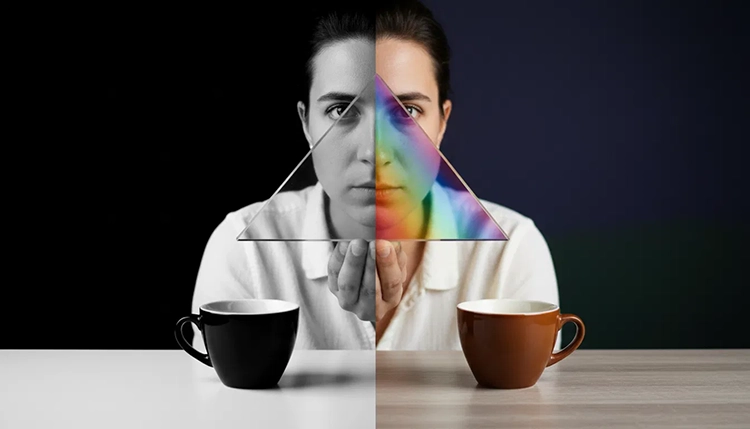
Flexible Thinking: Finding Richness Between Black and White
From childhood onward, we are conditioned to categorize the world: right versus wrong, good versus bad, beautiful versus ugly. While these sharp divisions seem to help our minds organize reality, they eventually become invisible traps that swing us between emotional extremes. Writing someone off entirely over a single mistake or ignoring all their flaws because of one good deed leaves no room for genuine understanding.
The Categorization Illusion To conserve energy, the brain naturally attempts to box experiences into neat opposites. Yet life is not a laboratory of strict binary choices; it is a fluid landscape where nuances and shades of gray coexist.
“What is the Categorization Illusion? It is an evolutionary cognitive bias where the human brain automatically forces complex, nuanced experiences into binary, rigid opposites to conserve cognitive energy and simplify emotional reality.”
Escaping “All-or-Nothing” Thinking in Relationships
Labeling people as purely good or purely evil is a common perceptual trap. The very same snowfall that feels romantic when watched from a warm living room becomes a frustrating ordeal when you are stranded on a highway. As circumstances change, meanings change alongside them.
Applying this flexibility to human relationships allows us to address specific behaviors without condemning an entire person. Recognizing that everyone makes mistakes helps us move past rigid “all-or-nothing” rules. When a disagreement arises, we do not need to cut ties completely; establishing healthy boundaries offers a far more balanced alternative.
Practicing Self-Compassion and Mental Flexibility
We often apply this harsh binary judgment most severely to ourselves. A single misstep can send us into a spiral of self-criticism, while a minor success might tempt us to ignore areas that still need growth.
Evaluating ourselves through the lens of specific contexts, timing, and circumstances prevents sweeping generalizations. Making a mistake on a given day does not define your character. Flexible thinking allows us to learn from our errors with grace and keep moving forward without dismantling our self-worth.
Embracing the Spectrum of Life
Overcoming the brain’s automatic labeling mechanism takes intentional effort. When we loosen our grip on strict categories, we begin to recognize the light within the dark and the dark within the light.
No experience, individual, or emotion can be squeezed into a single label. Capturing the subtle interconnections between extremes reveals the true depth of human experience, guiding us toward a far more balanced and steady perspective.