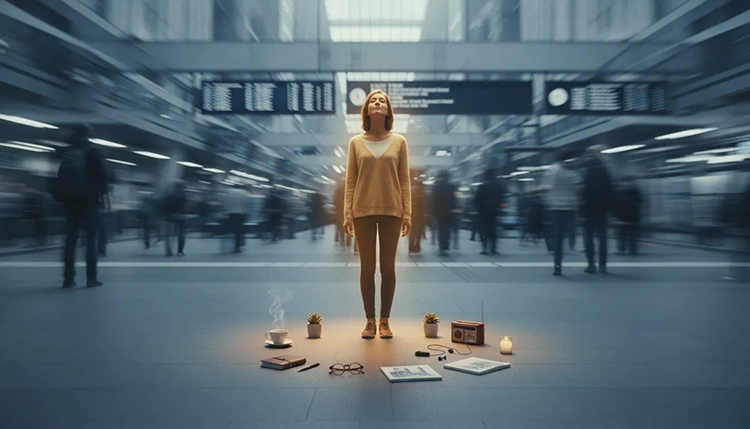
Why Are We So Terrified of Moving Slowly?
You are standing in line for a morning coffee, but your foot is tapping an anxious, erratic rhythm against the tile floor. Your thumb swipes mindlessly across a glowing glass screen, devouring notifications you won’t remember five minutes from now. Outside, the world moves at an exhausting, relentless tilt—economic turbulence, endless news cycles, personal deadlines, and the quiet, nagging feeling that no matter how fast you run, you are somehow falling behind.
Your tongue feels dry, your shoulders are pinned to your ears, and your chest carries a faint, persistent tightness. You aren’t just busy. You are culturally hyper-accelerated.
Modern life has tricked us into confusing speed with vitality. We treat our days like sinking ships, desperately bailing out water with leaky buckets, terrified that if we stop scooping for even a second, the deep blue will swallow us whole. But here is the quiet paradox: when everything moves at top speed, nothing actually registers. Life doesn’t feel richer when you rush through it; it simply feels shorter.
The Velocity Delusion
We live under the spell of what we might call The Velocity Delusion—the psychological trap where we measure the value of our lives by the rate of our output rather than the depth of our presence.
The Velocity Delusion is a chronic psychological state in which the human nervous system mistakes constant movement for progress and stillness for failure. Driven by a nervous threat response to existential drift, individuals sub-consciously trade deep sensory engagement and emotional processing for superficial task execution, ultimately rendering time perceived as passing faster while yielding less memorable meaning.
From an evolutionary standpoint, your brain is built to conserve energy and scan for threats. When you overload your daily bandwidth with chronic noise, economic stress, and constant hyper-vigilance, your amygdala interprets this endless urgency as a perpetual state of danger. Cortisol floods your bloodstream. Your heart rate rises slightly. Your perception narrows into survival mode, filtering out the soft, ambient beauty of the present moment so you can survive the imaginary tiger chasing you through your inbox.
You aren’t failing at managing your time. Your nervous system is simply exhausted from living in an endless state of false emergency.
The Art of the Friction Buffer
Consider a typical Tuesday afternoon. You step away from your desk to make a cup of tea. Instead of leaning against the counter and watching the steam rise, you check your email with one hand while stirring the mug with the other. You have eliminated all “friction” from your schedule, yet you feel more frayed than ever.
To reclaim control over the slipstream of time, you don’t need to quit your job or retreat to a mountain monastery. You simply need to build small, intentional barriers against momentum—what behavioral scientists call frictional grounding.
When you consciously slow down your physical movements, you send a direct neurological signal down the vagus nerve to your heart: We are safe. There is no fire.
- Touch the physical world: Put your hands in the soil of a houseplant, feel the cold temperature of tap water running over your wrists, or look at the intricate geometry of a cloud passing over your window.
- Step outside the internal narrative: Ask yourself in a moment of friction, “What is this discomfort trying to teach me right now?” Most stress is just unexamined energy waiting for an outlet.
- Release the unseen cargo: Surrender the unspoken demand to control how other people view you, the guilt of uncompleted side projects, and the silent anger over things you cannot fix today.
When two human hearts connect in a genuine, unhurried conversation—devoid of agenda or digital distraction—the brain releases oxytocin, instantly down-regulating our stress response. Joy requires space to expand. If every second of your day is pre-booked, delight has nowhere to sit.
A Small Shift: The Three-Breathe Anchor
The next time you feel the room spinning and the day slipping through your fingers like fine sand, try this simple recalibration right where you are.
Close your eyes. Place one hand flat against the center of your chest, feeling the quiet, steady cadence of your heartbeat underneath your palm. Take a deep, deliberate breath through your nose for four seconds, hold it briefly, and exhale slowly through your mouth.
Do this three times.
You haven’t solved your entire life’s task list, nor have you fixed the global economy. But in those ninety seconds, you pulled yourself out of the storm and placed your feet back on solid earth. The world can wait a moment; you have finally arrived back home to yourself.
The world can wait a moment; you have finally arrived back home to yourself. Take a second glance at the small moments you are rushing through today.