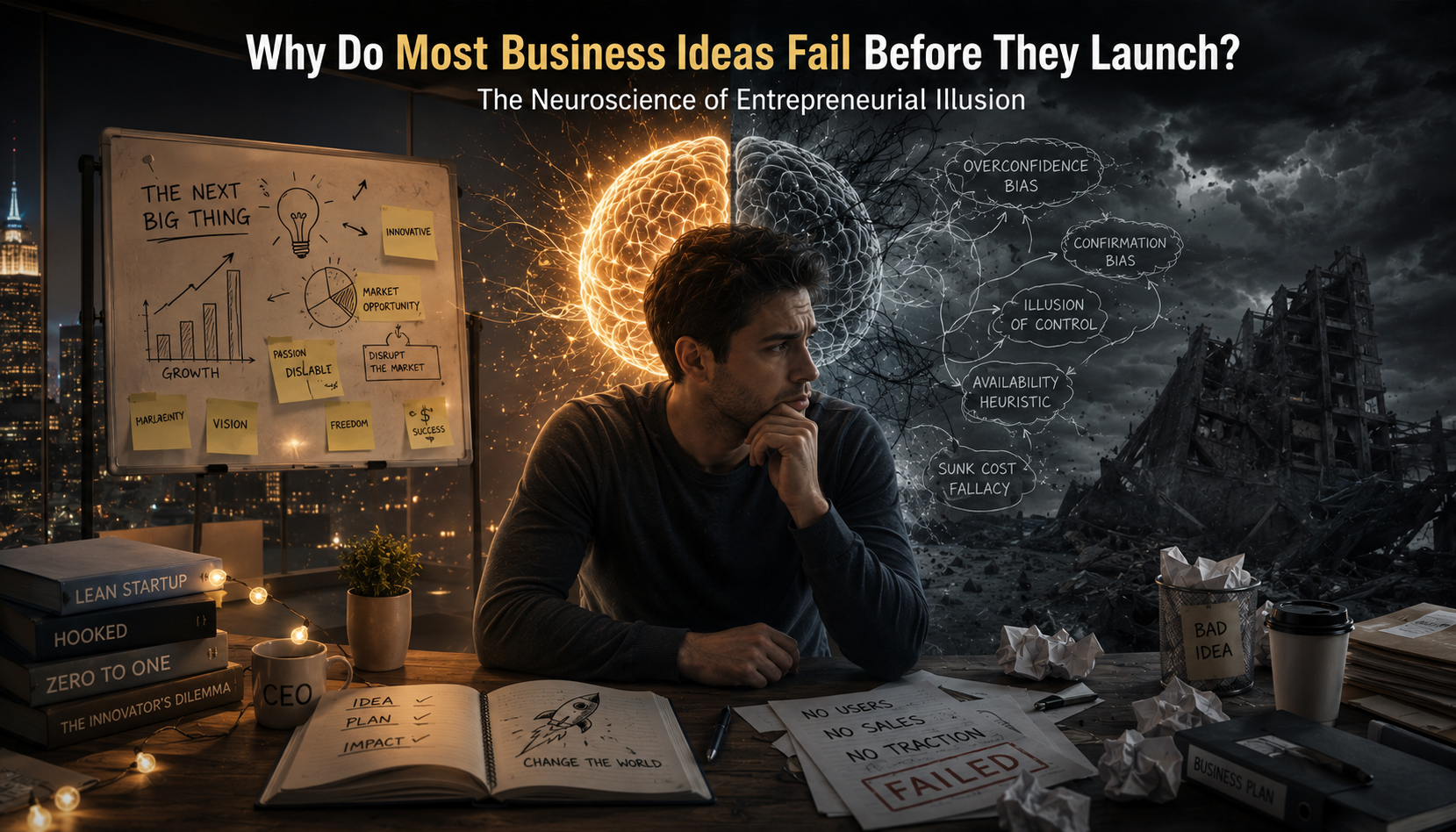
Have you ever woken up in the middle of the night gripped by a business idea that felt absolutely flawless? In that quiet hour, the path from conception to global market dominance seems direct, almost inevitable. You can clearly visualize the financial freedom, the cultural impact, and the profound sense of validation that will follow.
Yet, weeks or months later, that notebook remains closed on your desk. The initial electric rush has dissolved into a quiet, heavy avoidance. When you think about taking the first concrete step—registering the domain, drafting a financial ledger, or calling a potential partner—a wave of invisible friction paralyzes you. You feel busy, perhaps constantly researching, but the project remains entirely stagnant.
This friction is not a character flaw. It is a predictable biological event. Your nervous system has encountered the wide evolutionary gap that separates raw enthusiasm from true operational execution.
The Dopaminergic Traps of Mere Enthusiasm
Most aspiring founders fail to realize that the brain experiences a brilliant idea as a profound neurological reward before any real work has occurred. When you fantasize about a successful venture, the ventral striatum releases a surge of dopamine. To your nervous system, the mental simulation of success feels nearly identical to the real achievement.
[Initial Concept] ---> Dopamine Spike (Fantasy) ---> Subconscious Satiety ---> Executive Paralysis
This creates a psychological hazard: subconscious satiety. Because your brain has already consumed the emotional reward of the idea, it experiences the subsequent step—the tedious, unglamorous mechanics of building a business plan—as a steep drop in dopamine.
True entrepreneurship is not the pursuit of this emotional high. It is the ability to sustain executive focus long after the initial chemical rush has cleared. If a founder relies entirely on enthusiasm, they remain an ideator—neurologically addicted to the comfort of potential, yet terrified of the vulnerability of actual execution.
The Childhood Blueprint of Risk and Validation
To understand why some individuals seamlessly translate ideas into reality while others remain frozen in the planning phase, we must look to the early childhood blueprint. Between the ages of zero and seven, the human nervous system learns how to categorize risk, failure, and autonomy.
If your early conditioning taught you that mistake-making results in systemic rejection or emotional abandonment, your adult brain will view an unlaunched business as a safe haven. As long as the business remains a theory, it cannot fail. The moment you expose it to a real market, you risk invalidating your core sense of worth.
+-----------------------------------------------------------------+
|               THE VENTURE EXECUTION HORIZON                     |
+-----------------------------------------------------------------+
| THE FANTASY LOOP:   Idea --> Mental Simulation --> Stagnation   |
| THE OPERATIONAL LOOP: Idea --> Market Friction --> Adaptation  |
+-----------------------------------------------------------------+
Real venture building requires what I call the Operational Loop. It demands pushing the concept past the safety of your own mind and into the harsh reality of market validation. This requires a business plan—not as a rigid prediction of the future, but as a practical tool to force the prefrontal cortex out of defensive fantasy and into objective calculation.
The Cognitive Cost of Systemic Isolation
A common error among early-stage founders is the assumption that they must possess absolute competence across every operational vector. They attempt to manage product development, marketing, legal compliance, and financial forecasting simultaneously.
This approach triggers rapid decision fatigue. The human working memory can only track a few complex variables before executive function degrades. During my years supervising complex neuro-acoustic research tracking, I observed that the highest-performing teams were never composed of multi-tasking generalists. They were networks of deeply specialized minds, each managing a single operational channel to preserve collective cognitive bandwidth.
If you are launching an online enterprise, you do not need to personally master every legal framework or coding language. You need to build a small team that distributes the metabolic load. Attempting to build a venture in complete isolation is rarely a sign of dedication; it is usually a psychological defense mechanism designed to avoid the interpersonal friction of a shared journey.
Market Positioning and the Myth of Extrinsic Focus
Conventional business logic states that the primary objective of any new commercial entity is the immediate generation of capital. While cash flow is a vital biological necessity for survival, optimizing exclusively for short-term revenue is a significant strategic mistake.
The most resilient ventures are built on structural differentiation—the deliberate choice to offer an ecosystem that cannot be easily replicated by established competitors. This requires shifting your focus away from superficial metrics and toward deep user experience architecture.
When you create clear, original value that simplifies a consumer’s daily life, financial return follows as a natural byproduct of systemic equilibrium. If your venture looks exactly like the old options, the market will treat you as obsolete before you even launch.
True professional autonomy begins when you stop looking for permission from a volatile market, and instead build a reliable operational roadmap designed to survive the reality of human behavior.