What Makes a Person Truly Strong? The Science of Character Strengths and Mental Resilience

What Makes a Person Truly Strong? The Science of Character Strengths and Mental Resilience

The Hero Architecture: Why Character Strengths Are Evolutionary Tools, Not Moral Tropes You are lying awake at midnight, replaying a confrontation from earlier in the afternoon or staring at an unfinished project that has languished for weeks, wondering why you cannot simply command yourself to be different. In quiet moments of exhaustion, the mind naturally … Read more


200+ Deep Questions to Ask Someone: The Psychology of Meaningful Conversations

200+ Deep Questions to Ask Someone: The Psychology of Meaningful Conversations

The Architecture of Inquiry: Why We Ask Questions That Reveal Nothing We have all found ourselves standing in the dimly lit periphery of a cocktail party, or sitting across a small wooden table on an expectant first date, trapped in the mechanical choreography of small talk. “What’s your favorite movie?” “If you won the lottery, … Read more

Why Your Work Friends Matter More Than You Think: The Science of Happiness, Success, and Longevity

Why Your Work Friends Matter More Than You Think: The Science of Happiness, Success, and Longevity

The Micro-Ecosystem of the Workplace: How Occupational Relational Bonds Shape Longevity, Performance, and Neurobiology At 8:45 AM on a rainy Tuesday, two colleagues stand in a breakroom waiting for a coffee machine to cycle through its brew. One mentions an upcoming project deadline with a subtle sigh; the other nods, smiles warmly, and says, “I … Read more

Dr. Gabor Maté’s 7 A’s of Healing: How Hidden Stress Affects Your Mind and Body

Dr. Gabor Maté's 7 A's of Healing: How Hidden Stress Affects Your Mind and Body

The Biopsychosocial Debt: Why Disease Is Often the Body’s Refusal to Live a Lie A forty-two-year-old executive sits in a sterile clinic office, holding a fresh diagnosis of an autoimmune condition. She leads a disciplined life: she exercises four days a week, eats a clean plant-forward diet, and rarely misses a night’s sleep. Yet, her … Read more

How to Improve Emotional Intelligence: The Neuroscience of EQ and Better Relationships

How to Improve Emotional Intelligence: The Neuroscience of EQ and Better Relationships

The Emotional Signal Architecture: How High-EQ Leaders Convert Internal Chaos into Strategic Advantage It is a quiet Thursday afternoon in a high-stakes board conference. The lead product strategist is mid-presentation when a senior partner interrupts, flatly dismissing six months of cross-functional research as “analytically naive.” In the brief, razor-thin second following that remark, a physiological … Read more

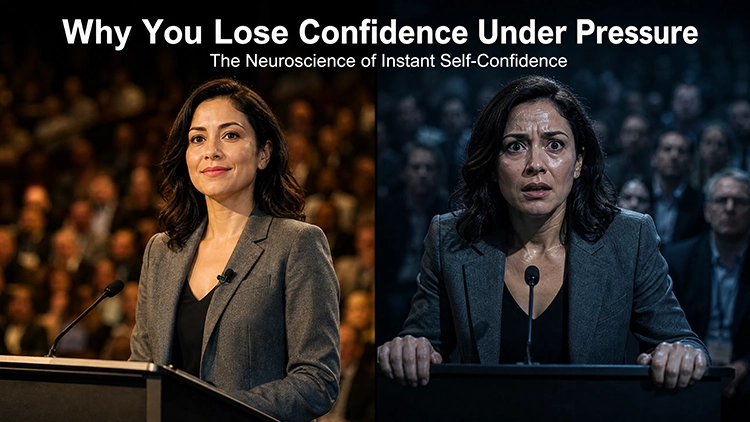
Why You Lose Confidence Under Pressure: The Neuroscience of Instant Self-Confidence

Why You Lose Confidence Under Pressure: The Neuroscience of Instant Self-Confidence

The High-Stakes Illusion: Why Quick Confidence Hacks Are Biological Circuit Breakers You are standing behind the heavy doors of a boardroom, or sitting in your parked car two minutes before a crucial interview, or waiting at a quiet corner table for a first date. Your heart is hammering against your ribs like a trapped bird. … Read more

How to Get Out of Your Comfort Zone: The Neuroscience of Fear, Growth and Lasting Confidence

How to Get Out of Your Comfort Zone: The Neuroscience of Fear, Growth and Lasting Confidence

The Comfort Zone Illusion: Why Your Brain Mistakes Familiar Misery for Safety You step into the office parking lot on a rainy Tuesday morning, sit in the idling car for two extra minutes, and feel a subtle, hollow heaviness in your chest. You do not hate your job, but you haven’t been challenged by it … Read more

Why You Can’t Take Action (And the Neuroscience of Finally Getting Started)

Why You Can't Take Action (And the Neuroscience of Finally Getting Started)

The Neuro-Executive Mechanics of Action: Bypassing Analysis Paralysis and Engineering Immediate Execution We are conditioned to treat execution as a downstream consequence of emotional readiness. We wait for the “right mood,” a surge of motivation, or the elimination of internal friction before initiating a task. When an uncomfortable, high-stakes, or complex objective presents itself, we … Read more

How to Live in the Present Moment (The Science Behind the Power of Now)

How to Live in the Present Moment (The Science Behind the Power of Now)

The Temporal Trap: Why Future-Oriented Mindsets Block Executive Agency and How the Present Moment Reclaims Cognitive Control Modern productivity paradigms heavily subsidize outcome-driven focus. We are taught to visualize distant milestones, engineer multi-year trajectories, and condition our immediate satisfaction on future achievement. We treat the present moment merely as a transitional corridor—a necessary friction point … Read more

How to Forgive Yourself (The Psychology of Guilt, Shame, and Self-Punishment)

How to Forgive Yourself (The Psychology of Guilt, Shame, and Self-Punishment)

The Architecture of Self-Forggiveness: Resolving Cognitive Dissonance, Shame, and the Self-Punishment Loop Self-forgiveness is frequently misunderstood as a form of self-indulgence, a way to minimize harm, or an attempt to bypass responsibility. Because of this misconception, when we make significant mistakes, we often default to chronic self-punishment. We replay the event endlessly, carry persistent guilt, … Read more