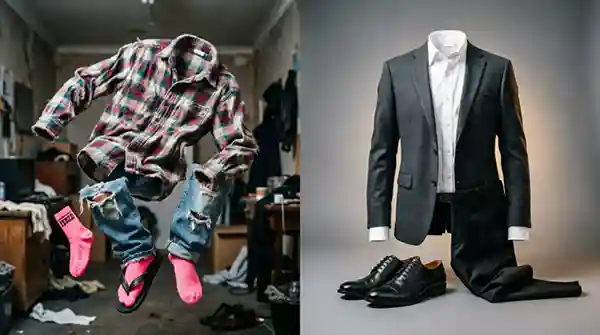
What Not to Wear to Work: 25 Items That Send the Wrong Message
I hate this topic.
Not because it’s unimportant. Because it forces me to admit something uncomfortable: we judge people by their clothes. We do it fast. We do it unconsciously. And we do it with a certainty that the evidence doesn’t support.
In a perfect world, you’d be evaluated solely on the quality of your work. Your output. Your ideas. Your contribution. The world is not perfect. And the research on first impressions has been telling us this for over a century.
So here’s the deal. This isn’t a lecture about dressing “professionally.” It’s a field guide to the things that will actively work against you. The items that send messages you didn’t intend to send. The choices that make people question your competence before you’ve said a single word.
Some of these are obvious. Some will annoy you. A few might make you defensive. Good. That means you’re paying attention.
Why your outfit speaks before you do
The year was 1920. A psychologist named Thorndike published a paper on what he called the “halo effect.” The finding was simple and devastating. When people rate one trait in a person, that rating bleeds into everything else. If someone is attractive, we assume they’re smarter. If they’re well-dressed, we assume they’re more competent. If they’re sloppy, we assume they’re careless.
Thorndike wasn’t studying fashion. He was studying how the mind organizes information. But the implications for what you wear to work are obvious.
Nearly a century later, a 2014 study in the Journal of Experimental Psychology confirmed the pattern. Researchers at Columbia University found that people make judgments about personality, status, and competence from clothing in as little as 100 milliseconds. The judgments are consistent across observers. And they’re remarkably resistant to change.
You have a tenth of a second. That’s your window.
The difference between “casual” and “careless”
There’s a version of this article that says “dress for the job you want, not the job you have.” It’s good advice. It’s also incomplete. Because the real question isn’t what you want. It’s what the people around you are reading.
A 2016 survey of hiring managers found that 65 percent said clothing choices could be the deciding factor between two equally qualified candidates. A separate study from the University of Hertfordshire in the UK found that men who wore tailored suits to work were perceived as more confident and successful than those who wore off-the-rack. The effect held even when the participants were told the suits were identical in quality.
Clothing is a signal. And like all signals, it can be noisy. It can say things you didn’t mean. It can undermine the message you’re trying to send.
Here’s what the research says about what not to send.
The case file: 25 items that work against you
1. Crocs. They’re comfortable. They’re antibacterial. They’re also beach shoes. The company’s own website describes them as “boat and outdoor” footwear. If your office is a boat, you have my permission. Otherwise, find something else. The exception is if you’re Mario Batali. If you’re Mario Batali, you can do whatever you want.
2. Uggs. Uggs are boots. They are not office boots. They are “I’m running to the grocery store and I’ve given up” boots. Pairing them with a mini skirt doesn’t make them professional. It makes them confused. Leather boots work. They don’t have to be heels. They just have to be intentional.
3. Fanny packs. The 1980s called. They want their fashion mistake back. A fanny pack in a professional setting says “I don’t understand the assignment.” Any bag works. A tote. A crossbody. A briefcase. Anything that doesn’t involve strapping your belongings to your waist like you’re on a hike.
4. Cloth hair ties. Same era. Same problem. A cloth scrunchie doesn’t say “I’m put together.” It says “I’m running late and this was on the counter.” Hair bands. Clips. A scarf. Even a hat, if your office is that casual. Just not the scrunchie.
5. Sweatsuits. This should be obvious. It isn’t. People wear sweatsuits to work. They shouldn’t. Even people who work in fitness don’t wear sweatsuits to the office. They change. You should too. Cotton trousers. A simple white tee. A cardigan. Comfort is possible without looking like you just rolled out of bed.
6. Leggings. Leggings are not pants. They are not office pants. They are not teleconference pants. They are yoga pants. If you’re doing yoga, wear them. If you’re giving a presentation, don’t. Ponte or wool-blend trousers look the same. They just don’t scream “I gave up.”
7. Leather pants. Unless you’re auditioning for a reality dating show, leather pants have no place in an office. They’re hot. They’re restrictive. They’re a statement. Make a different statement. A black blazer. Dark trousers. A structured bag.
8. Face tattoos. Just don’t. A face without tattoos is a face that doesn’t require explanation.
9. Velour tracksuits. They look expensive. They look soft. They also look like you’re about to run to the supermarket. The fabric doesn’t belong in an office. Neither does the vibe.
10. Message t-shirts. Your shirt says “World’s Best Mom.” Great. Save it for the weekend. Your shirt says “I’m with stupid.” Even better. Save it for never. Plain t-shirts exist. Wear them.
11. Too much skin. You can bring your stomach to work. You just don’t have to show it. The general rule: covered from just below the collarbone to just above the knee. A few inches either way depending on the industry. No one needs to see your underwear. No one needs to see your abs. Tight clothing reads as unprofessional regardless of how good you look.
12. Heavy makeup—or none at all. This one is uncomfortable. The research is clear. A 2011 study in the Journal of Applied Social Psychology found that women who wore makeup were perceived as more competent and trustworthy than those who didn’t. A separate survey found that 64 percent of managers thought makeup made women look more professional. If you hate makeup, try one thing. Lipstick. A trusted friend can help you pick a color. If you already wear ten products, try three. Mascara. Powder. Blush.
13. Wearing yesterday’s clothes. You didn’t go home last night. People will wonder why. They’ll wonder if it was a fight. A one-night stand. A walk of shame. They’ll wonder about your judgment. Don’t let them. If you can’t go home, buy something new. Borrow something from a friend. Just don’t show up in the same outfit.
14. Sequins. A little sparkle on a dark top is fine. A lot of sparkle is a costume. The rule: if your sequins would cover more than half a sheet of paper, it’s too much. Put the sparkle on your watch. Your earrings. Your necklace. Not your shirt.
15. Flip-flops. Flip-flops are for the beach. The park. Walking the dog. They are not for the office. No one wants to see your toes in a meeting. Try a dressy sandal. A peep-toe shoe. Something that says “I tried.”
16. Too much jewelry. The jangling bracelets. The clinking bangles. The sound of someone who can’t sit still. It’s distracting. It’s annoying. Wear one big bracelet instead of ten small ones. Same effect. No noise.
17. Sports jerseys. March Madness is exciting. Your team might win. Your boss will notice that you’re more focused on the score than the spreadsheet. Leave the jersey at home. Wear a pin. Coordinate your tie. Save the fandom for after hours.
18. Hats. Baseball caps. Beanies. Fedoras. They hide your eyes. They make you look like you’re hiding something. Unless you work outside, skip the hat. Dry shampoo exists. Use it.
19. Long nails. There’s a limit. Nails that prevent you from doing your job are too long. Nails with dirt underneath are too long. If you want long nails, maintain them. If you don’t, keep them clean and trimmed. Manicures are not just for women.
20. Dirty, wrinkled, torn clothes. If you don’t care about your appearance, people assume you don’t care about your work. Wrinkles from sitting at your desk are normal. Wrinkles from leaving your clothes in a pile on the floor are not. Iron. Tailor. Launder. It’s not hard.
21. Wallet chains. Wallet chains are for middle schoolers who vandalize school property. They make noise. They send the wrong message. They make you look scattered. Keep your wallet in your pocket. Or your bag. Or anywhere that doesn’t involve a chain.
22. Glitter. Glitter gets everywhere. It’s worse than sequins. It’s impossible to remove. You are not a middle school art project. You are a professional. Act like it.
23. Sunglasses indoors. We know you think you look cool. You don’t. You look hungover. You look like you’re hiding something. If you are hungover, drink water. Take aspirin. Take a shower. Leave the sunglasses in the car.
24. Animal prints. A little leopard is fine. A lot of leopard is a warning sign. One piece. One. Shoes. Bag. Belt. Not all three. Not a dress. Not a coat. The goal is “I have a personality,” not “I am a personality.”
25. Short shorts. This one can work if done right. Shorts that show your butt are not done right. Look for city shorts. They hit just above the knee. Pair them with a blazer and heels. You’ll look intentional. You won’t look like you’re going to the beach.
What the research says about comfort and professionalism
Here’s the tension. Everything I just listed is comfortable. That’s why people wear it. The research on cognitive load tells us that comfort matters. When you’re physically uncomfortable, you have less mental bandwidth for actual work. A 2012 study in the Journal of Consumer Research found that wearing uncomfortable clothing reduced performance on cognitive tasks.
So the solution isn’t to be miserable. The solution is to find comfortable clothes that don’t signal “I’ve given up.” Cotton trousers. Soft blazers. Quality fabrics. The goal isn’t discomfort. It’s intentionality.
When you’re sick and still have to go
You feel terrible. You look terrible. You have to go to work anyway. What do you do?
The instinct is to dress down. Be comfortable. Give yourself a break.
The research says the opposite. A 2015 study in Social Psychological and Personality Science found that what you wear affects how you feel. Participants who wore formal clothing performed better on cognitive tasks and felt more powerful. The effect was strongest for people who were already feeling uncertain.
If you’re sick, dress up. Not down. It won’t cure you. It might help you get through the day.
The bottom line: dress for the job you want
The research is clear. People judge you by your clothes. They do it fast. They do it unconsciously. They do it even when they know they shouldn’t.
You can’t control that. You can control what you wear.
The goal isn’t to look like everyone else. It’s to look like you belong. Like you take the work seriously. Like you understand the context you’re in.
That’s what “professional” means. It’s not a uniform. It’s a signal. And you’re sending it whether you like it or not.
So send the right one.
One last thing
I’m not going to tell you to throw away your Crocs. I’m not going to tell you to burn your Uggs. I’m not going to tell you to never wear a message t-shirt again.
I’m telling you to think about what you’re saying. To understand that clothes are a language. To know that the people around you are reading.
You can dress however you want. You just can’t control the interpretation.
That’s the deal. Take it or leave it.