The Night I Stopped Fighting With My Evenings
Three weeks ago I sat on the edge of my bed at 11:47 p.m., phone in hand, thumb scrolling through nothing. I had been tired since three in the afternoon. But I was still awake, still absorbing, still letting the day’s noise echo through my skull long after the day itself had ended. The last thing I saw before I finally passed out was a video of a stranger making pasta in a kitchen I will never visit.
That was the night I realized something obvious and a little embarrassing: I have never once thought about how I close my days. I think about how I open them. I have opinions about morning routines. I have read articles about cold showers and sunlight before coffee. But the last hour before sleep? It just happened to me. Every night. Like weather.
The source text I keep coming back to says the way you end the day matters as much as the way you start it. Not because you need to be productive until the final minute. Because the last thing your mind touches before sleep is the thing it will chew on all night. And I was feeding it garbage.
What “Closing the Day” Actually Means
There is a quiet distinction buried in the original text that I missed the first time I read it. The author says, with almost nervous care, that this is not about ignoring negative emotions. It is not about slapping gratitude on top of a wound and calling it healed. It is about letting the emotions finish their sentence. Letting them exist fully. And then, when they have spent themselves, letting them go.
I love that. Letting the emotions finish their sentence. Most of us interrupt them. We tell ourselves to cheer up, to move on, to be grateful, to stop dwelling. But emotions do not like being interrupted. They get louder.
The evening is the only time of day when you can let the day’s feelings finish talking. Not to solve them. Not to fix them. Just to let them run out of breath. That is what the night is for.
What I Tried and What Actually Changed
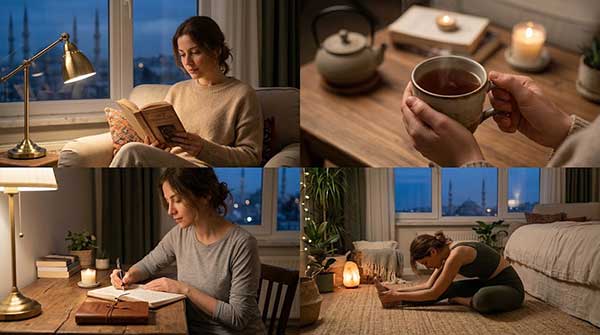
The first thing I tried was the simplest: writing down the day before bed. Not a polished journal entry. Not a memoir. Just a brain dump. Whatever was still spinning. “I should have said this.” “Why did I do that?” “Tomorrow I need to remember…” I wrote it in a notebook I bought at a pharmacy for three dollars. The act of moving the thoughts from my head to the page did something strange. It made them smaller. Not gone. Smaller.
The author of the source text mentions something I have started to notice: after a few weeks of this, patterns appear. You start to see that the same worries come up again and again. The same regrets. The same loops. And once you see the loop, you are no longer inside it.
The second thing I tried was the gratitude practice. I resisted this one. It felt too neat. But the way the text frames it saved me from my own cynicism. It does not ask you to pretend the bad things did not happen. It asks you to notice that the bad things were never the only things. Three small moments. The parking spot that opened up. The text from an old friend. The way the light hit the kitchen counter at four o’clock.
I started writing three things in the same pharmacy notebook. Some nights I could barely find one. But the search itself did something. It trained my attention to scan for what was not terrible. And here is the part I did not expect: after two weeks, I started noticing those moments while they were happening, not just in retrospect. The practice changed what I saw.
The Tea and the Book
This one felt the most indulgent. A cup of herbal tea and an actual paper book before bed. Not a phone. Not a tablet. A book with pages that rustle.
The first night I tried it, I felt almost guilty. Like I was getting away with something. Who has time to read before bed? But that is the trick — it is only twenty minutes. Sometimes fifteen. The tea is warm. The book is slow. And the combination pulls your brain out of the workday spiral and into a single, quiet thing.
I read a novel about a woman who owns a bakery in a small English town. Nothing happens. It is perfect. The tea goes cold. My eyelids get heavy. And I sleep.
The Last Half Hour
The source text is firm about this one: the last thirty minutes before sleep should be digital-free. No phone. No tablet. No television. Just you and whatever quiet thing you have chosen.
I did not do this at first. I rationalized. I told myself I needed to check one more email. One more notification. But the truth is, those things will still be there in the morning. They are not going anywhere. And the light from the screen was doing something to my brain that the tea and the book could not undo.
The first night I actually left my phone in the living room, I felt a little lost. Like I had forgotten to put on a limb. Then I read my book. Then I turned off the lamp. And I slept deeper than I had in months.
The Smallest Possible Start
The original text says something wise near the end: do not try to start all of these at once. Pick one. Just one. Let it become a habit. Then add another if you want to.
I started with the brain dump. It took five minutes. Then the gratitude list. Then the tea and the book. Now the phone goes away at 10:30, and I do not miss it.
You are the most valuable thing in your life. That sounds like a greeting card, but it is also just true. And taking care of yourself at night is not a luxury. It is a form of respect for the person who has to wake up tomorrow and do it all again.
A Few Things Worth Clearing Up
What if I miss something urgent on my phone before bed?
The short answer is that urgent things rarely arrive at 11 p.m. And if they do, they will still be urgent in the morning. The thirty-minute buffer is not about ignoring your life. It is about giving your nervous system a chance to understand that the day is over.
Do I have to write by hand, or can I use a journaling app?
Handwriting works differently. It slows you down. It forces the brain to process the words instead of just typing them. But if an app is the only way you will actually do it, use the app. The best journal is the one you keep.
What if I cannot think of three good things to write down?
Write one. Or write something neutral. Or write, “Today was hard, and I am still here.” The search matters more than the list. You are training your attention, not completing an assignment.