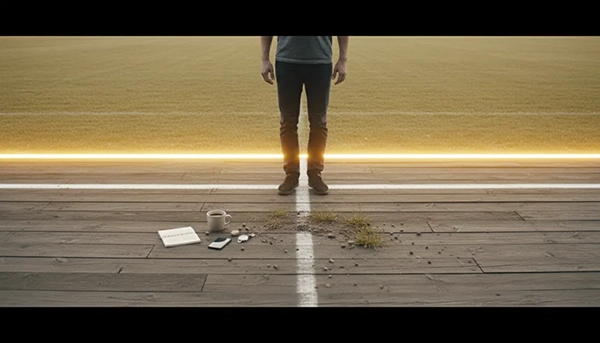
The Readiness Trap: Why We Wait for a Perfect Moment That Never Arrives
You open your phone before your feet even touch the floor in the morning, trading the quiet clarity of waking up for a cascade of other people’s highlights. By midday, your calendar belongs entirely to everyone else’s urgent demands. You fall asleep wondering where the day went, carrying a low-grade panic that time is evaporating while you stand completely still.
We treat time like an infinite bank account with no closing hours, until we realize we’ve spent years paying maintenance fees on a life we never actually chose. The terror of standing still is universal; we fear falling behind, yet we treat the mere act of starting a new path as a high-stakes performance review.
We want to master the instrument on day one, speak the language fluently before our first clumsy sentence, and launch the project without stumbling. When our first amateur attempt inevitably falls short of our cinematic expectations, we retreat back into the safety of passive consumption. We scroll, we watch, we wait.
Behavioral economists call this The Readiness Trap—the cognitive delusion that more preparation, more research, and more planning will eventually eliminate the emotional discomfort of being a beginner. It is the quiet conviction that if we wait long enough, confidence will magically precede action, rather than follow it.
Excellence is never born of a straight line. Behind every legendary body of work—whether it was Kafka writing in the dead of night or Picasso smearing paint on cheap canvas—lies a graveyard of terrible, awkward, uninspired drafts. The brain’s dopamine pathways are wired to crave immediate safety and avoid social embarrassment, which makes looking foolish feel like an existential threat.
The brain treats incompetence like a physical danger. Because the amygdala fires distress signals when we stumble in public view, we freeze. We mistake the discomfort of learning for a sign that we are on the wrong path entirely. True progress only begins the moment you give yourself permission to be profoundly, unapologetically bad at something new.
Breaking the paralysis doesn’t require a radical, life-upending overhaul. It starts with micro-experiments that lower the cognitive barrier to entry. You don’t sign up for a three-year conservatory program; you learn ten phrases of a language you’ve always admired. You don’t quit your job to become an artist; you spend twenty minutes sketching with a broken pencil or planting a single seed in a coffee mug. You disrupt the numbing loop of digital scrolling by swapping a screen for a blank notebook, a dusty classic novel, or the awkward rhythm of a new dance step.
Imagine sitting down with a blank journal at ten o’clock at night. Your internal critic immediately reminds you that you have nothing profound to say, that real writers have structured thoughts, that you are wasting paper. But when you write down three messy, unedited sentences about how tired your eyes feel, the friction dissolves. The page doesn’t judge. It simply receives.
A Practical Experiment
Tonight, put your phone in another room thirty minutes before you sleep. Take a single sheet of paper and choose one small, seemingly trivial thing you have always told yourself you are “too old” or “too busy” to try—learning ten words of Italian, playing a single chord on an old guitar, or writing a clumsy poem. Spend ten minutes doing it poorly.
Notice how the world does not end when you stumble, and how the heavy fog of stagnation begins to lift the moment you move your hands. The clock keeps ticking regardless of how tightly we grip our excuses, and the only difference between a life spent watching others live and a life of your own design is the quiet courage to be terrible at the beginning.