Why Does The Sound Of Someone Chewing Make Me Want To Scream
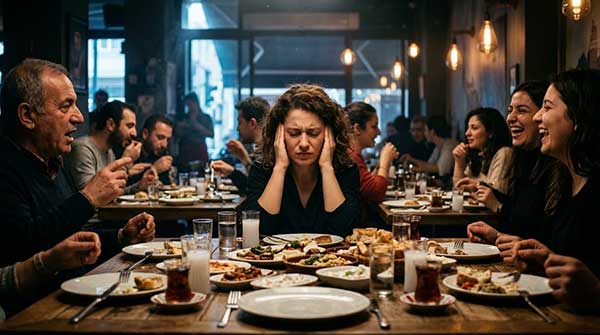
Priya keeps a pair of earbuds in every bag she owns — not for music, but for silence. She wears them at family dinners in Ohio, at her desk in open-plan offices, in movie theaters where a stranger three rows back is unwrapping candy. The trigger isn’t loud. It’s a spoon scraping a bowl, a coworker’s gum, the particular wet click of someone’s jaw. She told me once that people assume she’s dramatic. She isn’t. Something in her nervous system is doing exactly what it was built to do, just aimed at the wrong target.
There’s a name for this, and it sounds almost too tidy for something this raw: misophonia. I want to be honest that the research here is thinner than you’d expect for something so many people quietly live with — which is, itself, part of the story.
Is Misophonia A Real Medical Condition
Misophonia gets defined, clinically, as a disorder in which certain sounds trigger disproportionate emotional or physiological reactions — not mild irritation, but rage, disgust, panic, or a sudden, urgent need to flee the room. The sounds themselves tend to be small and human: chewing, breathing, sniffing, throat-clearing, the tap of a pen, occasionally something as odd as a bird outside a window. People with misophonia often know, in the moment, that the response is disproportionate. That awareness doesn’t make it stop.
It usually starts narrow — one sound, one person, one context — and can widen over time until sounds that never used to register start setting off the same alarm. The physical signs are specific enough to name: a tightening chest, a spiking heart rate, the sense of being cornered, an urge toward aggression that has nothing to do with the person actually chewing the gum. None of this, worth saying plainly, adds up to a diagnosis on its own — plenty of unrelated conditions produce similar symptoms, and self-diagnosing from a checklist is its own kind of trap.
Why Do Some People Get So Angry At Chewing Sounds
The neuroscientist Vilayanur Ramachandran was among the first researchers to take this seriously as a distinct phenomenon rather than a personality quirk. When early online support groups first reached out to his lab, his then-doctoral student Miren Edelstein admitted the team approached the claims skeptically — nobody had studied this before, and skepticism was the reasonable starting position.
Edelstein and her colleagues eventually interviewed eleven people from a support group and found something consistent across every one of them: an intense, involuntary reaction to specific mouth sounds — smacking, chewing, the wet consonants of eating. In a follow-up experiment comparing people with misophonia to people without it, everyone found the sounds unpleasant when played back loudly, but the misophonia group reacted far more sharply. The pattern suggested something structural — an unusually strong neural connection between the brain’s sound-processing regions and the limbic system, the part that handles emotion. Which is a clinical way of saying the wiring between “I heard something” and “I am in danger” runs a little too hot.
The volunteers weren’t confused about their own reactions. They knew the intensity didn’t match the sound. What they wanted from Edelstein wasn’t validation — it was tactics. How do you leave a room without it looking strange? How do you fake a phone call convincingly enough, often enough, that nobody notices the pattern? Some described these small evasions costing them relationships and jobs, one dodge at a time.
I should flag something here, because it matters: this particular study involved eleven people. Eleven. That’s not nothing, but it’s nowhere near enough to say how widely the pattern holds. A larger question — how common is this, really — needed a different kind of study entirely.
How Common Is Misophonia In Everyday People
That larger study came from Monica Wu, a clinical psychology doctoral student, working with psychiatrist Eric Storc and colleagues at the University of South Florida. They screened 483 undergraduates and found that roughly one in five carried significant misophonia symptoms — a number considerably higher than most people would guess walking into the research. The triggers, consistent with Ramachandran’s earlier work, clustered heavily around mouth sounds.
Half of the students with symptoms — about 10 percent of the entire sample — said the condition genuinely interfered with school or work. And Wu noticed something worth sitting with: misophonia symptoms tended to travel alongside anxiety, depression, and obsessive-compulsive patterns, though her study wasn’t the first to notice that particular overlap.
In 2013, psychologist Arjan Schröder and colleagues at the University of Amsterdam went further, proposing that misophonia be formally classified as its own psychiatric disorder — specifically within the obsessive-compulsive spectrum. Working with 42 patients who’d sought help for the condition, they found a consistent shape to it: aggressive reactions to specific sounds, paired with social withdrawal built around avoiding them. Nearly half the group met diagnostic criteria for obsessive-compulsive disorder on top of the misophonia itself.
Can Misophonia Actually Be Treated Or Cured
Here’s the uncomfortable answer: not in the sense of a cure. Wu is cautious about medication, arguing there isn’t enough foundational knowledge yet to justify it — but she’s genuinely hopeful about therapy, and her team reported success using cognitive behavioral therapy with two patients.
Not everyone in the field agrees misophonia belongs in psychiatry’s territory at all. Pawel Jastreboff, an otolaryngology professor at Emory University, describes it instead as an excessive and inappropriate response to sound — full stop, no psychiatric label required. He and his wife, audiologist Margaret Jastreboff, coined the term back in 2001 and have since treated hundreds of patients. Pawel says only a small fraction show any underlying psychiatric condition, and the couple has pushed back specifically against the Dutch research linking misophonia to OCD, arguing the connection is overstated.
The Jastreboffs prefer to frame misophonia as a learned response — something the nervous system picked up, which means it can, in theory, be partly unlearned. Their approach is a form of desensitization therapy: pairing a trigger sound with a genuinely positive experience until the nervous system stops treating it as a threat. Someone set off by loud chewing might sit with a person eating a cookie they actually enjoy, smelling it, tasting it themselves, slowly rebuilding the association from scratch.
“Misophonia absolutely should be treated successfully,” Pawel has said — the real question is knowing how. He reports that desensitization worked for 152 of 184 patients, roughly 83 percent. Which sounds compelling until you look closer: the data is observational, not a randomized controlled trial. Every patient received the same treatment, with no comparison group who got nothing, or something different, to weigh the results against — and a placebo effect can’t be ruled out from this design alone.
To his credit, Pawel doesn’t dodge this. He’s said plainly that properly controlled trials would be valuable, and that he hopes someone eventually runs them — the obstacle, in his account, is a roughly ten-million-dollar price tag nobody’s covered yet.
Honestly, none of this should be surprising. Misophonia is a young diagnosis sitting on a small pile of research, and disagreements this fundamental — is it psychiatric, is it learned, is it curable — tend to take decades to settle, not years.
A Question To Sit With
If a sound has ever made you want to leave a room mid-conversation, ask yourself honestly: was it the sound, or was it what your body decided the sound meant? That distinction is where most of the current research is quietly aimed.
A Few Things Worth Clarifying
Is misophonia the same as just being irritated by noise? Not quite — ordinary irritation doesn’t usually come with a racing heart, a feeling of being trapped, or an urge toward aggression. The scale of the reaction is the distinguishing feature, not the sound itself.
Should I see a doctor if certain sounds make me furious? A specialist familiar with misophonia is a reasonable first step, mainly because similar symptoms can show up for other reasons, and self-diagnosis tends to miss that nuance.
Does everyone with misophonia eventually need therapy? Not necessarily — plenty of people manage day to day with practical workarounds like Priya’s earbuds. Therapy tends to matter most once the condition starts costing someone real relationships, work, or peace of mind.