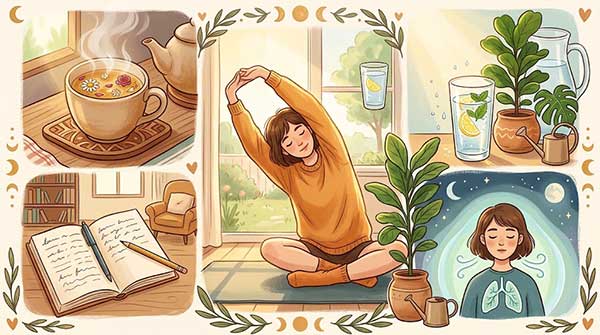
Instant Mood Boosters: Self-Care Practices for Mind, Body, and Spirit
The last time I truly bottomed out, it was a Tuesday afternoon in a Target parking lot in Columbus, Ohio. I had just spent forty minutes inside buying dish soap and a birthday card, and I couldn’t remember walking through the store. Not a single aisle. My body had been there, pushing a red cart, but my mind had been running through tomorrow’s meetings, a conversation I should have had last week, and the fact that I had not sat down to eat a meal in three days. I sat in the car with the keys in my lap and thought, “I don’t know how to feel better anymore.”
That is the quiet crisis underneath most self-care conversations. We are not lazy. We are not bad at taking care of ourselves. We have simply forgotten what actually works, because the noise of daily life has crowded out the signals our bodies and minds keep sending us.
The deepest human dilemma in this material is not finding time for self-care. It is recognizing that self-care was never supposed to be another item on the list. It was supposed to be the pause between the items.
What Self-Care Actually Means When You Have No Time
Most of us carry a specific fantasy about what self-care looks like. A warm bath. A massage. Candles. Soft music. A long afternoon with a book. And most of us also carry the quiet guilt of never doing any of it, because who has an afternoon? Who has the money for a massage? Who has a bathtub in a rental apartment with a shower stall that barely fits one adult?
The research is clear on what happens when we skip self-care entirely. Burnout rises. Emotional exhaustion takes over. We feel inadequate, depleted, and strangely guilty about our own depletion. The absence of care compounds into something heavier.
But here is what the research also shows, and what I did not understand in that Target parking lot: self-care does not require a dedicated block of time. It requires a shift in attention. A thirty-second pause can do more for a frayed nervous system than a spa weekend that never arrives.
I started keeping a list after that Tuesday. Not a to-do list. A “what actually works” list. Small things. Concrete things. Things I could do in the middle of a workday or in the five minutes before bed. The list became my mood emergency kit.
Mind and Spirit Practices for an Instant Mood Boost
There is a notebook on my desk with a cracked spine and coffee rings on the cover. Inside are quotes, fragments, photos, and a few sentences I wrote to myself on better days. When the bottom drops out, I open it randomly. The act of reading my own handwriting — the proof that a better version of me existed recently enough to write — is more grounding than any podcast or playlist. A feel-good notebook is not a scrapbook. It is evidence.
I have also learned to trust what my body already knows. Researchers estimate that the average adult makes around 35,000 decisions a day, and the cognitive load of those decisions drains more energy than we realize. One of the simplest ways to rest your mind is to stop negotiating with it. When you catch yourself deliberating over what to wear or what to eat, let your gut answer first. Let your hands reach for something. Stop treating every small choice like a high-stakes negotiation. Your mind will thank you by going quiet.
Sky watching sounds almost too simple to include here, but I have a friend in Pittsburgh who does this during her lunch break. She walks out of her office building, finds a bench, and just looks up. She told me once that it reminds her the world is bigger than her inbox. The sky does not care about her deadlines. The clouds are not keeping score. There is a particular kind of relief in being small under something vast.
Routine is comfortable until it becomes a cage. When life feels monotonous, the brain starts to dull in self-defense. The fix does not have to be dramatic. Drive home on a different road. Shop at a different grocery store. Move the couch to the other wall. Wear that shirt you always skip. Novelty, even in tiny doses, wakes up the brain’s reward system. It tells your nervous system that today is not just a copy of yesterday.
Then there is the phone. We all know the phone is part of the problem. But knowing and doing are different things. What finally worked for me was not a full digital detox — I am not built for that — but a thirty-minute experiment. I put the phone in airplane mode and set a timer. Then I just sat there. No entertainment. No distraction. Just me and the room. The first ten minutes were uncomfortable. By minute twenty, I noticed my shoulders had dropped. By minute thirty, I did not want to turn the phone back on. That resistance was information.
Children and animals are the only beings who are always in the present moment. That is why they are exhausting and why they are medicine. I spent an afternoon with my niece last month. She is four. She does not filter anything. She laughed at a leaf. A leaf. Then she made me look at it for five full minutes. By the end, I was laughing too. Not because the leaf was funny. Because her joy was contagious in a way no wellness app has ever managed.
Asking for help might be the most overlooked self-care practice in American life. We are raised to believe that independence is a virtue and needing people is a weakness. But sometimes the kindest thing you can do for yourself is to say, “I am drowning. Can you take one thing off my plate?” The relief that follows is not weakness. It is buoyancy.
And then there is silence. Not meditation with an app and a voice guiding you. Just sitting without input. No music. No podcasts. No scrolling. The first minute feels like withdrawal. The third minute feels like a door opening. I do not always make it to the third minute. But when I do, I remember what my own thoughts sound like.
Body-Based Self-Care That Works in Minutes
The mind and the body are not separate systems. They are one system with different languages. When the mind is spiraling, the body can pull it back. A body scan takes five minutes. You close your eyes and move your attention from your toes to your scalp, noticing sensations without judging them. It sounds so basic that it is easy to dismiss. But the first time I did it during a panic spiral, I was surprised by how quickly the spiral slowed. The body was fine. The body was just sitting in a chair. The mind had been the only thing on fire.
Oxygen is underrated as an emotional tool. When stress tightens the chest, the breath goes shallow. Carbon dioxide builds up. Fatigue follows. A few deep breaths — really deep, down into the belly — can change the chemistry. I do this at red lights now. Not in traffic. At the light. Full stop. Both hands on the wheel. One long inhale through the nose, one long exhale through the mouth. The light turns green, and I am a slightly different person.
Dancing is the one practice on this list that feels embarrassing until you do it alone with the door closed. I put on one song — something with a beat I cannot argue with — and I move. Not well. Not gracefully. Just movement. The combination of music and physical motion raises endorphins faster than almost anything else I have tried. The song ends, and the mood has shifted. It is not a cure. It is a reset.
Sunlight is not a luxury. The body needs it to produce vitamin D and regulate the hormones that govern sleep and mood. Ten minutes outside, even on a cloudy day, is a biological intervention. I used to think I was too busy for this. Then I started taking my morning coffee onto the back steps. Just standing there, sipping, squinting at the sky. It is not a hike. It is enough.
Personal care often gets dismissed as superficial, but the act of tending to your own body sends a signal to your nervous system that you are worth tending to. A warm shower. Clean clothes that fit. Brushing your hair. Lotion on dry hands. These are not indulgences. They are small acts of respect for the animal that carries your mind around all day.
Small Self-Care Moves for the Office
The workday is where self-care goes to die. Meetings stack up. Emails multiply. The body forgets it is a body. But even in an office cubicle, there are moves that help. Washing your face in the break room sink is a reset button. The cold water shocks the system out of its fog. Making a cup of tea is not about the tea — it is about the two minutes of standing still while the water heats. And if you have been sitting for hours, the tension in your neck and shoulders is real. A few slow stretches, some gentle head rolls, a reach for the ceiling — these things take thirty seconds and undo some of the damage of a sedentary day.
Try This Today
Pick one thing from this list. Just one. Not five. Not a new routine. One thing, and do it the next time you feel the familiar weight settle onto your chest. Do not wait for the perfect moment. Do not plan it. When the feeling comes, reach for the thing. That is the practice. Not the doing. The reaching.
Honest Answers to Hard Questions
Do I really need to do self-care every day?
Not in a rigid way. Some days the best self-care is ordering takeout and going to bed at eight. The point is not consistency. The point is responsiveness. Notice what you need and give it to yourself without making it a production.
What if I try these things and I still feel terrible?
Then the feeling may be bigger than a mood dip. Persistent low mood, fatigue, and loss of interest can be symptoms of depression or burnout, not just a bad week. Self-care helps, but it is not a substitute for professional support. If the weight does not lift, talk to someone who is trained to help you carry it.
Is it selfish to take time for myself when everyone else needs me?
The short answer is no, but the longer answer is more useful. You cannot pour from an empty cup — that is a cliché because it is true. Taking care of yourself is not taking something from others. It is making sure there is enough of you left to give.