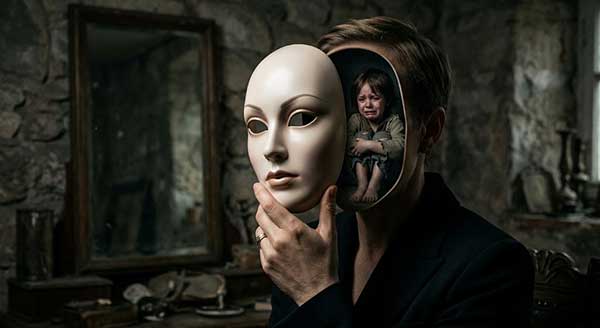
What the Wounded Child Inside Is Actually Saying
Nobody sets out to become a narcissist. That sentence feels almost dangerous to write in 2026, when the internet has turned the word into a catch-all for every ex who ever raised their voice, every boss who took credit, every parent who could not say sorry. But sit with it for a second. Nobody wakes up at seven years old and decides to build a personality around admiration, defensiveness, and a hunger that can never be filled. The narcissist was a child first. And that child had a story.
The deepest human dilemma in this material is not how to spot a narcissist or escape one. It is harder to hold: What happened to the child who learned that love had to be performed, that vulnerability was a liability, and that the only safe audience was a mirror? Because if that child had spoken, before the armor hardened, someone might have heard something ordinary. Something wounded. Something that needed to be asked, “What was your trouble?”
I think about a man I knew in Phoenix who ran a small marketing firm. He was charming in the way people are when they have studied charm as a second language. He could not take criticism. A client once suggested a minor revision to a campaign, and he spent three days telling anyone who would listen that the client was a fool, an amateur, a nobody. He was not angry. He was shattered. But shattered in a suit, at a desk, with a phone that never stopped ringing. He is the reason I stopped using the word narcissist as an insult.
Where the Term Comes From and Why It Matters
The word narcissism comes from Greek mythology. Narkissos was a young man of unusual beauty who rejected everyone who loved him. Nemesis, the goddess of retribution, punished him by making him fall in love with his own reflection. He stared at it until he died. The story is usually told as a cautionary tale about vanity. But read it again. Narkissos did not know he was looking at himself. He thought he had found someone else, someone beautiful, someone who finally saw him. The tragedy is not self-love. The tragedy is misrecognition.
Psychology picked up the term officially in 1898, when Havelock Ellis used it in the clinical literature. Since then, researchers have argued about its roots, its boundaries, and its treatment. But one thread runs through nearly every serious account: narcissism begins in childhood, and it begins with a wound.
Clinical theorists have long pointed to dysfunctional parental relationships as the foundation. The specific shape of that dysfunction varies. Some children are neglected. Some are ignored. Some are treated as extensions of a parent’s ambition — praised for what they accomplish, never for who they are. In all these cases, the child learns something devastating: love is conditional. Attention must be earned. Vulnerability is dangerous.
The Wound Behind the Mirror
There is a distinction the field makes between normal narcissism and pathological narcissism, and it matters more than most people realize. Everyone needs to be seen. Everyone wants their work acknowledged, their efforts mirrored back, their existence reflected in the eyes of another person. That is healthy. That is human. The difference shows up when criticism arrives.
A person with normal narcissism can hear “I think this needs revision” without feeling annihilated. They might bristle. They might defend. But they do not collapse or retaliate as if their life were under threat. The pathological narcissist cannot make that distinction. Research using the Rorschach test has found that people with narcissistic personality structures are extraordinarily sensitive to rejection. The wound is not a preference. It is a structural feature of the self.
From a distance, narcissists look supremely confident. Up close, the picture inverts. The grandiosity is a defense against a core experience of worthlessness. Cold, neglectful, or emotionally absent parenting leaves a child feeling inadequate, ashamed, and unseen. To survive that, the child builds a false self-confidence — a shining exterior that can walk into a room and demand admiration. The applause is not for the self. It is for the armor.
Heinz Kohut, one of the central figures in psychoanalytic thinking about narcissism, called this a “defect in the structure of the self.” The defect is not arrogance. It is emptiness. Low self-esteem, depression, a deep and neglected sense of worthlessness, feelings of rejection — these are the raw materials. The grandiosity is the compensation. And the compensation can be relentless because the hunger it feeds can never be satisfied. You cannot heal a wound by polishing the shield that covers it.
Freud, Kernberg, and the Child Who Turns Inward
Freud divided narcissism into primary and secondary forms. Primary narcissism is the normal state of early childhood, when the infant is the center of its own universe and loves itself without question. That is not pathology. That is development. Secondary narcissism occurs when the child fails to find a suitable object of love in the outside world. If the parents are cold, unresponsive, or neglectful, the child’s love has nowhere to go. So it turns back inward. The child becomes the object of his own affection because no one else will accept it.
Kernberg went further, arguing that when early needs are consistently unmet — when the child is ignored, blocked, deprived — the child withdraws into the self. The withdrawal is protective. But protection has a cost. The child stops trusting the outside world to meet any need, so he stops asking. And the asking, for a child, is the foundation of intimacy. When you cannot ask, you cannot receive. When you cannot receive, you cannot feel full. You carry a hollow space where connection should have grown.
What the Empty Child Becomes
Here is where the research gets unsettling. Studies using the Rorschach test with adults diagnosed with narcissistic personality disorder have found something clinicians call “emptiness depression.” The person feels a vast interior vacancy, a sense that something is missing where the self should be. To escape that emptiness, many narcissists throw themselves into work with extraordinary intensity. The busyness is not ambition. It is anesthesia. The achievement is not satisfaction. It is a temporary patch over a hole that opens again the moment the applause stops.
The child who was systematically told, through neglect or indifference, that his feelings did not matter learns to suppress them. He learns not to feel. That strategy keeps him alive in the short term. But over years, it becomes a prison. He becomes alienated from his own emotions. And because he cannot read his own inner life, he cannot read anyone else’s either. The empathy deficit we associate with narcissism is not a lack of caring. It is a lack of access. You cannot recognize a feeling in another person that you have forbidden yourself to feel.
This is the part most conversations about narcissism miss. The narcissist is not someone who loves himself too much. He is someone who has become a stranger to himself. The mirror is not an object of affection. It is a substitute for the reflection no one ever offered.
What We Owe Each Other
I want to be careful here. None of this excuses harmful behavior. Adults are responsible for their actions, regardless of what happened in their childhoods. If someone in your life is manipulative, cruel, or emotionally dangerous, you have every right to protect yourself. The decision to keep a narcissist in your life or walk away is yours alone.
But there is a difference between protecting yourself and participating in a cultural trend that treats narcissists as monsters, as subhuman, as punchlines. We do not know what anyone has lived through. We do not know what trauma shaped the person who hurt us. That knowledge does not obligate us to stay. But it can keep us from becoming the next link in a chain of dehumanization.
The man in Phoenix lost his business eventually. Too many bridges burned, too many clients walked away. I ran into him at a coffee shop a year later. He was quieter. He was working construction. He asked me how I was, and for the first time in all the years I had known him, he listened. Not performatively. Not waiting for his turn. He listened. I do not know what changed. I do not know if anything did. But I remember thinking: the armor had cracked, and underneath there was a person, tired and ordinary, who had been protecting a child nobody ever saw.
One Thing Before You Go
If this essay made you think of someone — an ex, a parent, a former friend — let that thought sit for a full minute without judgment. Then turn the lens around. Ask yourself: where do I perform when I should be honest? Where do I seek applause because I cannot tolerate silence? The narcissist is not a different species. The narcissist is what happens when a wound is left to heal in the dark. We all have a little of that dark.
Three Questions I Keep Getting
Is narcissism really caused by childhood neglect?
Research points strongly in that direction. Emotional neglect, cold parenting, and conditional love in early childhood are repeatedly linked to narcissistic personality structure in adults. But the cause is rarely one thing. Genetics, temperament, and environment all play a role. The neglect is not an excuse. It is a context.
Can a narcissist change?
Change is difficult but not impossible, especially with long-term therapy that addresses the underlying emptiness rather than just the surface behaviors. The person has to want to change, which is complicated because the defensive structure exists to keep them from feeling the very wound that needs healing.
What is the difference between a narcissist and someone who is just confident?
Confident people can tolerate criticism and do not need constant admiration to feel okay. Narcissists crumble or attack when criticized because the praise is not a bonus — it is the load-bearing wall of their self-esteem. That is why the Rorschach research on rejection sensitivity is so revealing.