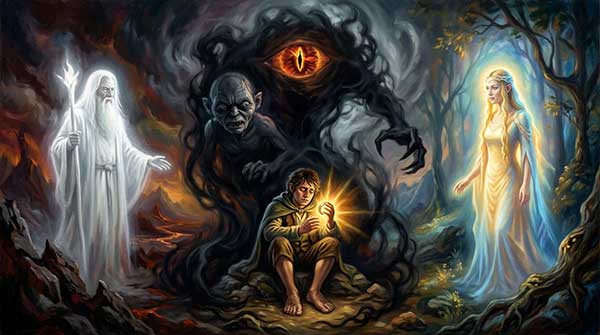
There Is Always Hope: The Lord of the Rings and Jungian Archetypes
Twenty years ago, during a snow-heavy Istanbul winter, Peter Jackson’s The Lord of the Rings arrived in theaters. I was preparing for the university entrance exam — back then it was called ÖSS — and every book stall in Kadıköy had the same paperback on display: an old wizard’s face on the cover, Tolkien’s name above it. I read The Fellowship of the Ring between study sessions. Then I watched the film. And like millions of others, I never really left Middle-earth.
I have been carrying that story around for two decades now. Not as nostalgia. As a map. Because the deeper I got into psychology — into the work of Carl Jung and the archetypes — the more I understood that Tolkien’s trilogy was never really about a ring. It was about what happens when ordinary people agree to walk toward the shadow instead of away from it.
The deepest human dilemma in this material is not the battle between good and evil. It is the quieter one: whether we can confront our own darkness without being consumed by it. And whether hope has any real substance, or is just a word we use when we have nothing else.
Why Jung Still Matters When We Talk About Story
Carl Jung believed something that sounds almost mystical to modern ears: that all of humanity is connected at a metaphysical level, and that this connection lives in what he called the collective unconscious. Not the personal unconscious — the individual basement of repressed memories — but a deeper layer, shared by everyone, containing images and patterns that have existed since the beginning of human experience.
Jung called these patterns archetypes. He described them as “primordial images” that have existed from the beginning, as “rulers of the collective consciousness.” They are not characters in stories. They are psychic behavior forms — shapes that organize how we experience life, love, danger, wisdom, and transformation. They surface in myths, dreams, religions, and, yes, in twentieth-century fantasy novels.
In his 1968 work The Archetypes and the Collective Unconscious, Jung outlined the most fundamental archetypes: the hero, the helper, the great mother, the shadow, the shadow self, and the wise old man. The Lord of the Rings gives us all of them, wearing hobbit feet and elven cloaks.
Frodo is the hero. Sam is the helper. Galadriel is the great mother. Gandalf is the wise old man. And Sauron — though he never fully appears — is the shadow: the dark, disembodied force that threatens to swallow everything.
But the more interesting shadow is not Sauron. It is the one inside Frodo. It is the ring itself.
The Hero’s Journey in Middle-earth
Joseph Campbell built his monomyth — the Hero’s Journey — on Jungian ground. His 1949 book The Hero with a Thousand Faces showed that stories from radically different cultures follow the same deep structure: a hero leaves home, faces trials, survives danger, and returns transformed. The Lord of the Rings is one of the clearest modern examples of this template.
The journey begins in the ordinary world. Frodo lives a quiet, comfortable life in the Shire, a place where the biggest concerns are pipe tobacco and garden parties. Then comes the call to adventure: Gandalf discovers that Bilbo’s old ring is the One Ring, and Frodo must leave. But Frodo resists. He does not want the burden. The call is refused, however briefly, until circumstances make refusal impossible.
The first threshold is crossed when the Fellowship forms and sets out toward Mount Doom. What follows is a long sequence of tests, allies, and enemies. Frodo and Sam meet allies like Arwen, Elrond, and Galadriel. They lose Gandalf to the Balrog — only to see him return as Gandalf the White, transformed. They are hunted by the Nazgûl. And they are accompanied by Gollum, the most complex figure in the entire trilogy: neither fully ally nor fully enemy, a creature split between his old self Sméagol and his corrupted self Gollum.
Meanwhile, the rest of the Fellowship faces parallel trials. Pippin, despite warnings, looks into the Palantír and is sent to Minas Tirith as a form of consequence. New allies appear — Éowyn, Théoden. New enemies emerge — Gríma Wormtongue, Saruman’s puppet.
The approach phase brings the deepest betrayal. Frodo, worn down by the ring, sends Sam away. Sam, realizing Frodo has been manipulated by Gollum, returns to rescue him. Together they push toward Mount Doom while the rest of the Fellowship fights on the battlefields.
Then comes the cave’s deepest point. Frodo reaches the Cracks of Doom and cannot let go. The ring has claimed him. He refuses to throw it. It is only through Gollum’s intervention — biting off Frodo’s finger and falling into the fire with the ring — that the quest is completed. The ring is destroyed. Sauron falls.
The reward is peace. The return point comes when Gandalf and the eagles rescue Frodo and Sam from the mountain. And the transformation is complete: Frodo is no longer the hobbit who left the Shire. He has been wounded, changed, hollowed out. He cannot simply go back to ordinary life. He sails to the Undying Lands with the elves, leaving Middle-earth behind.
The Shadow Is Not the Enemy
Here is where most readings of The Lord of the Rings go wrong. Sauron is not the shadow. Sauron is a plot device — an externalized evil, a dark lord who exists so the real battle can happen inside a small hobbit’s chest.
Jung said that every problem in life stems from our inability to integrate the shadow. The shadow is not evil. It is everything we refuse to see in ourselves — the anger, the greed, the weakness, the desire. It grows in the dark. The longer we deny it, the more monstrous it becomes. But when we turn toward it, when we name it and look at it directly, it loses some of its power.
The ring is the perfect symbol for this. It amplifies whatever is already there. It whispers. It tempts. It never forces. Boromir falls because he is ambitious. Galadriel is tempted because she is powerful. Frodo resists longer than anyone because he is, at his core, genuinely good — but even he cannot destroy it alone. No one can.
That is the most uncomfortable truth in Tolkien’s story, and in Jung’s psychology: you cannot defeat your shadow by strength. You cannot conquer it by willpower. You can only acknowledge it, carry it, and let something outside your own ego intervene when the moment comes. For Frodo, that something is Gollum — the shadow made flesh. The very creature everyone wanted to kill is the one who saves Middle-earth.
Jung would have smiled at this. The thing you hate most in yourself may be the thing that finally sets you free.
Hope Is Not Optimism
Tolkien’s famous line — “There is always hope” — is not the same as saying everything will work out. It is a different kind of statement. Optimism is a prediction about the future. Hope is a posture toward the present. It is the decision, made in the dark, to keep walking.
Frodo does not know he will succeed. He is not sure he will survive. He carries the ring through Mordor with no guarantee of anything. Sam, the helper archetype, keeps him going with small acts of loyalty — food, water, a story about the Shire, a refusal to leave his side even after being sent away.
That is where the real hope lives in this story. Not in Gandalf’s wisdom or Aragorn’s sword. In Sam’s stubborn, unglamorous devotion. In Frodo’s willingness to take one more step when every step hurts. Hope, Tolkien seems to say, is not a feeling. It is an action repeated in the absence of any reason to believe.
I think about my own life now, two decades after first reading those books. The exam I was preparing for? I did not get the score I wanted. I ended up somewhere else, on a path I could not have predicted. There have been winters since then that felt like Mordor — gray, endless, heavy. And in those winters, I have found myself thinking about the Shire. Not as a place to return to. As a place to carry inside.
One Thing Before You Go
Here is a question to sit with: What is the ring you are carrying? The thing you did not choose, that whispers to you in the dark, that you have been trying to drop but cannot. Now ask yourself: who is your Sam? And who is your Gollum — the part of you that you hate, but that may hold the key you have been looking for? You do not need to answer. You just need to look toward the shadow instead of away from it.
Three Questions I Keep Getting
Is Frodo really the hero, or is Sam the real hero of the story?
Tolkien himself said Sam is the chief hero. Frodo carries the ring, but Sam carries Frodo. The two are inseparable — the hero and the helper exist in relationship, not in isolation. Without Sam, Frodo fails. Without Frodo, Sam has no quest. This is Jung’s point: no archetype works alone.
What does the ring represent psychologically?
The ring represents the shadow’s magnet — the concentrated pull of everything unintegrated in the psyche. It amplifies what is already there. Everyone is tempted by it because everyone has a shadow. The difference is how each character relates to that temptation. Denial makes it stronger. Acknowledgment weakens its grip.
Why does Frodo leave Middle-earth at the end?
Frodo cannot return to ordinary life because he has been fundamentally changed by the journey. The Shire no longer fits him. In Jungian terms, the hero who has integrated the shadow can never go back to innocence. The departure to the Undying Lands is not a reward. It is an acceptance that transformation is permanent.