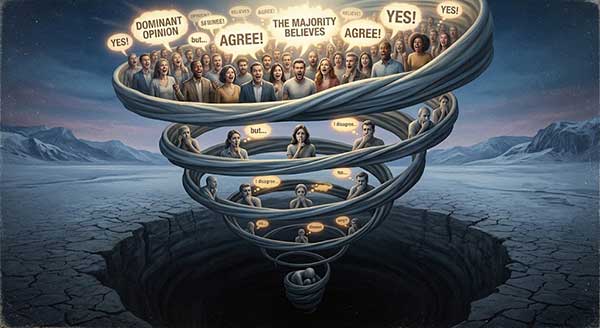
Why We Stay Silent When We Disagree: The Spiral of Silence
There is a moment in every meeting where the room tilts. Someone proposes something and everyone nods. The nodding moves clockwise around the table like a wave. And you are sitting there with a sentence in your throat that does not agree. Not violently. Just differently. But the wave reaches you and you nod too. Not because you changed your mind. Because nodding was easier.
That is the spiral. Not the word. The experience. The small, daily choosing of belonging over truth.
The person who gave that experience a name was Elisabeth Noelle-Neumann, a German political scientist who published her theory of the Spiral of Silence in 1974 in the Journal of Communication. The idea was radical for its time and has only grown more relevant since. Noelle-Neumann argued that our willingness to express an opinion depends almost entirely on whether we perceive that opinion as popular. If we think the majority is with us, we speak. If we think the majority is against us, we go quiet. And the quieter we go, the quieter everyone else who agrees with us goes too. The silence feeds itself. That is the spiral.
How We Decide What Is Safe to Say
Noelle-Neumann’s theory rests on a simple premise: humans are constantly scanning the environment for signals about which opinions are acceptable and which are not. The scanning happens mostly below awareness. We read the room. We check the group chat. We notice who gets liked and who gets pile-on. We see what the algorithm surfaces and what it buries. All of that information gets fed into a running calculation: Is it safe to say what I actually think?
The cues come from everywhere. Mainstream media coverage tells us what the consensus is supposed to be. Colleagues at the coffee machine tell us what is acceptable at work. Friends on Instagram and X tell us what is acceptable in our social circle. And past experience tells us what happens when we get it wrong.
The source material I keep returning to this month describes this calculation with uncomfortable precision. We weigh the popularity of our opinion before we open our mouths. We adjust. We soften. We stay quiet. Not because we are cowards. Because the costs of being wrong are real.
What Exclusion Does to a Person
There is a reason silence feels safer than speaking. The fear of social rejection is not a character flaw. It is a survival instinct. Evolutionary biologists have long argued that early humans depended on group membership for basic survival. To be cast out of the tribe was, in many cases, a death sentence. The brain does not know that we are no longer on the savanna. It just knows that exclusion is dangerous.
Modern research supports this. A 2003 study published in Science by Naomi Eisenberger and her colleagues at UCLA found that social rejection activates the same neural pathways as physical pain. The brain processes being left out in the same regions that light up when you stub your toe or burn your hand. The pain is not metaphorical. It is neurological.
So when we choose silence over dissent, we are not being irrational. We are protecting ourselves from a very old and very real form of pain. The problem is that the protection has a cost. Every time we swallow a thought, we make it easier to swallow the next one. And every silence makes the majority opinion seem more universal than it actually is.
How the Spiral Tightens
Noelle-Neumann called it a spiral for a reason. It moves. It accelerates. Each time someone voices the majority opinion and receives approval, the majority opinion feels safer. Each time someone voices a minority opinion and receives pushback, the minority opinion feels more dangerous. The feedback loop tightens.
What makes this so insidious is that the majority opinion may not actually be the majority. It may just be the loudest. Or the most visible. Or the most willing to risk speaking. The spiral does not measure what people actually believe. It measures what people are willing to say. Those are not the same thing.
The source material makes this point with a clarity that should unsettle everyone who spends time online: some opinions only seem unpopular because it is taboo to say them out loud. In reality, many people hold them. They just do not know each other exists, because no one is talking. The silence creates the illusion of consensus. The illusion of consensus deepens the silence. Around and around.
What the Internet Did to the Spiral
Noelle-Neumann developed her theory in the age of television, when the primary source of “what everyone thinks” was three network news programs. The internet should have broken the spiral. In some ways it has. Voices that were once completely marginalized can now find each other across vast distances. Anonymity can make it easier to speak.
But the internet has also intensified the surveillance. The calculation that Noelle-Neumann described as mostly unconscious is now explicit. We can see exactly how many likes a post gets. We can watch, in real time, who agrees and who attacks. The consequences of saying the wrong thing are more visible than they have ever been. A single tweet can end a career. A single comment can make you the main character of someone else’s outrage.
The spiral has not disappeared. It has moved into the algorithm. What we see is not what is true. It is what the platform has determined will keep us scrolling. And what keeps us scrolling is often the most extreme version of whatever opinion the algorithm thinks we hold. The center goes quiet. The edges get loud. The spiral tightens around us all.
What Breaks the Spiral
The source material offers a genuinely hopeful turn. Not all silence is permanent. People do speak. They speak when the issue matters deeply to them. They speak when they feel confident in their information. They speak when they have concluded that the cost of silence is higher than the cost of being seen as different.
The research on this is consistent. In Noelle-Neumann’s own work and in the studies that followed, the people most likely to voice a minority opinion are those who hold it with conviction. Not certainty. Conviction. They have thought about it. They have examined their own reasons. They have decided that this matters enough to risk the discomfort of standing apart.
When they speak, something interesting happens. Others who agreed but were silent begin to feel safer. The visible consensus cracks. The spiral reverses. Not all at once. But enough.
The source material mentions the role of humor in this process, and I think this is one of the most practical insights in the entire piece. Humor creates a space where difficult things can be said without triggering the full weight of social sanction. The joke is a vehicle. It carries the truth without forcing the listener to confront it head-on. The Slovenian philosopher Slavoj Žižek has made an entire public career out of this. He tells crass, uncomfortable jokes, then delivers the point. The joke disarms. The point lands. People walk away thinking thoughts they would never have accepted in a straight lecture.
This is not a new insight. Court jesters existed because kings needed to hear the truth without killing the messenger. Satire works because it makes the unbearable bearable enough to look at. When you cannot say the thing, sometimes you can joke the thing. And the joke, if it is good, opens the door for the serious version later.
What I Am Still Not Saying
I have to be honest here. Writing this essay is easier than living it. I still nod in meetings when I should speak. I still soften my opinions when I can feel the room turning. I still write sentences and delete them because I can imagine the replies. The spiral is not a theory I observe from outside. It is something I wake up inside every morning.
What I am learning is that the goal is not to be fearless. The goal is to be aware. To notice the moment when I am choosing silence out of fear rather than out of genuine uncertainty. To ask myself, before I nod, whether the nod is real or just safe. That question does not always change my behavior. But it changes my relationship to the behavior. It keeps me from pretending that my silence was agreement.
The source material ends with a line that has stayed with me for days: look at your silences. There are answers there. I think that is true, but it is also scary. Because the silences are not empty. They are full. Full of unsaid sentences. Full of unshared opinions. Full of selves we have chosen not to be in order to stay inside the circle.
The circle is not nothing. Belonging matters. Connection matters. The warmth of being accepted is not a weakness. It is one of the deepest human needs. But the circle can become a cage. And the spiral can become a prison. And the question is whether we are willing to risk a little loneliness for the chance of being seen as we actually are.
I do not have an answer. I have a practice. I try to say one true thing a day. Not a big thing. Not a brave thing. Just a true thing. To a friend. In a meeting. In a message. The practice does not break the spiral. But it keeps my voice from atrophying. It keeps the unsaid from becoming the never-said.
Maybe that is enough. Maybe that is how spirals break. Not with heroes. With small, stubborn acts of honesty. With people who are tired of swallowing their own sentences. With jokes that carry more truth than the punchline suggests.
The next time you are in a room and the wave of nodding comes toward you, pause. Just for a second. Ask yourself what you actually think. You do not have to say it. You do not have to become the dissenter. But notice the gap between what you think and what you are about to perform. That noticing is the beginning.
The spiral is not made of walls. It is made of silences. And silences can be broken. Not always. Not easily. But sometimes. By someone who decides that the cost of disappearing is higher than the cost of being seen.