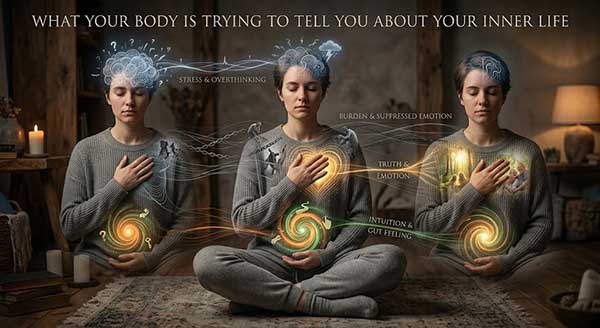
The Body Keeps Score Until You Stop Running
The tightness in my neck showed up on a Tuesday morning in March. Not the kind of tightness that comes from sleeping wrong. The kind that has been there for years, waiting for you to notice it. I was driving to work in Chicago, hands at ten and two, when I realized my shoulders had been up around my ears for what felt like forever. I dropped them. Thirty seconds later, they were back up. My body had been bracing for something I could not name, and it had been doing it so long that the bracing felt like home.
That was the day I started asking questions I had never asked before. Not about my job or my relationships or my future. About my body. Why did my feet hurt by noon? Why did I clench my jaw in meetings? Why did my lower back ache after sitting for an hour? What was my body trying to tell me that I had been too busy to hear?
The deepest human dilemma in this source is not about the body. It is about direction. We are raised to believe that discovery happens out there — in new cities, new jobs, new people, new experiences. We chase meaning by adding more to our lives. But the body is not out there. The body is the one thing that has been with us the whole time, recording everything, holding every tension, every fear, every unspoken word. And we have been treating it like furniture.
What the Body Knows That the Mind Ignores
Every body is like a snowflake. No two hold the same history. The tightness in my jaw is not the same as the tightness in yours. The ache in my lower back carries a different story than the ache in yours. But we do not learn to read these stories. We learn to medicate them, stretch them, or ignore them until they get loud enough to demand attention.
I have a friend in Portland who started seeing a somatic therapist after years of chronic anxiety. She told me something that rearranged my thinking. The therapist did not ask about her childhood or her thoughts. She asked her to close her eyes and describe what she felt in her chest. My friend said it felt like a fist. The therapist said, “When did you first notice the fist?” That question did more for her than years of talk therapy. The body had been holding the answer. Nobody had asked it directly.
The source text asks a series of questions that should stop every reader cold: Where are the sensitive places in your body? Where is the tension? Why are your feet so hard? Why do your shoulders sit like stone? Why do you clench your pelvis? What is the pain in your knee trying to say? These are not medical questions. They are biographical questions. The body is a diary. Most of us have never opened it.
The Mirror We Forgot We Were Holding
Here is where it gets uncomfortable. We spend enormous energy looking for ourselves in other people. Do they like me? Do they see me? Am I doing this right? The source text says something that stung when I read it: we forgot that we are our own mirror. We went looking for reflection in everyone else’s face, and in the process, we lost the ability to see ourselves.
I did this for years. I needed people to tell me I was good at my job, good in relationships, good enough. The validation never lasted. Because I was asking the wrong people the wrong question. The question was not “Am I enough?” The question was “Can I feel myself from the inside?” And the answer, for a long time, was no.
We built walls around our vulnerability. Those walls did not protect us. They made us rigid. The body kept score. The shoulders went up. The jaw tightened. The breath got shallow. We thought we were holding ourselves together. We were actually holding ourselves apart.
The Glass and the Water
The source text uses an image I cannot shake. Imagine a glass of water. Most of us spend our lives describing the glass — the shape, the size, the style. But the water is the point. The water is the life. The water is the feeling. If you only know the glass, you do not know what it holds. You know the container, but not the content.
I have spent years describing my own glass. Job title. Relationship status. City. Income. Accomplishments. The glass got fancier. The water stayed untouched. And then one day you wake up and wonder why you are thirsty.
The source text says something else that is hard to hear: when the water is gone, we start seeing empty glasses everywhere. We see people as containers, not as living beings. We see ourselves as containers. The emptiness is not out there. It is in here. The water was always there, waiting. We just never learned to drink.
Why We Keep Moving Fast
Modern life is built for speed. We consume faster, swipe faster, move faster. The source text says we have trained our bodies for this pace and then mistaken the speed for satisfaction. But speed is not depth. You can visit ten cities in ten days and never actually arrive anywhere. You can meet a hundred people and never once feel seen.
The body does not move at the speed of a feed. The body moves at the speed of breath, of blood, of nerves. When we force it to keep up with the pace of a news cycle, it rebels. It sends signals — tension, pain, fatigue, anxiety, depression, restlessness. These are not failures of the body. They are attempts to communicate. The body is saying, “Slow down. Notice me. I am still here.”
The source text asks a question that has stayed with me: is moving faster on the road the same as actually discovering something? The answer is no. Discovery requires attention. Attention requires slowness. You cannot know a flower by running past it. You cannot know your own body by ignoring it.
What We Do to Love
There is a line in the source text that will make some readers flinch: “Sexuality, the supreme creative energy, becomes consumption energy.” That is not a conservative argument about morality. It is a deeper observation about how we have flattened one of the most profound human experiences into something transactional.
The source text traces this back to the Victorian era, when sexuality was so repressed that feeling desire was a source of shame. We swung the other way. Now not feeling desire, not performing it, not consuming it, is the shame. Both extremes miss the point. Sexuality is not about the other person first. It is about your own life energy, moving through your own body, felt from the inside. A tree roots downward before it reaches upward. Its branches touch other trees only after it has established itself in the ground.
I have never thought about it that way. The idea that you need to feel your own energy before you can truly share it with someone else. That connection with another person is an extension of connection with yourself. Not a replacement for it.
The source text quotes Rollo May, who writes about four kinds of love in the Western tradition: sex or lust, eros as the drive to create, philia as friendship, and agape as selfless love for the other’s wellbeing. Any real experience of love, May says, is a mixture of these four in different proportions. That mixture is the taste of the water in the glass. And you cannot taste it if you have never learned to drink from your own source.
What the Body Is Asking For
The body is not asking for a spa day. It is asking for relationship. It wants to be noticed, listened to, cared for. Not as a project. As a partner. The source text says the body keeps records in collaboration with the soul. Those records surface as stress, anxiety, depression, anger, restlessness, emptiness. Not to punish you. To get your attention.
Jung said something the source text returns to at the end: “He who looks outside dreams. He who looks inside awakens.” That is the whole journey. Not to abandon the outside world. Not to become a hermit. But to wake up to the one thing you have been carrying with you the whole time. The body is not a vehicle for the self. The body is the self. And the self is waiting.
I have started a practice that is so small it feels almost embarrassing. Every morning, before I reach for my phone, I put my hand on my chest and ask one question: “What do you feel?” Most mornings, the answer is nothing. But some mornings, the answer is something. A tightness. A warmth. A hum. And I have started to trust that the something is worth listening to.
Where This Leaves You
You do not need to go anywhere to begin this exploration. You do not need a retreat or a teacher or a new city. You need ten minutes and a willingness to feel what is already there. The source text says the body will open its record book when you approach it with care. Not all at once. Slowly. The way you would approach a nervous animal. With patience. With respect. With no agenda.
Start with your feet. They have been carrying you for decades. How do they feel right now? Not how they look. How they feel from the inside. Then move up. Your ankles. Your knees. Your hips. Your belly. Your chest. Your throat. Your jaw. Your temples. Just notice. Do not fix. Do not judge. Notice.
This is not self-care in the scented-candle sense. This is self-relationship. It is the beginning of knowing yourself as a living body, not just a thinking head. And that knowledge, the source text promises, is what allows you to stand in front of other people without needing them to tell you who you are. You will already know. You will already be awake.
The last line of the source text is an invitation. It does not command. It does not prescribe. It simply says: let us take steps toward waking up. I am taking mine. Slowly. Imperfectly. With my hand on my chest and my feet on the ground. The glass is still there. The water is still in it. I am learning to drink.